Department of Kinesiology, University of Connecticut, Storrs, CT 06269, USA; Institute for Collaboration on Health, Intervention, and Policy, University of Connecticut, Storrs, CT 06269, USA.
Institute for Collaboration on Health, Intervention, and Policy, University of Connecticut, Storrs, CT 06269, USA; Department of Psychological Sciences, University of Connecticut, Storrs, CT 06269, USA.
J Sport Health Sci. 2021 Mar;10(2):211-221. doi: 10.1016/j.jshs.2020.03.007. Epub 2020 May 1.
Professional health organizations are not currently recommending Tai Ji Quan alongside aerobic exercise to treat hypertension. We aimed to examine the efficacy of Tai Ji Quan as antihypertensive lifestyle therapy.
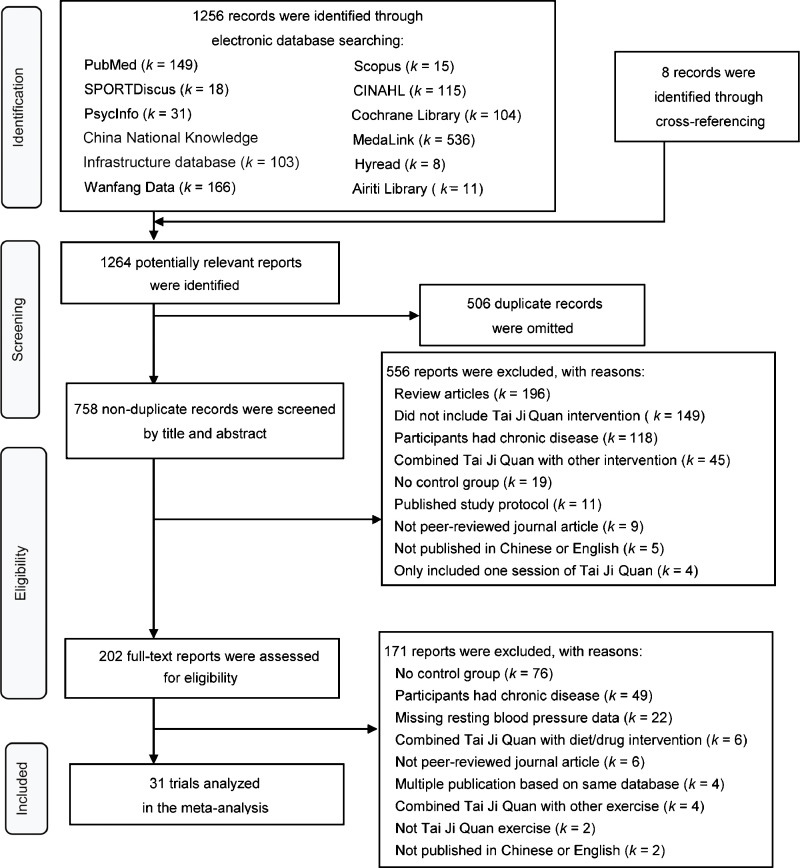
Tai Ji Quan interventions published in English and Chinese were included when they involved healthy adults, reported pre- and post-intervention blood pressure (BP), and had a non-exercise/non-diet control group. We systematically searched 11 electronic databases for studies published through July 31, 2018, yielding 31 qualifying controlled trials. We (1) evaluated the risk of bias and methodological study quality, (2) performed meta-regression analyses following random-effects assumptions, and (3) generated additive models representing the largest possible clinically relevant BP reductions.
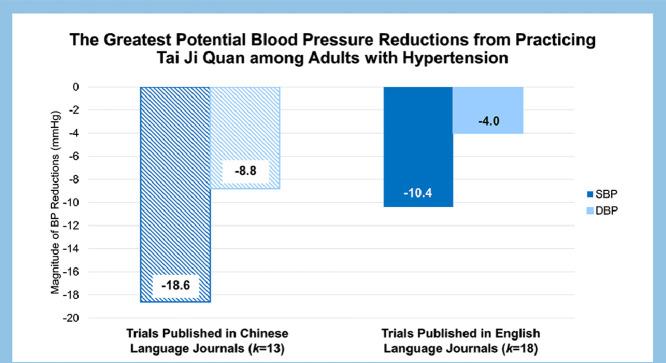
Participants (n = 3223) were middle-aged (56.6 ± 15.1 years of age, mean ± SD) adults with prehypertension (systolic BP (SBP) = 136.9 ± 15.2 mmHg, diastolic BP (DBP) = 83.4 ± 8.7 mmHg). Tai Ji Quan was practiced 4.0 ± 1.4 sessions/week for 54.0 ± 10.6 min/session for 22.3 ± 20.2 weeks. Overall, Tai Ji Quan elicited significant reductions in SBP (-11.3 mmHg, 95%CI: -14.6 to -8.0; d = -0.75) and DBP (-4.8 mmHg, 95%CI: -6.4 to -3.1; d = -0.53) vs. control (p < 0.001). Controlling for publication bias among samples with hypertension, Tai Ji Quan trials published in English elicited SBP reductions of 10.4 mmHg and DBP reductions of 4.0 mmHg, which was half the magnitude of trials published in Chinese (SBP reductions of 18.6 mmHg and DBP reductions of 8.8 mmHg).
Our results indicate that Tai Ji Quan is a viable antihypertensive lifestyle therapy that produces clinically meaningful BP reductions (i.e., 10.4 mmHg and 4.0 mmHg of SBP and DBP reductions, respectively) among individuals with hypertension. Such magnitude of BP reductions can lower the incidence of cardiovascular disease by up to 40%.
专业健康组织目前不建议将太极拳与有氧运动结合起来治疗高血压。我们旨在研究太极拳作为降压生活方式疗法的疗效。
纳入以健康成年人作为研究对象、报告干预前后血压(BP)值,并设有非运动/非饮食对照组的英文和中文太极拳干预研究。我们系统检索了截至 2018 年 7 月 31 日发表的 11 个电子数据库,共纳入 31 项合格的对照试验。我们(1)评估了偏倚风险和方法学研究质量,(2)进行了随机效应假设下的荟萃回归分析,(3)生成了表示最大可能的临床相关 BP 降低的加性模型。
参与者(n=3223)为中年(56.6±15.1 岁,均值±标准差)成年人,患有前期高血压(收缩压(SBP)=136.9±15.2mmHg,舒张压(DBP)=83.4±8.7mmHg)。太极拳每周练习 4.0±1.4 次,每次 54.0±10.6 分钟,持续 22.3±20.2 周。总体而言,太极拳可显著降低 SBP(-11.3mmHg,95%CI:-14.6 至-8.0;d=-0.75)和 DBP(-4.8mmHg,95%CI:-6.4 至-3.1;d=-0.53),与对照组相比(p<0.001)。在控制高血压样本的发表偏倚后,英语发表的太极拳试验可降低 10.4mmHg 的 SBP,4.0mmHg 的 DBP,而中文发表的试验可降低 18.6mmHg 的 SBP 和 8.8mmHg 的 DBP,前者的效果仅为后者的一半。
我们的结果表明,太极拳是一种可行的降压生活方式疗法,可在高血压患者中产生具有临床意义的 BP 降低(即 SBP 和 DBP 分别降低 10.4mmHg 和 4.0mmHg)。这种程度的 BP 降低可使心血管疾病的发生率降低 40%。