McEwen Craig A
Bowdoin College, Department of Sociology, Brunswick, ME, 04011, USA.
Neurobiol Stress. 2022 Jan 4;17:100426. doi: 10.1016/j.ynstr.2022.100426. eCollection 2022 Mar.
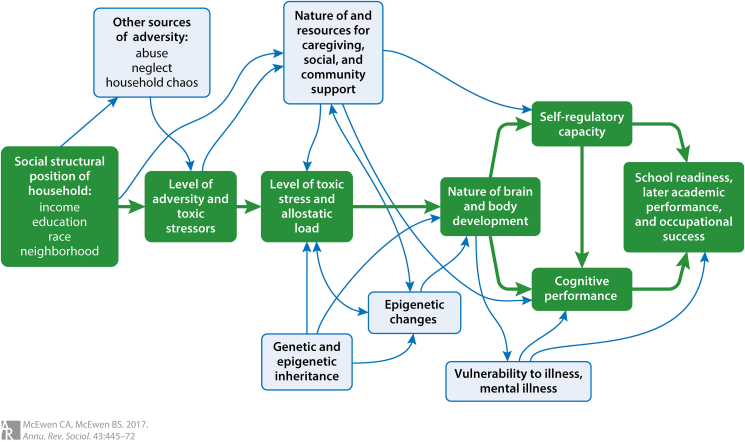
How do sociology and stress biology connect in efforts to understand the impact of early childhood adversity on health and life chances? This memorial article describes the collaboration between Bruce and Craig McEwen in bringing stress neurobiology to sociologists. It attempts, in turn, to bring sociology to stress neurobiologists, the second goal of this collaboration. It frames the social sources of human stress in terms of the social determinants of health as well as more proximal childhood adversities. It also underlines the importance of supportive adult and community relationships in preventing toxic stress. Bruce was hopeful that stress biology research could inform public health efforts aimed at improving population health and more equitable life trajectories. To strengthen our understanding of stress and to contribute to that goal, stress neurobiologists can help tease out the complex social causes of stress by expanding the range of variables employed to identify its sources as well as the protections against it in human populations.
在试图理解童年早期逆境对健康和人生机遇的影响时,社会学与应激生物学是如何联系起来的?这篇纪念文章描述了布鲁斯与克雷格·麦尤恩在将应激神经生物学引入社会学家方面的合作。反过来,它试图将社会学带给应激神经生物学家,这是此次合作的第二个目标。它从健康的社会决定因素以及更直接的童年逆境的角度阐述了人类应激的社会根源。它还强调了支持性的成人和社区关系在预防毒性应激方面的重要性。布鲁斯希望应激生物学研究能够为旨在改善人群健康和实现更公平人生轨迹的公共卫生努力提供信息。为了加强我们对应激的理解并促成这一目标,应激神经生物学家可以通过扩大用于确定应激源及其在人群中的防护措施的变量范围,来帮助梳理应激的复杂社会成因。