Department of Pathology & Immunology, Baylor College of Medicine, Texas Children's Hospital, Houston, TX, USA.
Graduate School of Biomedical Sciences, Baylor College of Medicine, Houston, TX, USA.
Stem Cells. 2022 Aug 25;40(8):736-750. doi: 10.1093/stmcls/sxac033.
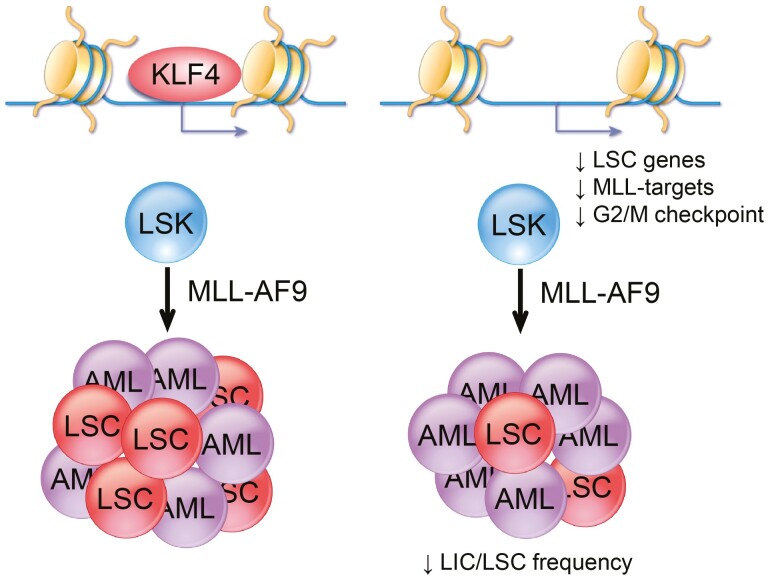
Acute myeloid leukemia (AML) is an aggressive malignancy of the bone marrow with 5-year overall survival of less than 10% in patients over the age of 65. Limited progress has been made in the patient outcome because of the inability to selectively eradicate the leukemic stem cells (LSC) driving the refractory and relapsed disease. Herein, we investigated the role of the reprogramming factor KLF4 in AML because of its critical role in the self-renewal and stemness of embryonic and cancer stem cells. Using a conditional Cre-lox Klf4 deletion system and the MLL-AF9 retroviral mouse model, we demonstrated that loss-of-KLF4 does not significantly affect the induction of leukemia but markedly decreased the frequency of LSCs evaluated in limiting-dose transplantation studies. Loss of KLF4 in leukemic granulocyte-macrophage progenitors (L-GMP), a population enriched for AML LSCs, showed lessened clonogenicity and percentage in the G2/M phase of the cell cycle. RNAseq analysis of purified L-GMPs revealed decreased expression of stemness genes and MLL-target genes and upregulation of the RNA sensing helicase DDX58. However, silencing of DDX58 in KLF4 knockout leukemia indicated that DDX58 is not mediating this phenotype. CRISPR/Cas9 deletion of KLF4 in MOLM13 cell line and AML patient-derived xenograft cells showed impaired expansion in vitro and in vivo associated with a defective G2/M checkpoint. Collectively, our data suggest a mechanism in which KLF4 promotes leukemia progression by establishing a gene expression profile in AML LSCs supporting cell division and stemness.
急性髓系白血病(AML)是一种侵袭性骨髓恶性肿瘤,65 岁以上患者的 5 年总生存率低于 10%。由于无法选择性地根除驱动难治性和复发性疾病的白血病干细胞(LSC),患者的预后进展有限。在此,我们研究了重编程因子 KLF4 在 AML 中的作用,因为其在胚胎和癌症干细胞的自我更新和干性中起着关键作用。我们使用条件性 Cre-lox Klf4 缺失系统和 MLL-AF9 逆转录病毒小鼠模型,证明 KLF4 的缺失不会显著影响白血病的诱导,但在限制剂量移植研究中明显降低了 LSC 的频率。在白血病粒细胞-巨噬细胞祖细胞(L-GMP)中缺失 KLF4,L-GMP 是 AML LSC 的富集群体,其克隆形成能力和细胞周期 G2/M 期的比例降低。纯化的 L-GMPs 的 RNAseq 分析显示干性基因和 MLL 靶基因的表达降低,RNA 感应解旋酶 DDX58 的表达上调。然而,在 KLF4 敲除白血病中沉默 DDX58 表明 DDX58 不是介导这种表型的原因。在 MOLM13 细胞系和 AML 患者来源异种移植细胞中使用 CRISPR/Cas9 缺失 KLF4 显示体外和体内扩增受损,与 G2/M 检查点缺陷相关。总之,我们的数据表明,KLF4 通过在 AML LSC 中建立支持细胞分裂和干性的基因表达谱来促进白血病进展的机制。