Department of Biology, Indiana University, Bloomington, Indiana, USA.
mBio. 2022 Jun 28;13(3):e0050822. doi: 10.1128/mbio.00508-22. Epub 2022 May 10.
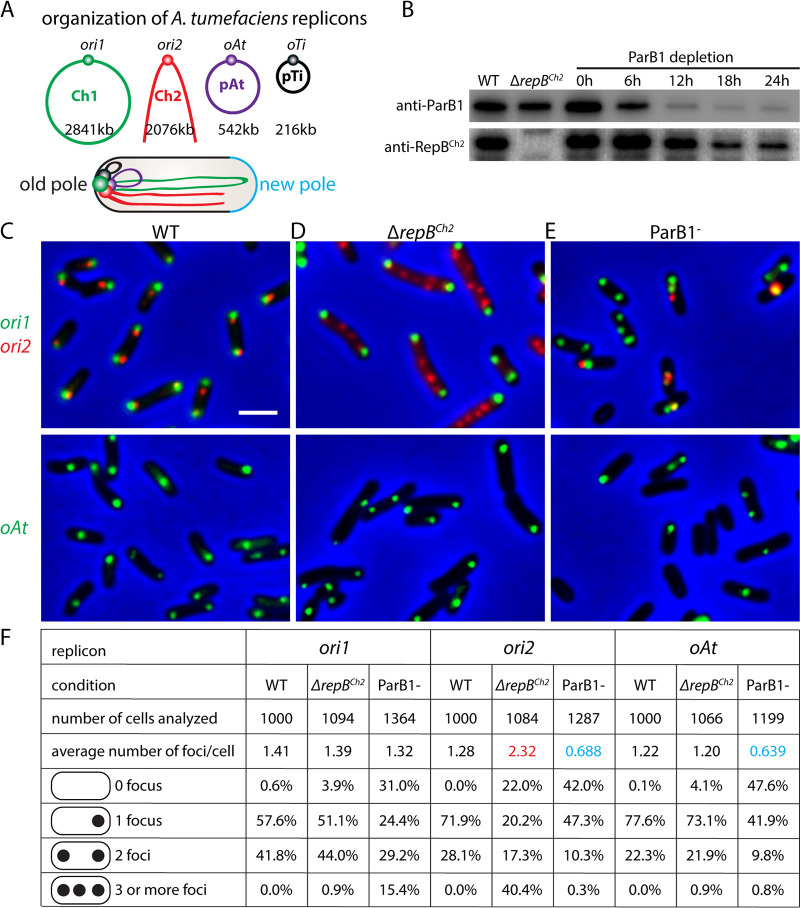
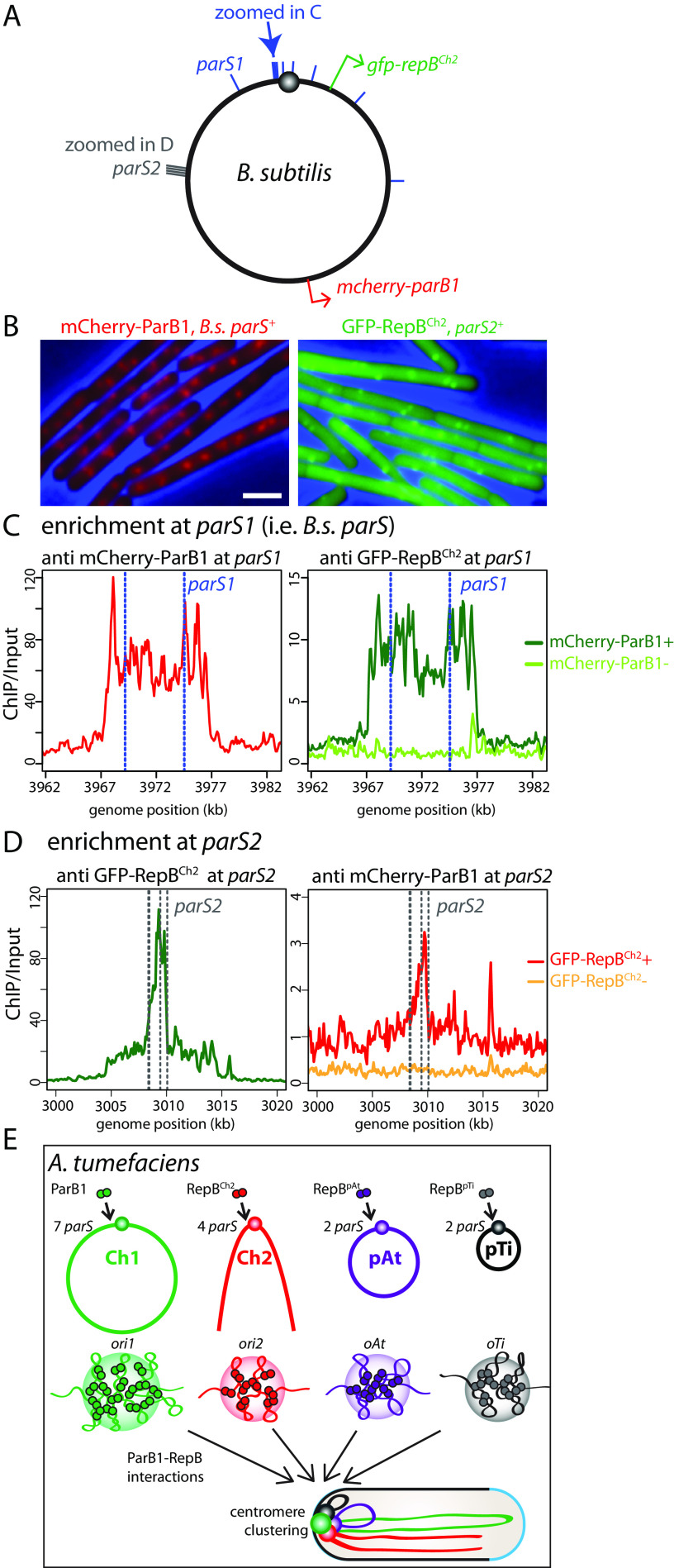
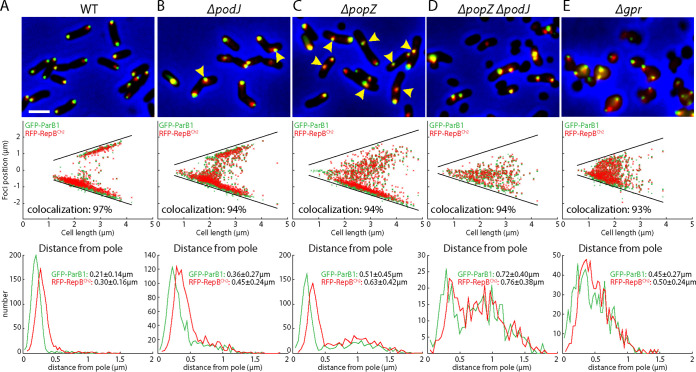
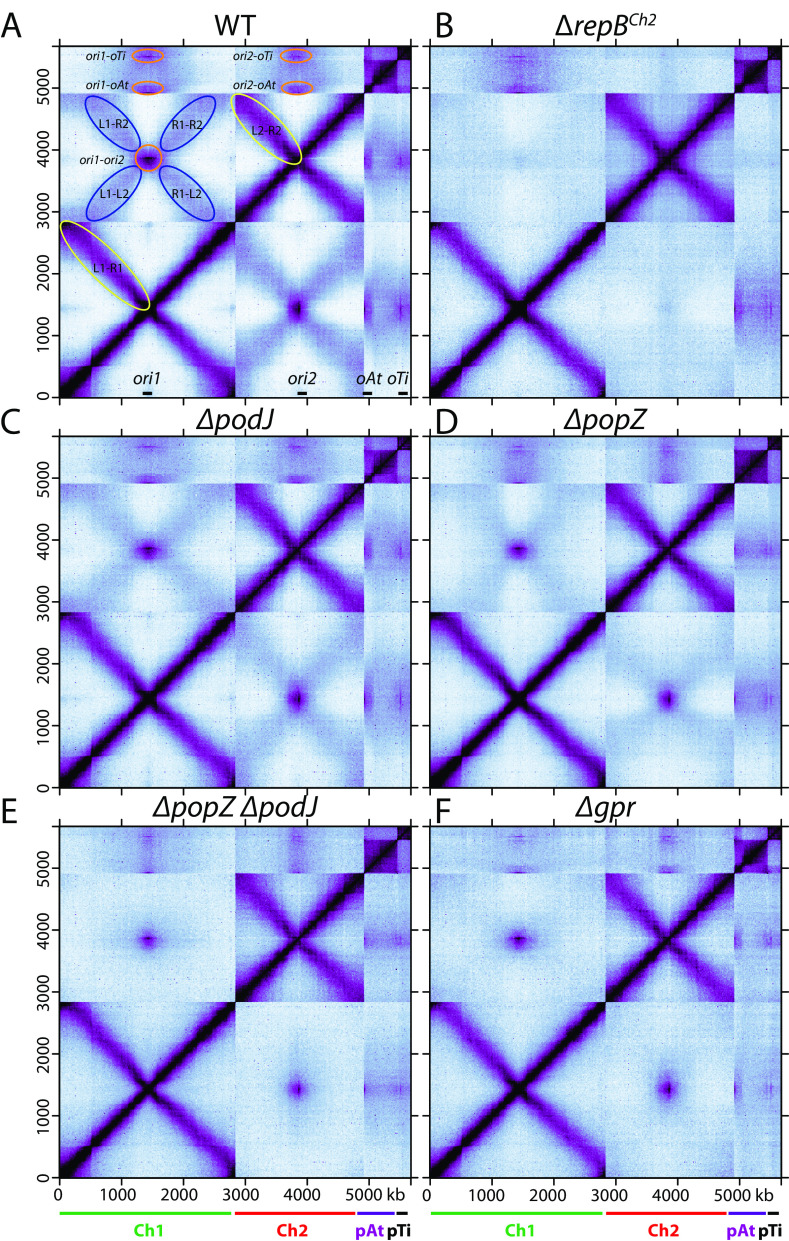
Many pathogens or symbionts of animals and plants contain multiple replicons, a configuration called a multipartite genome. Multipartite genomes enable those species to replicate their genomes faster and better adapt to new niches. Despite their prevalence, the mechanisms by which multipartite genomes are stably maintained are poorly understood. Agrobacterium tumefaciens is a plant pathogen that contains four replicons: a circular chromosome (Ch1), a linear chromosome (Ch2), and two large plasmids. Recent work indicates that their replication origins are clustered at the cell poles in a manner that depends on their ParB family centromeric proteins: ParB1 for Ch1 and individual RepB paralogs for Ch2 and the plasmids. However, understanding of these interactions and how they contribute to genome maintenance is limited. By combining genome-wide chromosome conformation capture (Hi-C) assays, chromatin-immunoprecipitation sequencing (ChIP-seq), and live cell fluorescence microscopy, we provide evidence here that centromeric clustering is mediated by interactions between these centromeric proteins. We further show that the disruption of centromere clustering results in the loss of replicons. Our data establish the role of centromeric clustering in multipartite genome stability. About 10% of sequenced bacteria have multiple replicons, also known as multipartite genomes. How these multipartite genomes are maintained is still poorly understood. Here, we use Agrobacterium tumefaciens as a model and show that the replication origins of the four replicons are clustered through direct interactions between the centromeric proteins; disruption of origin clustering leads to the loss of replicons. Thus, our study provided evidence that centromeric clustering is important for maintaining multipartite genomes.
许多动植物病原体或共生体含有多个复制子,这种结构被称为多分体基因组。多分体基因组使这些物种能够更快地复制其基因组,并更好地适应新的生态位。尽管它们很普遍,但多分体基因组稳定维持的机制仍知之甚少。根癌农杆菌是一种植物病原体,它含有四个复制子:一个圆形染色体 (Ch1)、一个线性染色体 (Ch2) 和两个大质粒。最近的研究表明,它们的复制起点以依赖于 ParB 家族着丝粒蛋白的方式聚集在细胞两极:ParB1 用于 Ch1,而 Ch2 和质粒的单个 RepB 同源物用于其他复制子。然而,对这些相互作用及其如何有助于基因组维持的理解是有限的。通过结合全基因组染色体构象捕获(Hi-C)测定、染色质免疫沉淀测序(ChIP-seq)和活细胞荧光显微镜,我们在这里提供了证据,证明着丝粒簇集是由这些着丝粒蛋白之间的相互作用介导的。我们进一步表明,着丝粒簇集的破坏导致复制子的丢失。我们的数据确立了着丝粒簇集在多分体基因组稳定性中的作用。约 10%的测序细菌具有多个复制子,也称为多分体基因组。这些多分体基因组是如何维持的仍不清楚。在这里,我们以根癌农杆菌为模型,表明四个复制子的复制起点通过着丝粒蛋白之间的直接相互作用聚集在一起;起源聚类的破坏导致复制子的丢失。因此,我们的研究提供了证据,证明着丝粒簇集对于维持多分体基因组很重要。