Department of Biological Sciences, Louisiana State University, Baton Rouge, LA, United States of America.
Center for Coastal Marine Sciences, California Polytechnic State University, San Luis Obispo, CA, United States of America.
PLoS One. 2022 May 10;17(5):e0267180. doi: 10.1371/journal.pone.0267180. eCollection 2022.
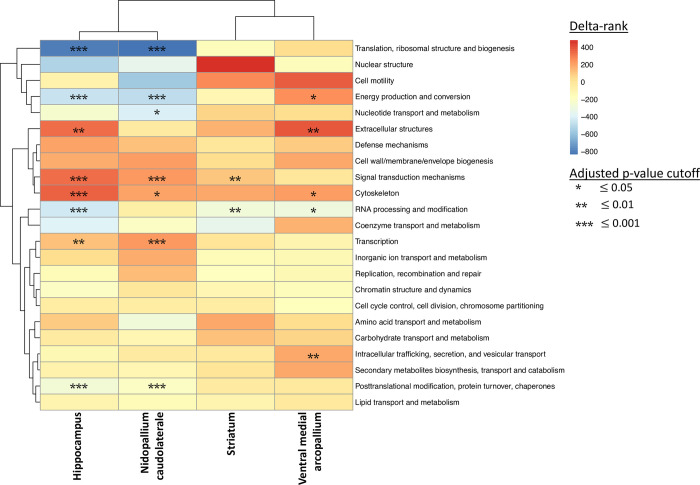
Neophobia (aversion to new objects, food, and environments) is a personality trait that affects the ability of wildlife to adapt to new challenges and opportunities. Despite the ubiquity and importance of this trait, the molecular mechanisms underlying repeatable individual differences in neophobia in wild animals are poorly understood. We evaluated wild-caught house sparrows (Passer domesticus) for neophobia in the lab using novel object tests. We then selected a subset of neophobic and non-neophobic individuals (n = 3 of each, all females) and extracted RNA from four brain regions involved in learning, memory, threat perception, and executive function: striatum, caudal dorsomedial hippocampus, medial ventral arcopallium, and caudolateral nidopallium (NCL). Our analysis of differentially expressed genes (DEGs) used 11,889 gene regions annotated in the house sparrow reference genome for which we had an average of 25.7 million mapped reads/sample. PERMANOVA identified significant effects of brain region, phenotype (neophobic vs. non-neophobic), and a brain region by phenotype interaction. Comparing neophobic and non-neophobic birds revealed constitutive differences in DEGs in three of the four brain regions examined: hippocampus (12% of the transcriptome significantly differentially expressed), striatum (4%) and NCL (3%). DEGs included important known neuroendocrine mediators of learning, memory, executive function, and anxiety behavior, including serotonin receptor 5A, dopamine receptors 1, 2 and 5 (downregulated in neophobic birds), and estrogen receptor beta (upregulated in neophobic birds). These results suggest that some of the behavioral differences between phenotypes may be due to underlying gene expression differences in the brain. The large number of DEGs in neophobic and non-neophobic birds also implies that there are major differences in neural function between the two phenotypes that could affect a wide variety of behavioral traits beyond neophobia.
恐新症(对新物体、新食物和新环境的厌恶)是一种影响野生动物适应新挑战和新机遇能力的个性特征。尽管这种特征普遍存在且很重要,但野生动物中可重复的个体间恐新症差异的分子机制仍知之甚少。我们在实验室中使用新物体测试评估了野生捕获的家麻雀(Passer domesticus)的恐新症。然后,我们选择了一组恐新症和非恐新症个体(每组 3 只,均为雌性),并从参与学习、记忆、威胁感知和执行功能的四个大脑区域中提取 RNA:纹状体、尾侧背内侧海马体、内侧腹侧弓状皮质和尾侧外侧核(NCL)。我们使用 11889 个基因区域进行差异表达基因(DEG)分析,这些基因区域在麻雀参考基因组中有注释,我们平均每个样本有 2570 万条映射读。PERMANOVA 确定了大脑区域、表型(恐新症与非恐新症)和大脑区域与表型相互作用的显著影响。比较恐新症和非恐新症鸟类发现,在四个大脑区域中的三个区域中,DEG 存在组成型差异:海马体(转录组的 12%显著差异表达)、纹状体(4%)和 NCL(3%)。DEG 包括学习、记忆、执行功能和焦虑行为的重要已知神经内分泌调节剂,包括 5-羟色胺受体 5A、多巴胺受体 1、2 和 5(在恐新症鸟类中下调)和雌激素受体β(在恐新症鸟类中上调)。这些结果表明,表型之间的一些行为差异可能是由于大脑中潜在的基因表达差异。恐新症和非恐新症鸟类中的大量 DEG 也意味着两种表型之间的神经功能存在重大差异,这可能会影响除恐新症以外的广泛行为特征。