Centre for OA Pathogenesis Versus Arthritis, Kennedy Institute of Rheumatology, University of Oxford, Oxford, United Kingdom.
Diamond Light Source Ltd, Diamond House, Harwell Science and Innovation Campus, Didcot, United Kingdom.
PLoS One. 2022 May 10;17(5):e0268223. doi: 10.1371/journal.pone.0268223. eCollection 2022.
Established MRI and emerging X-ray contrast agents for non-invasive imaging of articular cartilage rely on non-selective electrostatic interactions with negatively charged proteoglycans. These contrast agents have limited prognostic utility in diseases such as osteoarthritis (OA) due to the characteristic high turnover of proteoglycans. To overcome this limitation, we developed a radiocontrast agent that targets the type II collagen macromolecule in cartilage and used it to monitor disease progression in a murine model of OA.
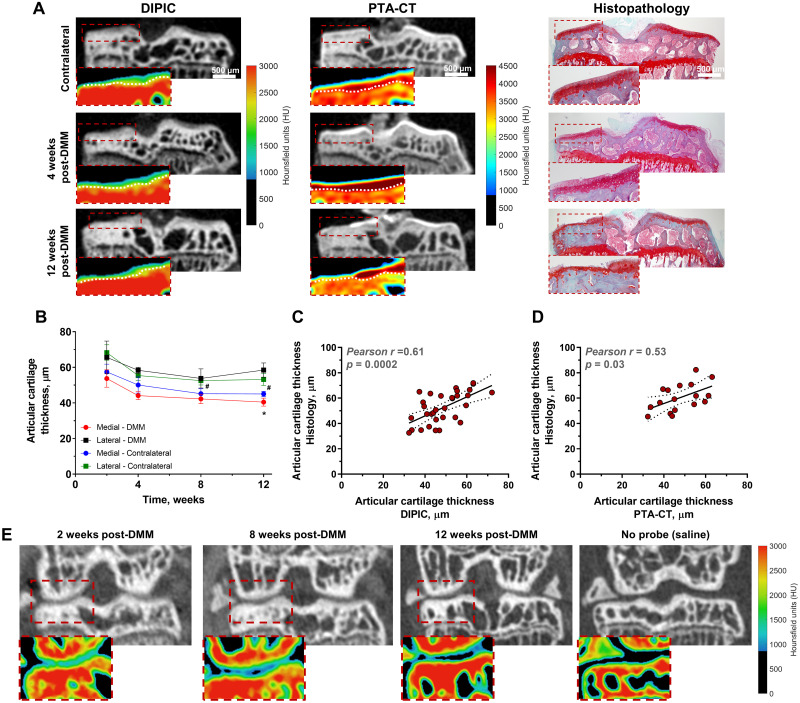
To confer radiopacity to cartilage contrast agents, the naturally occurring tyrosine derivative 3,5-diiodo-L-tyrosine (DIT) was introduced into a selective peptide for type II collagen. Synthetic DIT peptide derivatives were synthesised by Fmoc-based solid-phase peptide synthesis and binding to ex vivo mouse tibial cartilage evaluated by high-resolution micro-CT. Di-Iodotyrosinated Peptide Imaging of Cartilage (DIPIC) was performed ex vivo and in vivo 4, 8 and 12 weeks in mice after induction of OA by destabilisation of the medial meniscus (DMM). Finally, human osteochondral plugs were imaged ex vivo using DIPIC.
Fifteen DIT peptides were synthesised and tested, yielding seven leads with varying cartilage binding strengths. DIPIC visualised ex vivo murine articular cartilage comparably to the ex vivo contrast agent phosphotungstic acid. Intra-articular injection of contrast agent followed by in vivo DIPIC enabled delineation of damaged murine articular cartilage. Finally, the translational potential of the contrast agent was confirmed by visualisation of ex vivo human cartilage explants.
DIPIC has reduction and refinement implications in OA animal research and potential clinical translation to imaging human disease.
现有的磁共振成像(MRI)和新兴的 X 射线对比剂可用于非侵入性成像关节软骨,但它们依赖于与带负电荷的蛋白聚糖的非选择性静电相互作用。由于蛋白聚糖的高周转率,这些对比剂在骨关节炎(OA)等疾病中的预后应用有限。为了克服这一限制,我们开发了一种针对软骨中 II 型胶原大分子的放射性对比剂,并将其用于监测 OA 小鼠模型中的疾病进展。
为了使软骨对比剂具有放射不透性,将天然存在的酪氨酸衍生物 3,5-二碘-L-酪氨酸(DIT)引入到针对 II 型胶原的选择性肽中。通过基于 Fmoc 的固相肽合成合成了 DIT 肽衍生物,并通过高分辨率 micro-CT 评估其在离体小鼠胫骨软骨上的结合情况。在通过内侧半月板不稳定(DMM)诱导 OA 后 4、8 和 12 周,在小鼠体内和体内进行了 Di-Iodotyrosinated Peptide Imaging of Cartilage(DIPIC)。最后,使用 DIPIC 对离体人骨软骨插件进行成像。
合成并测试了 15 种 DIT 肽,得到了 7 种具有不同软骨结合强度的先导肽。DIPIC 可与体外对比剂磷钨酸一样清晰地显示出体外小鼠关节软骨。关节内注射对比剂后,再进行体内 DIPIC 可清晰显示出受损的小鼠关节软骨。最后,通过对离体人软骨外植体的成像,证实了该对比剂的转化潜力。
DIPIC 对 OA 动物研究具有减少和精细化的意义,并有潜在的临床转化为人类疾病成像的应用。