Stomatological Hospital, Southern Medical University, Guangzhou, China.
Department of Oral and Maxillofacial Surgery, the First Affiliated Hospital, Fujian Medical University, Fuzhou, China.
Int J Oral Sci. 2022 May 10;14(1):25. doi: 10.1038/s41368-022-00174-4.
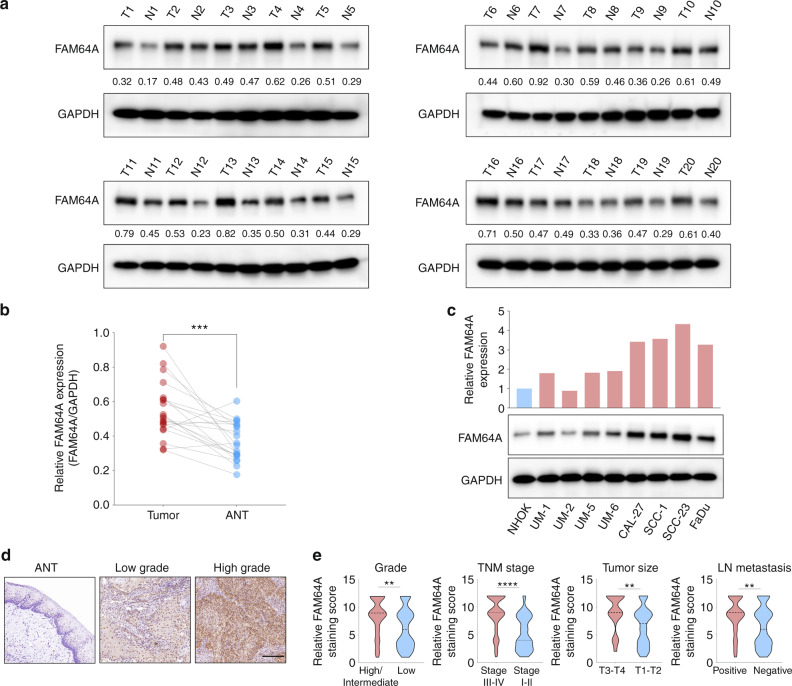
Head and neck squamous cell carcinoma (HNSCC) still lacks effective targeted treatment. Therefore, exploring novel and robust molecular targets is critical for improving the clinical outcome of HNSCC. Here, we reported that the expression levels of family with sequence similarity 64, member A (FAM64A) were significantly higher in HNSCC tissues and cell lines. In addition, FAM64A overexpression was found to be strongly associated with an unfavorable prognosis of HNSCC. Both in vitro and in vivo evidence showed that FAM64A depletion suppressed the malignant activities of HNSCC cells, and vice versa. Moreover, we found that the FAM64A level was progressively increased from normal to dysplastic to cancerous tissues in a carcinogenic 4-nitroquinoline-1-oxide mouse model. Mechanistically, a physical interaction was found between FAM64A and forkhead box protein M1 (FOXM1) in HNSCC cells. FAM64A promoted HNSCC tumorigenesis not only by enhancing the transcriptional activity of FOXM1, but also, more importantly, by modulating FOXM1 expression via the autoregulation loop. Furthermore, a positive correlation between FAM64A and FOXM1 was found in multiple independent cohorts. Taken together, our findings reveal a previously unknown mechanism behind the activation of FOXM1 in HNSCC, and FAM64A might be a promising molecular therapeutic target for treating HNSCC.
头颈部鳞状细胞癌(HNSCC)仍然缺乏有效的靶向治疗方法。因此,探索新的、强大的分子靶点对于改善 HNSCC 的临床结局至关重要。在这里,我们报道了家族与序列相似性 64 成员 A(FAM64A)的表达水平在 HNSCC 组织和细胞系中明显升高。此外,发现 FAM64A 过表达与 HNSCC 的不良预后密切相关。体内外证据均表明,FAM64A 耗竭抑制了 HNSCC 细胞的恶性活动,反之亦然。此外,我们发现,在致癌性 4-硝基喹啉-1-氧化物小鼠模型中,FAM64A 水平从正常到发育不良再到癌症组织逐渐升高。在机制上,我们在 HNSCC 细胞中发现 FAM64A 与叉头框蛋白 M1(FOXM1)之间存在物理相互作用。FAM64A 促进 HNSCC 肿瘤发生不仅通过增强 FOXM1 的转录活性,而且更重要的是通过自动调节环调节 FOXM1 的表达。此外,在多个独立队列中发现 FAM64A 和 FOXM1 之间存在正相关。总之,我们的研究结果揭示了 HNSCC 中 FOXM1 激活的一个未知机制,FAM64A 可能是治疗 HNSCC 的有前途的分子治疗靶点。