Sato Takaaki, Milne Zachary B, Nomura Masahiro, Sasaki Naruo, Carpick Robert W, Fujita Hiroyuki
University of Pennsylvania, Department of Mechanical Engineering and Applied Mechanics, Philadelphia, PA, USA.
Sandia National Laboratories, Nanostructure Physics, Albuquerque, NM, USA.
Nat Commun. 2022 May 10;13(1):2551. doi: 10.1038/s41467-022-30290-y.
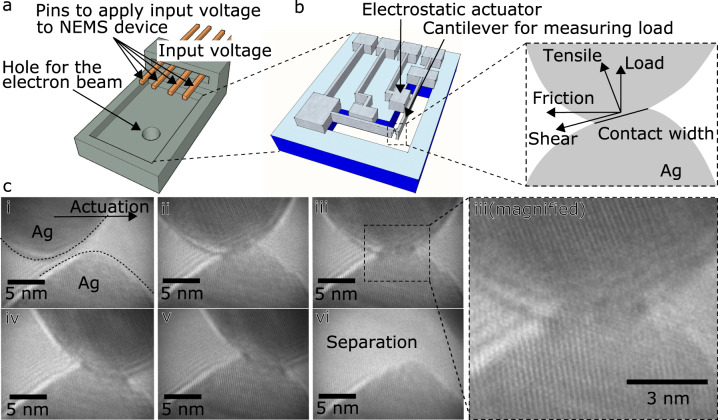
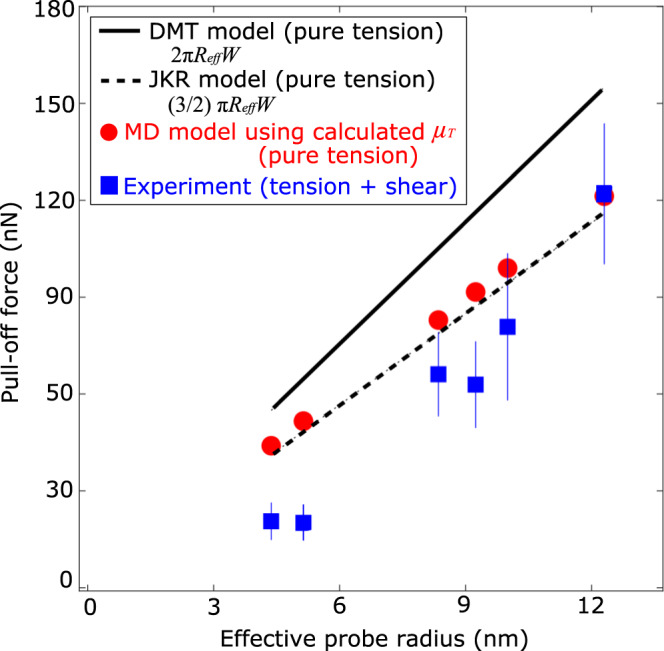
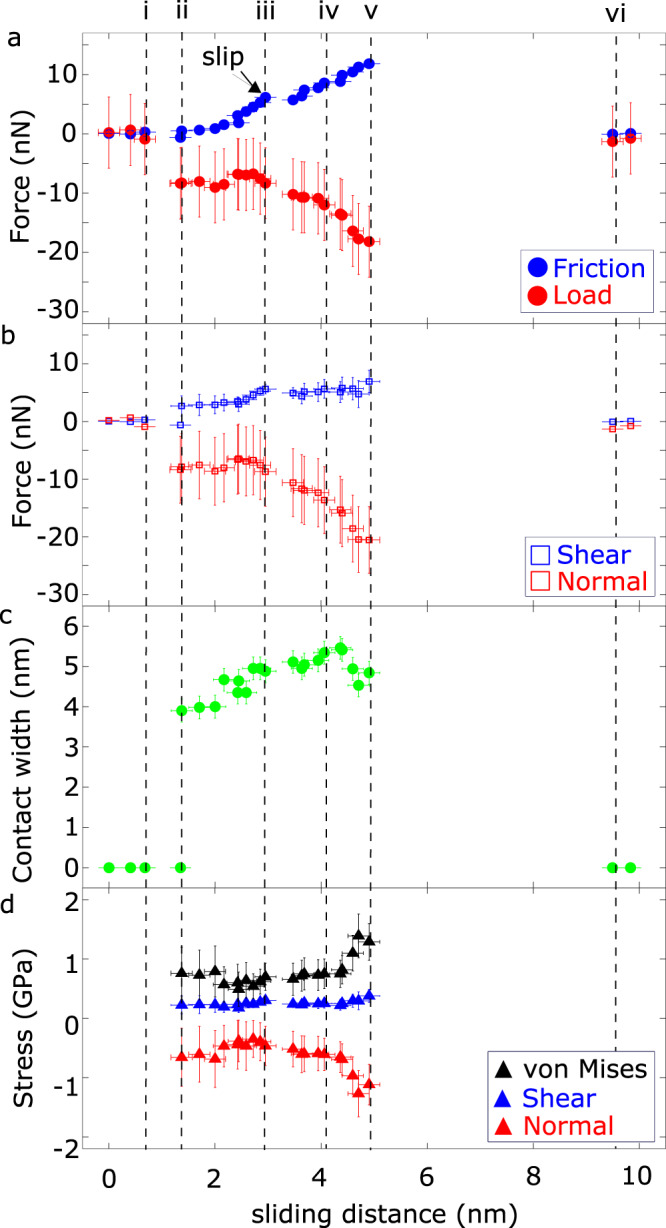
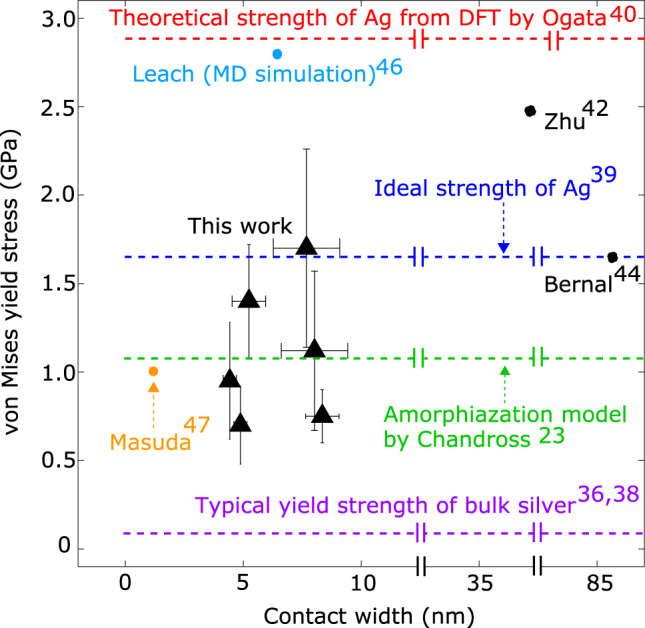
The behavior of materials in sliding contact is challenging to determine since the interface is normally hidden from view. Using a custom microfabricated device, we conduct in situ, ultrahigh vacuum transmission electron microscope measurements of crystalline silver nanocontacts under combined tension and shear, permitting simultaneous observation of contact forces and contact width. While silver classically exhibits substantial sliding-induced plastic junction growth, the nanocontacts exhibit only limited plastic deformation despite high applied stresses. This difference arises from the nanocontacts' high strength, as we find the von Mises stresses at yield points approach the ideal strength of silver. We attribute this to the nanocontacts' nearly defect-free nature and small size. The contacts also separate unstably, with pull-off forces well below classical predictions for rupture under pure tension. This strongly indicates that shearing reduces nanoscale pull-off forces, predicted theoretically at the continuum level, but not directly observed before.
由于材料在滑动接触时的界面通常不可见,因此确定其行为具有挑战性。我们使用定制的微加工设备,在超高真空透射电子显微镜下对晶体银纳米接触进行了原位拉伸和剪切联合测量,从而能够同时观察接触力和接触宽度。虽然传统上银在滑动时会出现大量由塑性结生长引起的变化,但尽管施加了高应力,纳米接触仅表现出有限的塑性变形。这种差异源于纳米接触的高强度,因为我们发现屈服点处的冯·米塞斯应力接近银的理想强度。我们将此归因于纳米接触几乎无缺陷的性质和小尺寸。这些接触的分离也不稳定,其拉脱力远低于纯拉伸下破裂的经典预测值。这有力地表明,剪切会降低纳米级拉脱力,这在理论上是在连续介质水平预测的,但此前未被直接观察到。