Clinic for Nephrology and Dialysis, Cantonal Hospital Basel-Land, Liestal, Switzerland.
Clinic for Transplantation immunology and nephrology, University Hospital Basel, Basel & Swiss Transplant Cohort Study (STCS), Basel, Switzerland.
BMC Nephrol. 2022 May 10;23(1):178. doi: 10.1186/s12882-022-02802-x.
Recurrence of IgA nephropathy (IgAN) after kidney transplantation occurs in about 30% of patients. The relevance of recurrence for the long-term graft survival is expected to increase, since graft survival continues to improve.
In a nested study within the Swiss Transplant Cohort Study the incidence of IgAN recurrence, predictive factors, graft function and graft and patient survival were evaluated. Serum concentration of total IgA, total IgG, Gd-IgA1 and IgA-IgG immune complex were measured using ELISA-based immunologic assays.
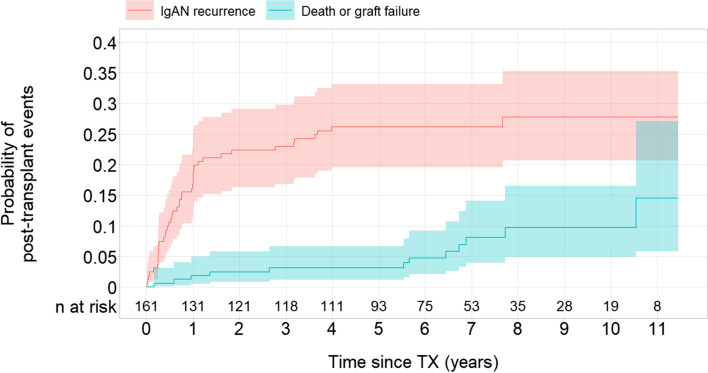
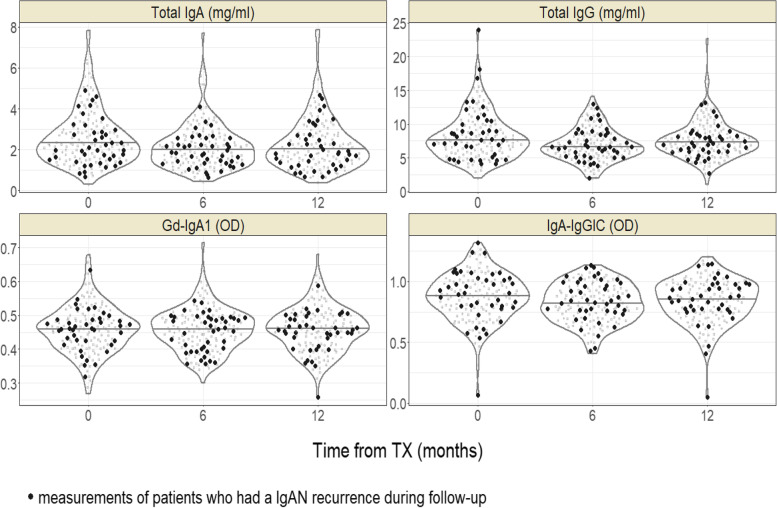
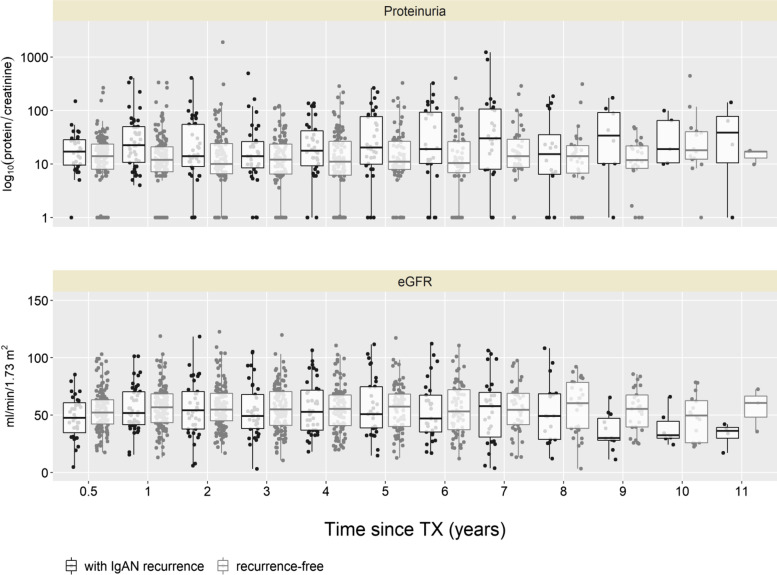
Between May 2008 and December 2016, 28 women and 133 men received their kidney allograft for end-stage kidney disease due to IgAN in Switzerland. Over a median follow-up time of 7 years after transplantation, 43 out of 161 patients (26.7%) developed an IgAN recurrence, of which six (13.9%) had an allograft failure afterwards and further four patients (9.3%) died. During the same follow-up period, 6 out of 118 patients (5%) each experienced allograft failure or died without prior IgAN recurrence. After 11 years the risk for IgAN recurrence was 27.7% (95%-CI: 20.6-35.3%). Renal function was similar in patients with and without recurrence up to 7 years after transplantation, but worsened thereafter in patients with recurrence (eGFR median (interquartile range) at 8 years: 49 ml/min/1.73m (29-68) vs. 60 ml/min/1.73m (38-78)). Serum concentration of total IgA, total IgG, Gd-IgA1 and IgA-IgG immune complex within the first year posttransplant showed no significant effect on the recurrence of IgAN. Younger recipients and women had a higher risk of recurrence, but the latter only in the short term.
Our study showed a recurrence risk of 28% at 11 years after transplantation, which is consistent with previous literature. However, the predictive value of known biomarkers, such as serum Gd-IgA1 and IgA-IgG IC, for IgAN recurrence could not be confirmed.
IgA 肾病(IgAN)在约 30%的移植肾受者中复发。随着移植物存活率的持续提高,复发对长期移植物存活率的相关性预计会增加。
在瑞士移植队列研究的嵌套研究中,评估了 IgAN 复发的发生率、预测因素、移植物功能以及移植物和患者存活率。使用基于 ELISA 的免疫测定法检测血清总 IgA、总 IgG、Gd-IgA1 和 IgA-IgG 免疫复合物的浓度。
2008 年 5 月至 2016 年 12 月期间,在瑞士,28 名女性和 133 名男性因 IgAN 接受了终末期肾病的肾移植。在移植后中位随访 7 年期间,161 例患者中有 43 例(26.7%)发生了 IgAN 复发,其中 6 例(13.9%)随后发生了移植物衰竭,另有 4 例(9.3%)患者死亡。在同一随访期间,118 例患者中有 6 例(5%)分别在无 IgAN 复发的情况下发生了移植物衰竭或死亡。11 年后,IgAN 复发的风险为 27.7%(95%CI:20.6-35.3%)。在移植后 7 年内,复发组和未复发组的肾功能相似,但在复发组中肾功能恶化(8 年时 eGFR 中位数(四分位距):49ml/min/1.73m(29-68)比 60ml/min/1.73m(38-78))。移植后 1 年内血清总 IgA、总 IgG、Gd-IgA1 和 IgA-IgG 免疫复合物浓度对 IgAN 的复发无显著影响。年轻受者和女性复发风险较高,但后者仅在短期内如此。
本研究显示,移植后 11 年时的复发风险为 28%,与先前的文献一致。然而,血清 Gd-IgA1 和 IgA-IgG IC 等已知生物标志物对 IgAN 复发的预测价值不能得到证实。