Jiangsu Cancer Hospital, Jiangsu Institute of Cancer Research, The Affiliated Cancer Hospital of Nanjing Medical University, Nanjing, China.
Department of Environmental Genomics, Jiangsu Key Laboratory of Cancer Biomarkers, Prevention and Treatment, Collaborative Innovation Center for Cancer Personalized Medicine, Center for Global Health, School of Public Health, Nanjing Medical University, 101 Longmian Avenue, Jiangning District, Nanjing, 211166, China.
BMC Med. 2022 May 11;20(1):168. doi: 10.1186/s12916-022-02366-5.
The association between vitamin E and cancer risk has been widely investigated by observational studies, but the findings remain inconclusive. Here, we aimed to evaluate the causal effect of circulating vitamin E on the risk of ten common cancers, including bladder, breast, colorectal, esophagus, lung, oral and pharynx, ovarian, pancreatic, prostate, and kidney cancer.
A Mendelian randomization (MR) analytic framework was applied to data from a cancer-specific genome-wide association study (GWAS) comprising a total of 297,699 cancer cases and 304,736 controls of European ancestry. Three genetic instrumental variables associated with circulating vitamin E were selected. Summary statistic-based methods of inverse variance weighting (IVW) and likelihood-based approach, as well as the individual genotyping-based method of genetic risk score (GRS) were used. Multivariable IVW analysis was further performed to control for potential confounding effects. Furthermore, the UK Biobank cohort was used as external validation, supporting 355,543 European participants (incident cases ranged from 437 for ovarian cancer to 4882 for prostate cancer) for GRS-based estimation of circulating vitamin E, accompanied by a one-sample MR analysis of dietary vitamin E intake underlying the time-to-event analytic framework.
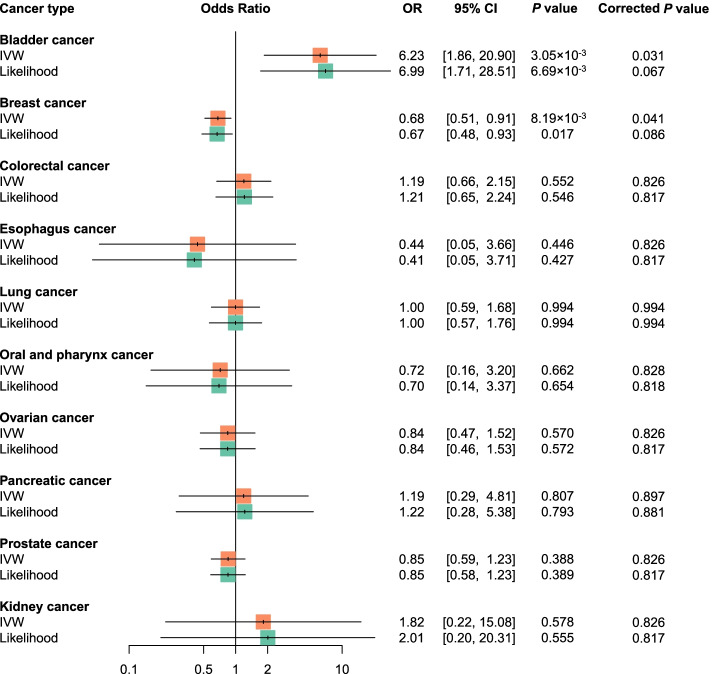
Specific to cancer GWAS, we found that circulating vitamin E was significantly associated with increased bladder cancer risk (odds ratios [OR] = 6.23, P = 3.05×10) but decreased breast cancer risk (OR = 0.68, P = 8.19×10); however, the significance of breast cancer was dampened (P > 0.05) in the subsequent multivariable MR analysis. In the validation stage of the UK Biobank cohort, we did not replicate convincing causal effects of genetically predicted circulating vitamin E concentrations and dietary vitamin E intake on the risk of ten cancers.
This large-scale population study upon data from cancer-specific GWAS and a longitudinal biobank cohort indicates plausible non-causal associations between circulating vitamin E and ten common cancers in the European populations. Further studies regarding ancestral diversity are warranted to validate such causal associations.
维生素 E 与癌症风险之间的关联已被大量观察性研究进行了研究,但结果仍不确定。在这里,我们旨在评估循环维生素 E 对十种常见癌症(包括膀胱癌、乳腺癌、结直肠癌、食管癌、肺癌、口腔和咽癌、卵巢癌、胰腺癌、前列腺癌和肾癌)风险的因果效应。
应用孟德尔随机化(MR)分析框架,对一项特定于癌症的全基因组关联研究(GWAS)的数据进行分析,该研究共纳入了 297699 例癌症病例和 304736 例对照,均为欧洲血统。选择了三个与循环维生素 E 相关的遗传工具变量。使用基于汇总统计的逆方差加权(IVW)和似然比方法,以及基于个体基因分型的遗传风险评分(GRS)方法。进一步进行了多变量 IVW 分析,以控制潜在的混杂效应。此外,使用英国生物库队列作为外部验证,支持基于 GRS 的循环维生素 E 估计,该队列纳入了 355543 名欧洲参与者(卵巢癌的发病例数从 437 例到前列腺癌的 4882 例不等),并进行了基于时间到事件分析框架的饮食维生素 E 摄入的单样本 MR 分析。
针对癌症 GWAS,我们发现循环维生素 E 与膀胱癌风险增加显著相关(比值比 [OR] = 6.23,P = 3.05×10),但与乳腺癌风险降低显著相关(OR = 0.68,P = 8.19×10);然而,在随后的多变量 MR 分析中,乳腺癌的显著性降低(P > 0.05)。在英国生物库队列的验证阶段,我们没有复制出遗传预测的循环维生素 E 浓度和饮食维生素 E 摄入与十种癌症风险之间具有说服力的因果关系。
这项基于癌症特异性 GWAS 数据和纵向生物库队列的大规模人群研究表明,在欧洲人群中,循环维生素 E 与十种常见癌症之间存在合理的非因果关联。需要进一步研究祖先多样性以验证这种因果关系。