Lydia Becker Institute of Immunology and Inflammation, School of Biological Sciences, Faculty of Biology Medicine and Health, University of Manchester, Manchester, UK.
Center for Biostatistics, School of Health Sciences, Faculty of Biology Medicine and Health, The University of Manchester, Manchester, UK.
Exp Dermatol. 2022 Sep;31(9):1373-1384. doi: 10.1111/exd.14605. Epub 2022 May 15.
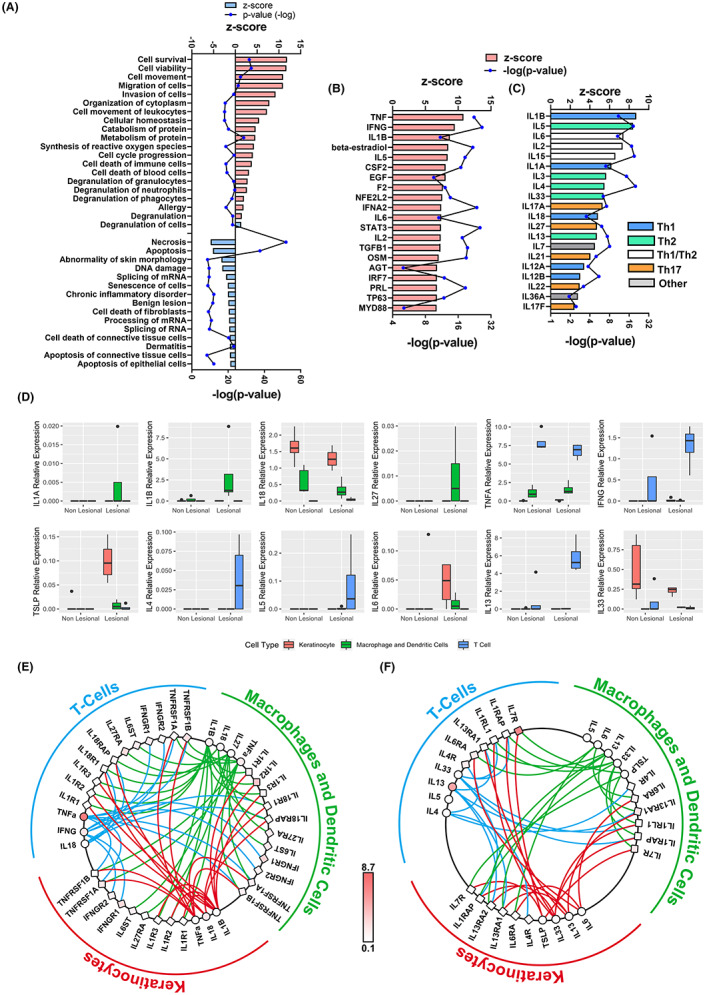
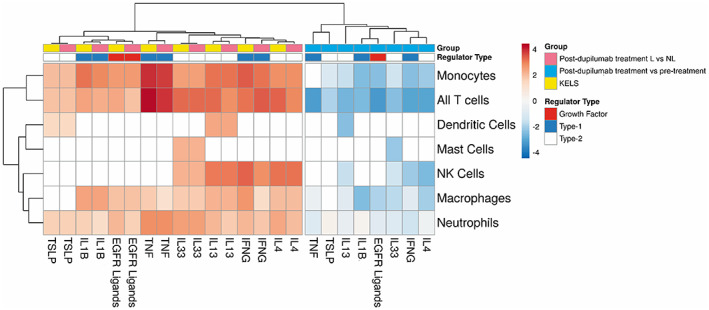
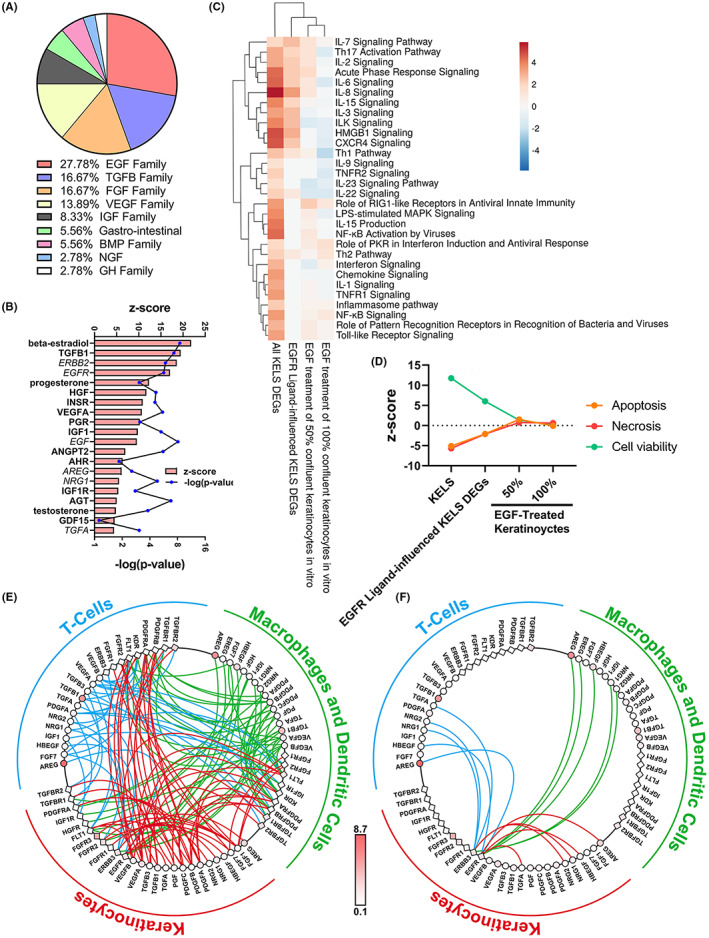
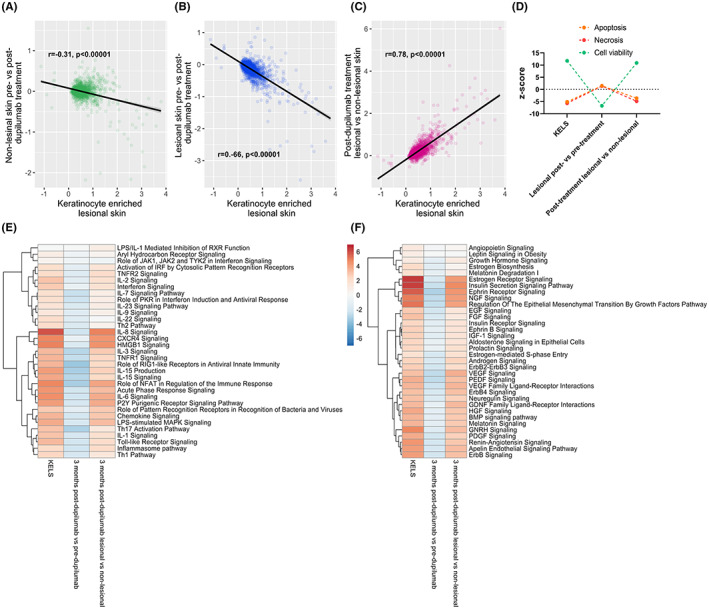
Atopic dermatitis (AD) remains a highly heterogenous disorder with a multifactorial aetiology. Whilst keratinocytes are known to play a fundamental role in AD, their contribution to the overall immune landscape in moderate-to-severe AD is still poorly understood. In order to design new therapeutics, further investigation is needed into common disease pathways at the molecular level. We used publicly available whole-tissue RNAseq data (4 studies) and single-cell RNAseq keratinocyte data to identify genes/pathways that are involved in keratinocyte responses in AD and after dupilumab treatment. Transcripts present in both keratinocytes (single-cell) and whole-tissue, referred to as the keratinocyte-enriched lesional skin (KELS) genes, were analysed using functional/pathway analysis. Following statistical testing, 2049 genes (16.8%) were differentially expressed in KELS. Enrichment analyses predicted increases in not only type-1/type-2 immune signalling and chemoattraction, but also in EGF-dominated growth factor signalling. We identified complex crosstalk between keratinocytes and immune cells involving a dominant EGF family signature which converges on keratinocytes with potential immunomodulatory and chemotaxis-promoting consequences. Although keratinocytes express the IL4R, we observed no change in EGF signalling in KELS after three-month treatment with dupilumab, indicating that this pathway is not modulated by dupilumab immunotherapy. EGF family signalling is significantly dysregulated in AD lesions but is not associated with keratinocyte proliferation. EGF signalling pathways in AD require further study.
特应性皮炎(AD)仍然是一种高度异质的疾病,具有多因素的发病机制。虽然角质形成细胞被认为在 AD 中起着至关重要的作用,但它们对中重度 AD 整体免疫景观的贡献仍知之甚少。为了设计新的治疗方法,需要在分子水平上进一步研究常见的疾病途径。我们使用了公开的全组织 RNAseq 数据(4 项研究)和单细胞 RNAseq 角质形成细胞数据,以鉴定参与 AD 中角质形成细胞反应以及在 dupilumab 治疗后的基因/途径。在角质形成细胞(单细胞)和全组织中都存在的转录本,称为角质形成细胞丰富的病变皮肤(KELS)基因,使用功能/途径分析进行分析。经过统计学测试,有 2049 个基因(16.8%)在 KELS 中表达差异。富集分析预测不仅会增加 1 型/2 型免疫信号和趋化作用,还会增加 EGF 主导的生长因子信号。我们发现角质形成细胞和免疫细胞之间存在复杂的串扰,涉及到一个主导的 EGF 家族特征,该特征与角质形成细胞汇聚,具有潜在的免疫调节和趋化作用促进作用。尽管角质形成细胞表达 IL4R,但我们观察到在 dupilumab 治疗三个月后,KELS 中的 EGF 信号没有变化,这表明该途径不受 dupilumab 免疫疗法的调节。AD 病变中 EGF 家族信号明显失调,但与角质形成细胞增殖无关。AD 中的 EGF 信号通路需要进一步研究。