Shen Xiaoqin, Chen Xiaolei, Sun Dejun, Wu Tao, Li Yujiang
Shandong Provincial Research Center for Water Pollution Control, School of Environmental Science & Engineering, Shandong University Jinan 250100 PR China
Key Laboratory of Colloid & Interface Science of Education Ministry, Shandong University Jinan 250100 PR China
RSC Adv. 2018 Feb 15;8(14):7351-7360. doi: 10.1039/c8ra00503f. eCollection 2018 Feb 14.
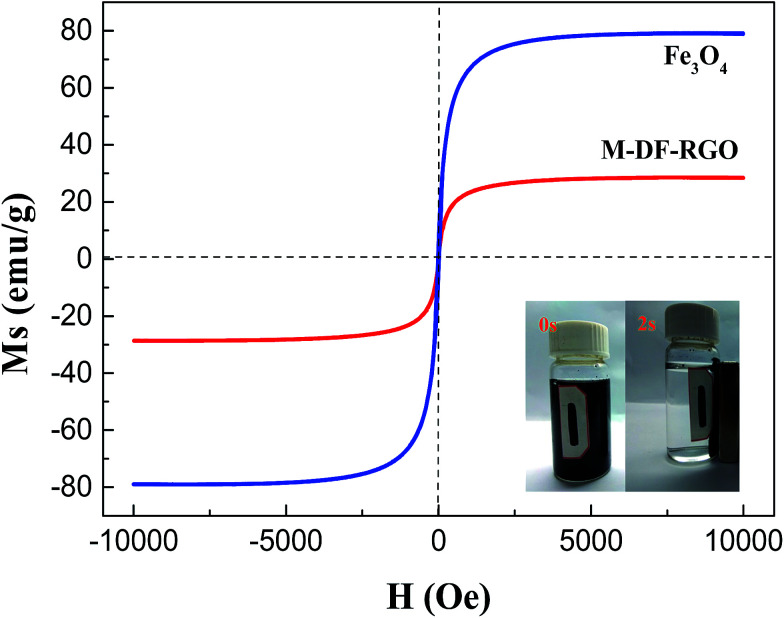
A magnetic hybrid nanomaterial, which contains magnetite (FeO) particles and diazonium functionalized-reduced graphene oxide (DF-RGO), was fabricated a three-pot reaction. First, the reduced graphene oxide (RGO) was synthesized a redox reaction. Second, diazonium functionalized-RGO was prepared a feasible chemical reaction. Third, FeO particles were loaded onto the surface of DF-RGO by covalent bonding, fabricating the M-DF-RGO hybrid. The fabricated hybrid was characterized by SEM, TEM, AFM, XRD, XPS, FT-IR, TGA, Raman spectroscopy, and magnetometry. The resulting M-DF-RGO hybrid possessed unique magnetic properties and was applied to remove 4-chlorophenol (4-CP) and 2,4-dichlorophenol (2,4-DCP) from aqueous solution. The adsorption of 4-CP and 2,4-DCP on the M-DF-RGO hybrid was performed under various conditions, with respect to initial chlorophenol concentration, pH, and contact time. The results suggest that the adsorption of 4-CP and 2,4-DCP onto the M-DF-RGO hybrid is strongly dependent on pH and weakly dependent on contact time. In addition, the adsorption isotherm of 4-CP and 2,4-DCP on the M-DF-RGO hybrid fits the Freundlich model well and the adsorption capacities of 4-CP and 2,4-DCP on M-DF-RGO reached 55.09 and 127.33 mg g, respectively, at pH 6 and 25 °C. In this situation, intermolecular interactions including π-π interactions and hydrogen bonding are operative. The calculated results of density functional theory further demonstrate that 2,4-DCP molecules could be more easily absorbed than 4-CP molecules by the M-DF-RGO hybrid. Moreover, the M-DF-RGO hybrid could be easily separated by a magnetic separation process, and showed good recyclability of more than five cycles.
一种包含磁铁矿(FeO)颗粒和重氮官能化还原氧化石墨烯(DF-RGO)的磁性杂化纳米材料通过三锅反应制备而成。首先,通过氧化还原反应合成还原氧化石墨烯(RGO)。其次,通过可行的化学反应制备重氮官能化RGO。第三,通过共价键将FeO颗粒负载到DF-RGO表面,制备出M-DF-RGO杂化物。通过扫描电子显微镜(SEM)、透射电子显微镜(TEM)、原子力显微镜(AFM)、X射线衍射(XRD)、X射线光电子能谱(XPS)、傅里叶变换红外光谱(FT-IR)、热重分析(TGA)、拉曼光谱和磁力测定对制备的杂化物进行表征。所得的M-DF-RGO杂化物具有独特的磁性,并应用于从水溶液中去除4-氯苯酚(4-CP)和2,4-二氯苯酚(2,4-DCP)。在各种条件下,针对初始氯苯酚浓度、pH值和接触时间,对4-CP和2,4-DCP在M-DF-RGO杂化物上的吸附进行了研究。结果表明,4-CP和2,4-DCP在M-DF-RGO杂化物上的吸附强烈依赖于pH值,而对接触时间的依赖性较弱。此外,4-CP和2,4-DCP在M-DF-RGO杂化物上的吸附等温线很好地符合Freundlich模型,在pH值为6和25℃时,4-CP和2,4-DCP在M-DF-RGO上的吸附容量分别达到55.09和127.33 mg/g。在这种情况下,包括π-π相互作用和氢键在内的分子间相互作用起作用。密度泛函理论的计算结果进一步表明,M-DF-RGO杂化物对2,4-DCP分子的吸附比4-CP分子更容易。此外,M-DF-RGO杂化物可以通过磁分离过程轻松分离,并且显示出超过五个循环的良好可回收性。