Zhang Song, Liu Huan, Li Hong, Wu MoLi, Yu Yang, Li FengZhi, Cheng XiaoXin
Department of Cell Biology and Liaoning Laboratory of Cancer Genetics and Epigenetics, Dalian Medical University Liaoning 116044 China
Qiqihar Medical University Heilongjiang 161006 China.
RSC Adv. 2018 Apr 16;8(25):14048-14055. doi: 10.1039/c8ra00744f. eCollection 2018 Apr 11.
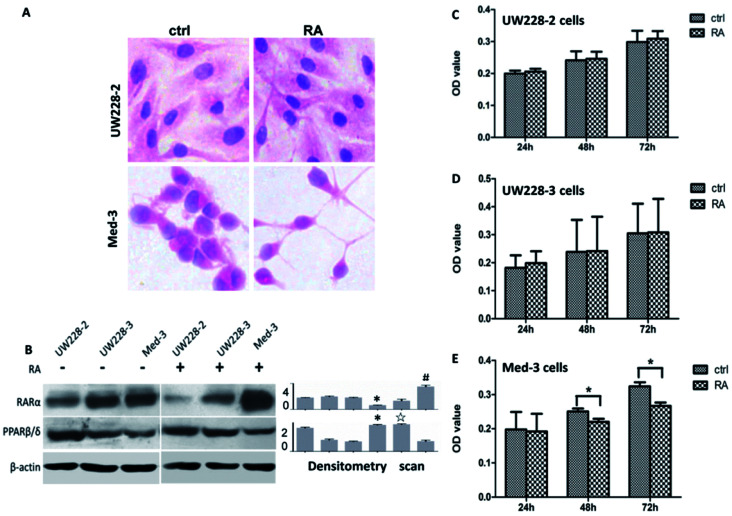
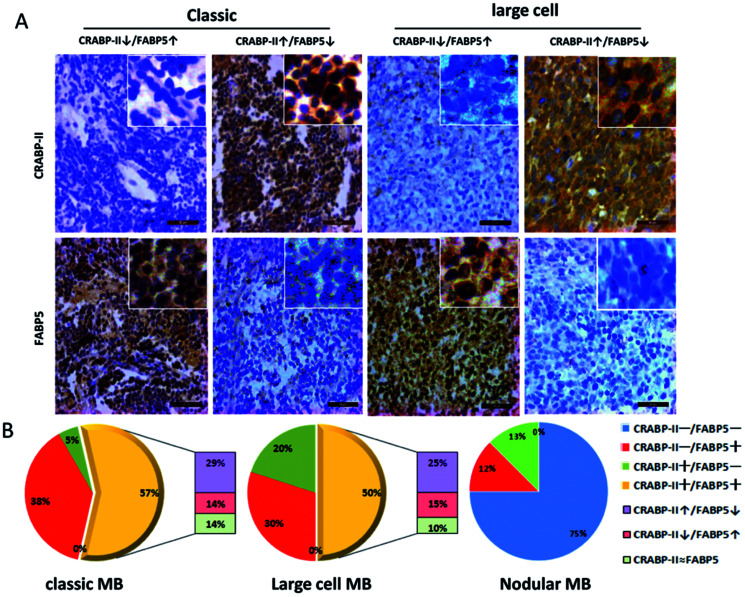
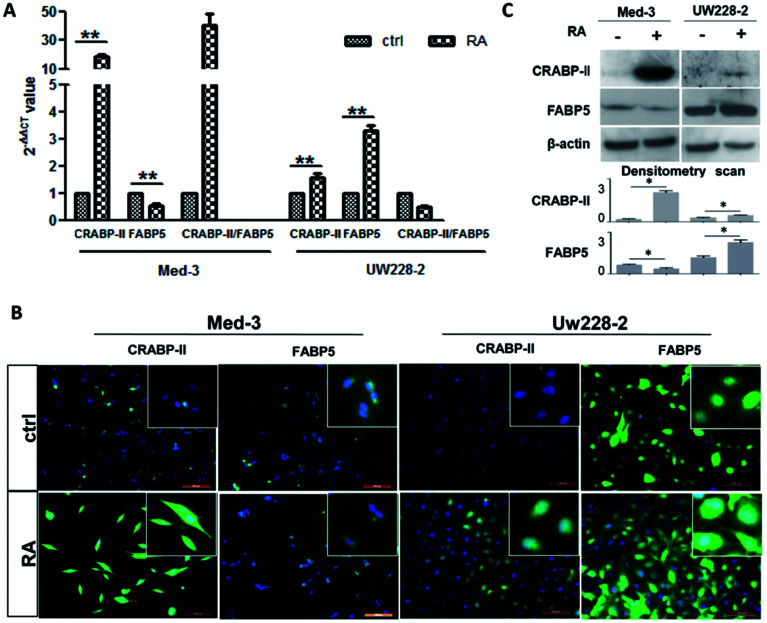
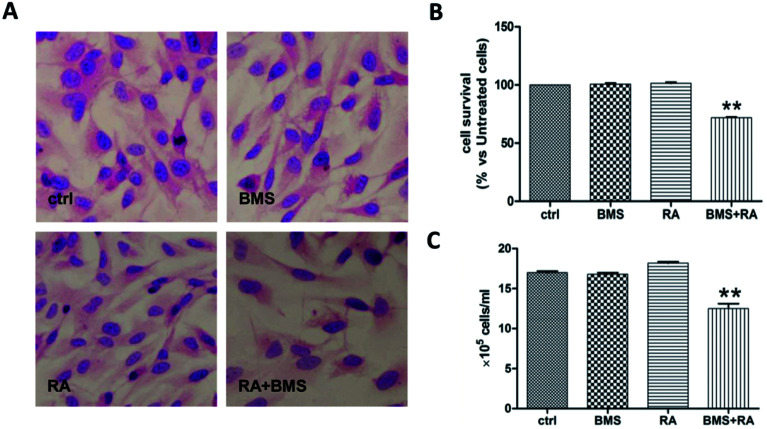
Medulloblastoma (MB) cells exhibit different responses to retinoid acid (RA) for reasons that are poorly understood. RA signaling can be transduced by two approaches that are mediated by cellular retinoic acid-binding protein 2 (CRABP-II) as a tumor-suppressive pathway, and by fatty acid-binding protein 5 (FABP5) as a tumor-promoting pathway. The biological effects of RA on cancer cells are largely determined by the patterns of CRABP-II and FABP5 expression. This study aims to profile the statuses of CRABP-II and FABP5 expression in MB and to evaluate their correlation with RA sensitivities using RA-sensitive (Med-3) and RA-insensitive (UW228-2, UW228-3) MB cells. Our results show that CRABP-II is distinctly expressed and the level of FABP5 is extremely low in Med-3 cells, while the patterns of CRABP-II and FABP5 expression are reversed in UW228-2 and UW228-3 cells. RA up-regulates CRABP-II expression in Med-3 cells, whereas it up-regulates FABP5 expression in the other two cell lines. The FABP5-specific inhibitor BMS309403 increases the RA sensitivity of UW228-2 cells ( < 0.01). Tissue microarray-based immunohistochemical staining showed CRABP-II/FABP5 expression patterns in MB that were variable (CRABP-II-/FABP5-, CRABP-II-/FABP5+, CRABP-II+/FABP5- and CRABP-II+/FABP5+) and imbalanced (CRABP-II↑/FABP5↓ and CRABP-II↓/FABP5↑). MB cases exhibited patterns ofCRABP-II-/FABP5- (12.24%, 6/49), CRABP-II-/FABP5+ (30.61%, 15/49) or CRABP-II↓/FABP5↑ (12.24%, 6/49), implicating unresponsiveness or insensitivity to RA. In conclusion, the ratios of CRABP-II/FABP5 levels are closely related to the RA sensitivities of MB cells. The differential CRABP-II and FABP5 expression patterns are prospective parameters, and of potential value in personalized RA therapy for MB.
髓母细胞瘤(MB)细胞对维甲酸(RA)表现出不同的反应,其原因尚不清楚。RA信号可以通过两种途径转导,一种由细胞视黄酸结合蛋白2(CRABP-II)介导,作为一种肿瘤抑制途径;另一种由脂肪酸结合蛋白5(FABP5)介导,作为一种肿瘤促进途径。RA对癌细胞的生物学效应在很大程度上取决于CRABP-II和FABP5的表达模式。本研究旨在分析MB中CRABP-II和FABP5的表达状态,并使用对RA敏感的(Med-3)和对RA不敏感的(UW228-2、UW228-3)MB细胞评估它们与RA敏感性的相关性。我们的结果表明,在Med-3细胞中CRABP-II明显表达,而FABP5水平极低,而在UW228-2和UW228-3细胞中CRABP-II和FABP5的表达模式则相反。RA上调Med-3细胞中CRABP-II的表达,而在另外两种细胞系中上调FABP5的表达。FABP5特异性抑制剂BMS309403增加了UW228-2细胞对RA的敏感性(<0.01)。基于组织芯片的免疫组化染色显示,MB中CRABP-II/FABP5的表达模式是可变的(CRABP-II-/FABP5-、CRABP-II-/FABP5+、CRABP-II+/FABP-和CRABP-II+/FABP5+)且不平衡(CRABP-II↑/FABP5↓和CRABP-II↓/FABP5↑)。MB病例表现出CRABP-II-/FABP5-(12.24%,6/49)、CRABP-II-/FABP5+(30.61%,15/49)或CRABP-II↓/FABP5↑(12.24%,6/49)的模式,提示对RA无反应或不敏感。总之,CRABP-II/FABP5水平的比值与MB细胞对RA的敏感性密切相关。CRABP-II和FABP5的差异表达模式是前瞻性参数,在MB的个性化RA治疗中具有潜在价值。