Senasu Teeradech, Hemavibool Khuanjit, Nanan Suwat
Materials Chemistry Research Center, Department of Chemistry and Center of Excellence for Innovation in Chemistry (PERCH-CIC), Faculty of Science, Khon Kaen University Khon Kaen 40002 Thailand
Department of Chemistry, Faculty of Science, Naresuan University Phitsanulok 65000 Thailand.
RSC Adv. 2018 Jun 20;8(40):22592-22605. doi: 10.1039/c8ra02061b. eCollection 2018 Jun 19.
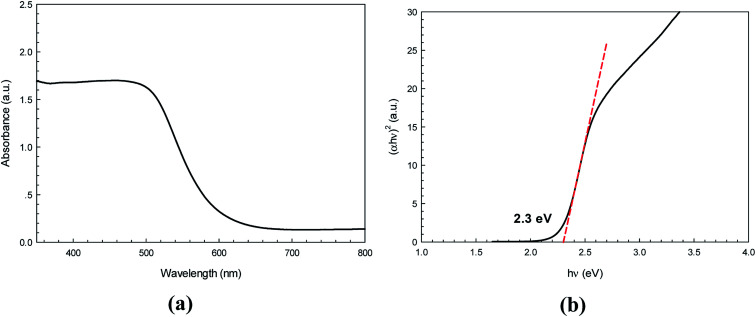
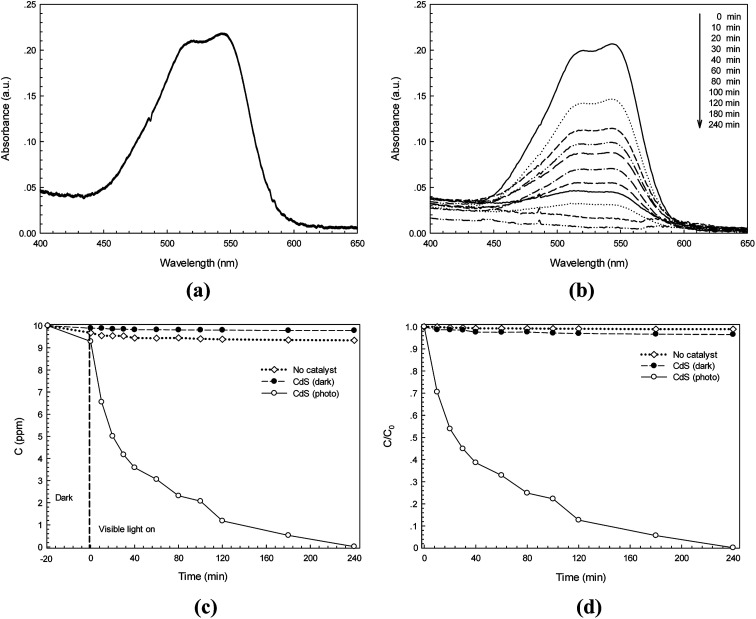
A CdS photocatalyst was synthesized successfully at low temperature a catalyst-free hydrothermal technique which is simple, green and also easily controlled. The synthesized CdS photocatalyst showed hexagonal wurtzite structure with high crystallinity and excellent optical properties. The catalyst was used for degradation of two anionic azo dyes namely reactive red (RR141) and Congo red (CR) azo dyes. The catalyst showed very high efficiency of 99.8% and 99.0% toward photodegradation of RR141 and CR dye, respectively. The photodegradation reaction followed pseudo-first order kinetics. Chemical scavenger studies showed that direct photogenerated hole transfer from CdS to the azo dye was most likely the major pathway for photodegradation of the azo dye. The chemical structure of the CdS photocatalyst remained stable after photodegradation. The CdS photocatalyst retains its original efficiency even after the fifth cycle of reuse indicating the advantages of stability and reusability. The CdS nanostructures will be suitable for removal of highly toxic and hazardous organic materials in environmental protection.
采用一种简单、绿色且易于控制的无催化剂水热技术,在低温下成功合成了硫化镉光催化剂。合成的硫化镉光催化剂呈现出具有高结晶度和优异光学性能的六方纤锌矿结构。该催化剂用于降解两种阴离子偶氮染料,即活性红(RR141)和刚果红(CR)偶氮染料。该催化剂对RR141和CR染料的光降解效率分别高达99.8%和99.0%。光降解反应遵循准一级动力学。化学清除剂研究表明,光生空穴从硫化镉直接转移到偶氮染料很可能是偶氮染料光降解的主要途径。光降解后,硫化镉光催化剂的化学结构保持稳定。即使在第五次重复使用循环后,硫化镉光催化剂仍保持其原始效率,表明其具有稳定性和可重复使用性的优点。硫化镉纳米结构将适用于环境保护中去除剧毒和有害有机材料。