Khaled Chirine S, Sinno Sara A J
Department of Pathology and Laboratory Medicine, American University of Beirut Medical Center, Beirut, Lebanon.
Gynecol Oncol Rep. 2022 Apr 30;41:100990. doi: 10.1016/j.gore.2022.100990. eCollection 2022 Jun.
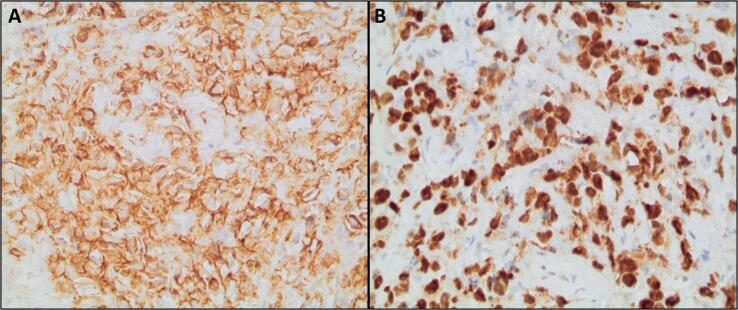
Angiosarcomas are uncommon malignant mesenchymal neoplasms of endothelial origin. They may be primary or secondary to radiation exposure, chronic lymphedema or to other associated risk factors. They can occur anywhere in the body, with the most common location being the skin of the head and neck. Radiation-induced angiosarcomas of the gynecologic tract are very rare with only few cases reported in the literature. We report a case of a 54-year-old lady who developed angiosarcoma of the vagina and vulva 9 years following radiotherapy for cervical cancer. She was treated with chemoradiotherapy and died nine months following the diagnosis of angiosarcoma. We also performed a literature review of the radiation-induced angiosarcomas arising in the vagina and vulva. Angiosarcomas should always be considered in the differential diagnosis when dealing with a tumor located in a previously irradiated area, as they may clinically mimic recurrence of the original tumor the patient had.
血管肉瘤是一种罕见的起源于内皮的恶性间叶性肿瘤。它们可以是原发性的,也可以继发于辐射暴露、慢性淋巴水肿或其他相关危险因素。它们可发生于身体的任何部位,最常见的部位是头颈部皮肤。妇科放疗诱导的血管肉瘤非常罕见,文献中仅有少数病例报道。我们报告一例54岁女性,在宫颈癌放疗9年后发生阴道和外阴血管肉瘤。她接受了放化疗,在血管肉瘤诊断后9个月死亡。我们还对阴道和外阴发生的放疗诱导血管肉瘤进行了文献综述。当处理位于先前放疗区域的肿瘤时,鉴别诊断中应始终考虑血管肉瘤,因为它们在临床上可能类似于患者原来肿瘤的复发。