Esrafili Mehdi D, Heydari Safa
Department of Chemistry, Faculty of Basic Sciences, University of Maragheh P. O. Box 55136-553 Maragheh Iran
RSC Adv. 2019 Nov 27;9(67):38973-38981. doi: 10.1039/c9ra05759e.
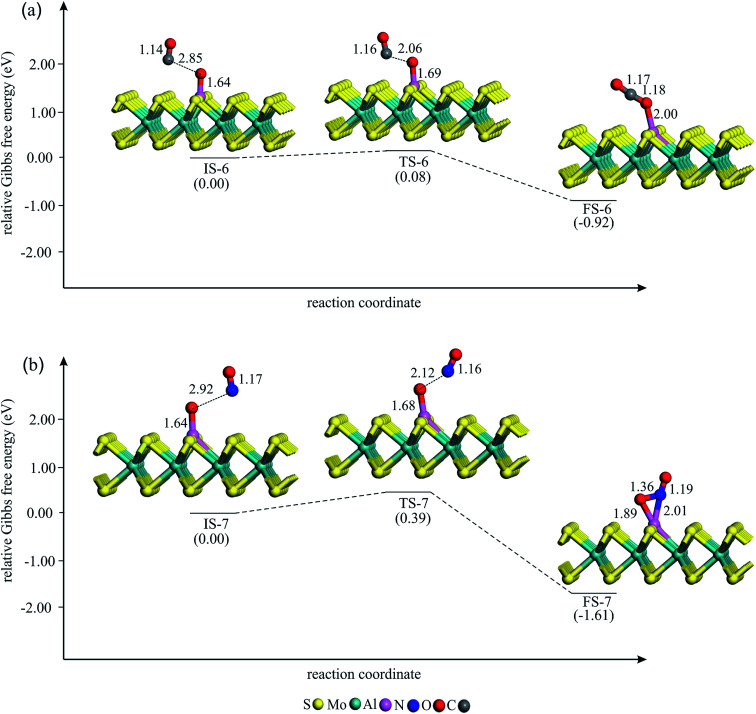
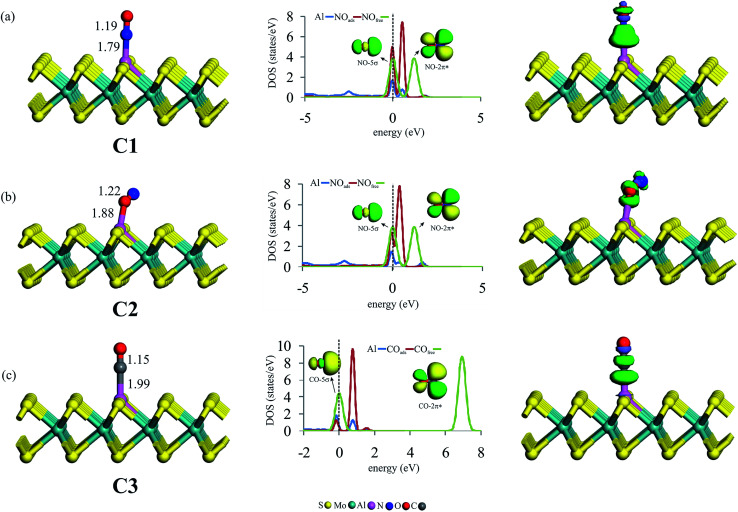
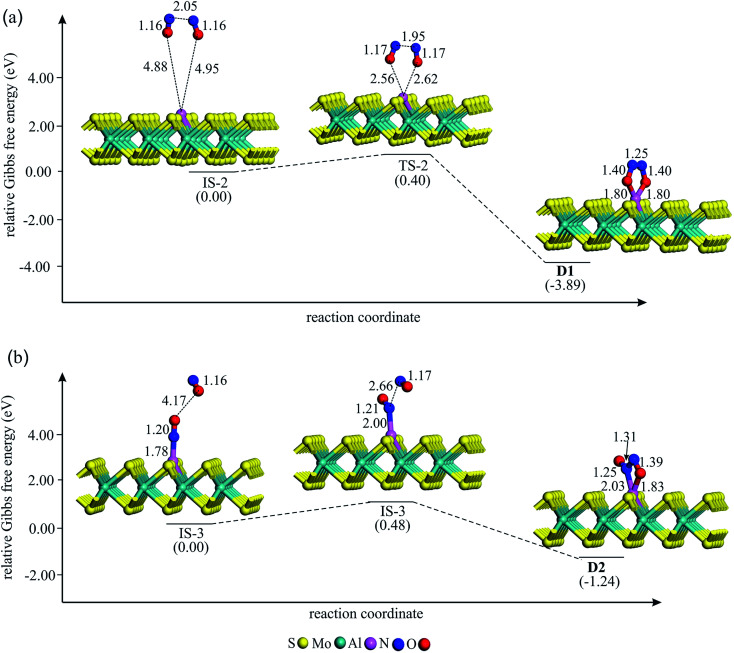
Converting toxic air pollutants such as nitric oxide (NO) and carbon monoxide (CO) into less harmful gases remains a critical challenge for many industrial technologies. Here, by performing first-principles calculations, we introduce a cheap, stable and novel catalyst for the conversion of NO and CO molecules into NO and CO using Al-doped MoS (Al-MoS). According to our results, dissociation of NO molecules on Al-MoS has a large energy barrier (3.62 eV), suggesting that it is impossible at ambient temperature. In contrast, the coadsorption of NO molecules to form (NO) moieties is characterized as the first step of the NO reduction process. The formed (NO) is unstable on Al-MoS, and hence it is easily decomposed into NO molecules, and an oxygen atom is adsorbed onto the Al atom (O). This reaction step is exothermic and needs an activation energy of 0.37 eV to be overcome. Next, the O moiety is removed from the Al atom by a CO molecule, and thereby the Al-MoS catalyst is recovered for the next round of reaction. The side reaction producing NO the reaction of NO with the O moiety cannot proceed on Al-MoS due to its large activation energy.
将有毒空气污染物,如一氧化氮(NO)和一氧化碳(CO)转化为危害较小的气体,对许多工业技术来说仍然是一项严峻挑战。在此,通过进行第一性原理计算,我们引入了一种廉价、稳定且新颖的催化剂,用于将NO和CO分子转化为NO和CO,即铝掺杂的二硫化钼(Al-MoS)。根据我们的结果,NO分子在Al-MoS上的解离具有较大的能垒(3.62电子伏特),这表明在环境温度下是不可能发生的。相比之下,NO分子共吸附形成(NO)基团被认为是NO还原过程的第一步。在Al-MoS上形成的(NO)不稳定,因此很容易分解成NO分子,并且一个氧原子吸附到铝原子上(O)。这一反应步骤是放热的,需要克服0.37电子伏特的活化能。接下来,O基团被一个CO分子从铝原子上移除,从而使Al-MoS催化剂得以回收用于下一轮反应。由于其较大的活化能,产生NO的副反应——NO与O基团的反应在Al-MoS上无法进行。