Lee Joon Young, Ahn Jun Ki, Park Ki Soo, Park Hyun Gyu
Department of Chemical and Biomolecular Engineering (BK 21+ Program), KAIST Daehak-ro 291, Yuseong-gu Daejeon 305-338 Republic of Korea
Department of Biological Engineering, College of Engineering, Konkuk University Seoul 05029 Republic of Korea.
RSC Adv. 2018 Mar 21;8(20):11241-11246. doi: 10.1039/c7ra13642k. eCollection 2018 Mar 16.
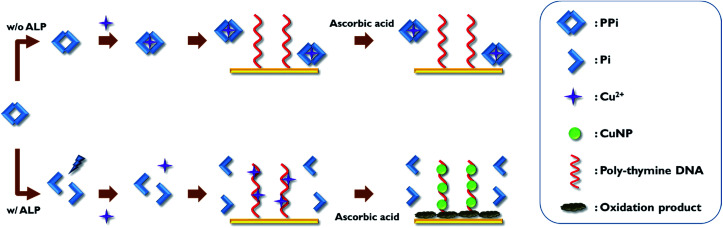
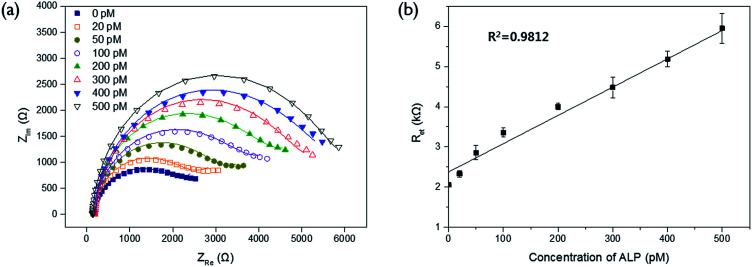
We herein describe a novel impedimetric method to determine alkaline phosphatase (ALP) activity based on the Cu-mediated oxidation of ascorbic acid on a specific DNA probe-modified electrode. In this method, pyrophosphate (PPi) capable of complexing with Cu is employed as a substrate of the ALP enzyme. In the presence of ALP, PPi is hydrolyzed to phosphate (Pi), which is not able to entrap Cu. The free Cu are specifically bound to a poly-thymine DNA probe immobilized on the electrode surface and reduced to form copper nanoparticles by a concomitant oxidation of ascorbic acid. As a result, the oxidation products of ascorbic acid are accumulated on the electrode surface, which consequently increase electron transfer resistance ( ) by interrupting the electron transfer on the electrode. On the other hand, in the absence of ALP, PPi remains intact to effectively capture Cu, consequently preventing the oxidation of ascorbic acid and the subsequent increase of . Based on this design principle, the change in , which is proportional to ALP activity, was measured by electrochemical impedance spectroscopy (EIS) and ALP activities were successfully determined down to 6.5 pM (7.2 U L) with excellent selectivity.
我们在此描述了一种基于特定DNA探针修饰电极上铜介导的抗坏血酸氧化来测定碱性磷酸酶(ALP)活性的新型阻抗测定方法。在该方法中,能够与铜络合的焦磷酸(PPi)被用作ALP酶的底物。在ALP存在的情况下,PPi水解为磷酸盐(Pi),而Pi无法捕获铜。游离的铜特异性地结合到固定在电极表面的聚胸腺嘧啶DNA探针上,并通过抗坏血酸的伴随氧化还原为铜纳米颗粒。结果,抗坏血酸的氧化产物在电极表面积累,从而通过中断电极上的电子转移增加电子转移电阻( )。另一方面,在没有ALP的情况下,PPi保持完整以有效捕获铜,从而防止抗坏血酸的氧化和随后 的增加。基于这一设计原理,通过电化学阻抗谱(EIS)测量与ALP活性成比例的 的变化,并成功测定了低至6.5 pM(7.2 U/L)的ALP活性,具有出色的选择性。