Nie Jinlin, Schneider Jenny, Sieland Fabian, Zhou Long, Xia Shuwei, Bahnemann Detlef W
Key Laboratory of Marine Chemistry Theory and Technology, Ministry of Education, College of Chemistry and Chemical Engineering, Ocean University of China Songling Road 238 266100 Qingdao China
Institut für Technische Chemie, Leibniz Universität Hannover Callinstr. 3 D-30167 Hannover Germany
RSC Adv. 2018 Jul 19;8(46):25881-25887. doi: 10.1039/c8ra05450a.
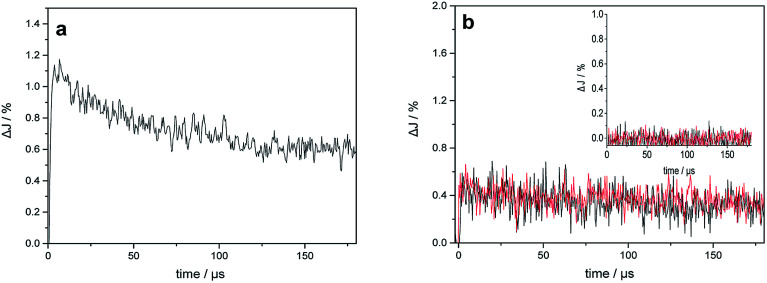
The Surface Plasmon Resonance (SPR) driven photocatalytic H production upon visible light illumination (≥500 nm) was investigated on gold-loaded TiO (Au-TiO). It has been clearly shown that the Au-SPR can directly lead to photocatalytic H evolution under illumination (≥500 nm). However, there are still some open issues about the underlying mechanism for the SPR-driven photocatalytic H production, especially the explanation of the resonance energy transfer (RET) theory and the direct electron transfer (DET) theory. In this contribution, by means of the EPR and laser flash photolysis spectroscopy, we clearly showed the signals for different species formed by trapped electrons and holes in TiO upon visible light illumination (≥500 nm). However, the energy of the Au-SPR is insufficient to overcome the bandgap of TiO. The signals of the trapped electrons and holes originate from two distinct processes, rather than the simple electron-hole pair excitation. Results obtained by Laser Flash Photolysis spectroscopy evidenced that, due to the Au-SPR effect, Au NPs can inject electrons to the conduction band of TiO and the Au-SPR can also initiate e/h pair generation (interfacial charge transfer process) upon visible light illumination (≥500 nm). Moreover, the Density Functional Theory (DFT) calculation provided direct evidence that, due to the Au-SPR, new impurity energy levels occurred, thus further theoretically elaborating the proposed mechanisms.
在负载金的二氧化钛(Au-TiO₂)上研究了表面等离子体共振(SPR)驱动的可见光(≥500 nm)照射下的光催化产氢。已经清楚地表明,Au-SPR在光照(≥500 nm)下可直接导致光催化析氢。然而,关于SPR驱动的光催化产氢的潜在机制仍存在一些未解决的问题,特别是对共振能量转移(RET)理论和直接电子转移(DET)理论的解释。在本论文中,通过电子顺磁共振(EPR)和激光闪光光解光谱,我们清楚地展示了在可见光(≥500 nm)照射下TiO₂中由捕获的电子和空穴形成的不同物种的信号。然而,Au-SPR的能量不足以克服TiO₂的带隙。捕获的电子和空穴的信号源自两个不同的过程,而不是简单的电子 - 空穴对激发。激光闪光光解光谱获得的结果证明,由于Au-SPR效应,Au纳米颗粒可以将电子注入到TiO₂的导带中,并且Au-SPR在可见光(≥500 nm)照射下也可以引发电子/空穴对的产生(界面电荷转移过程)。此外,密度泛函理论(DFT)计算提供了直接证据,表明由于Au-SPR,出现了新的杂质能级,从而进一步从理论上阐述了所提出的机制。