Zhao Shuai, Xie Shicheng, Sun Peipei, Zhao Zheng, Li Lin, Shao Xiaoming, Liu Xiaolin, Xin Zhenxiang
Key Laboratory of Rubber-Plastics, Ministry of Education, Shandong Provincial Key Laboratory of Rubber-Plastics, School of Polymer Science and Engineering, Qingdao University of Science and Technology Qingdao 266042 China
RSC Adv. 2018 May 16;8(32):17813-17825. doi: 10.1039/c8ra01659c. eCollection 2018 May 14.
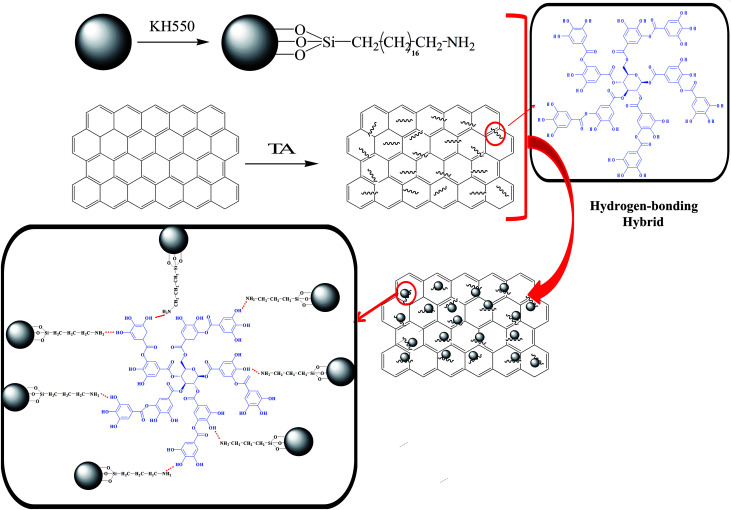
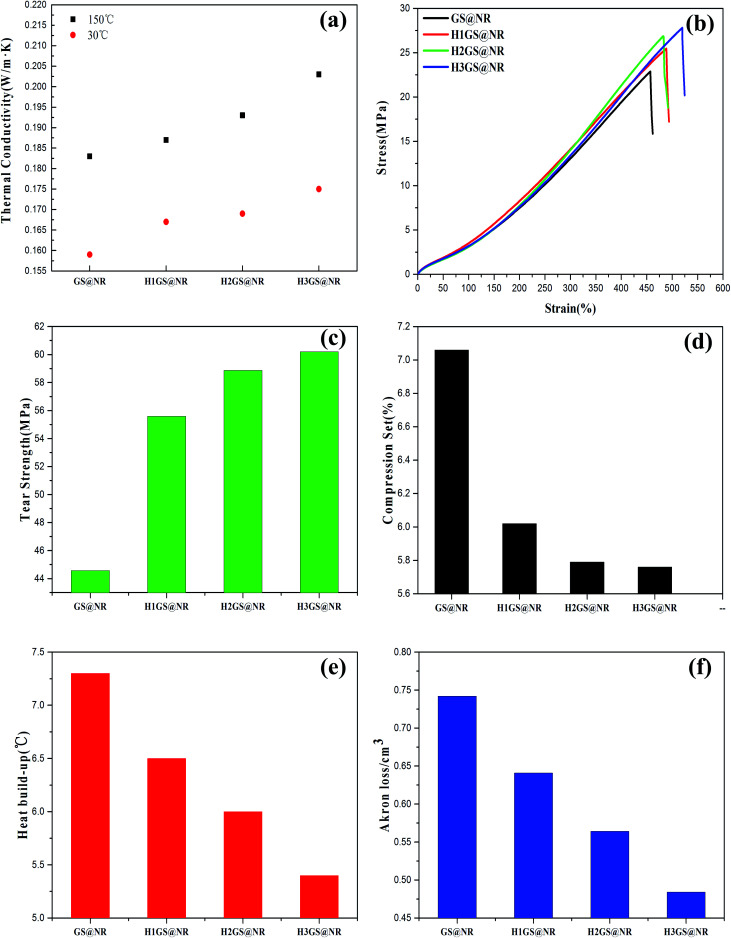
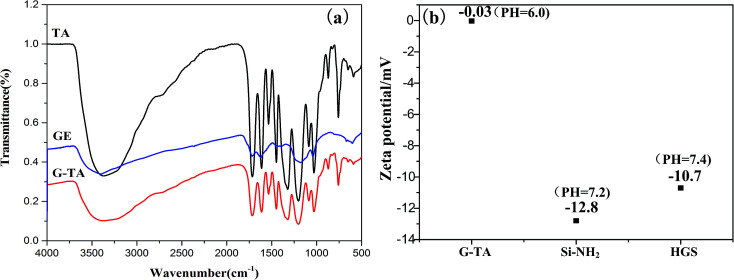
A novel graphene-silicon dioxide hybrid (HGS) was prepared by plant polyphenol-tannic acid (TA) functionalized pristine graphene (G-TA) and primary amine-containing silane coupling agent modified SiO (Si-NH). Through strong hydrogen-bonding interaction between the phenolic hydroxyl groups on G-TA and primary amine groups on Si-NH, SiO was uniformly loaded to the surface of graphene. Due to the synergistic dispersion effect of graphene and SiO, which prevents restacking and re-aggregating of both graphene and SiO, HGS hybrids were distributed evenly in the natural rubber (NR) matrix (HGS@NR). Simultaneously, the surface roughness of graphene after loading SiO and the interfacial interaction between the HGS hybrid and NR matrix were substantially improved. Due to the good dispersion and strong interface, the overall properties of HGS@NR nanocomposites are drastically enhanced compared with those of GS@NR nanocomposites prepared by dispersing the blend of unmodified graphene and SiO (GS) in NR. The HGS@NR nanocomposites possess the highest tensile strength up to 27.8 MPa at 0.5 wt% and tear strength of 60.2 MPa at 0.5 wt%. Thermal conductivities of the HGS@NR nanocomposites were found to be 1.5-fold better than that of the GS@NR nanocomposites. Also, the HGS@NR nanocomposites exhibit excellent abrasive resistant capacity that is nearly 2-fold better than that of the GS@NR nanocomposites. These results suggest that HGS has great potential in high-performance nanocomposites and a new strategy of constructing the efficient graphene-SiO hybrid fillers has been established.
通过植物多酚 - 单宁酸(TA)功能化的原始石墨烯(G - TA)和含伯胺的硅烷偶联剂改性的SiO₂(Si - NH₂)制备了一种新型的石墨烯 - 二氧化硅杂化材料(HGS)。通过G - TA上的酚羟基与Si - NH₂上的伯胺基团之间的强氢键相互作用,SiO₂被均匀地负载到石墨烯表面。由于石墨烯和SiO₂的协同分散作用,可防止石墨烯和SiO₂的重新堆叠和再聚集,HGS杂化材料均匀分布在天然橡胶(NR)基体中(HGS@NR)。同时,负载SiO₂后石墨烯的表面粗糙度以及HGS杂化材料与NR基体之间的界面相互作用得到显著改善。由于良好的分散性和强界面作用,与通过将未改性的石墨烯和SiO₂的混合物(GS)分散在NR中制备的GS@NR纳米复合材料相比,HGS@NR纳米复合材料的整体性能得到大幅提高。HGS@NR纳米复合材料在0.5 wt%时具有高达27.8 MPa的最高拉伸强度和60.2 MPa的撕裂强度。发现HGS@NR纳米复合材料的热导率比GS@NR纳米复合材料高1.5倍。此外,HGS@NR纳米复合材料表现出优异的耐磨性能,比GS@NR纳米复合材料高出近2倍。这些结果表明,HGS在高性能纳米复合材料方面具有巨大潜力,并且已经建立了一种构建高效石墨烯 - SiO₂杂化填料的新策略。