Fu Shaobin, Meng Qingfeng, Yang Junshan, Tu Jiajia, Sun Di-An
Institute of Medical Plant Development, Chinese Academy of Medical Sciences, Peking Union Medical College Beijing 100193 China
Pharmacy School of Zunyi Medical University Zunyi 563000 China.
RSC Adv. 2018 May 3;8(29):16400-16405. doi: 10.1039/c8ra01217b. eCollection 2018 Apr 27.
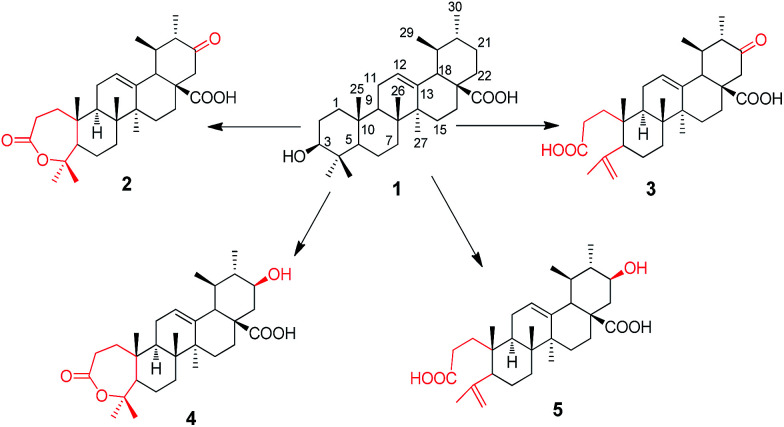
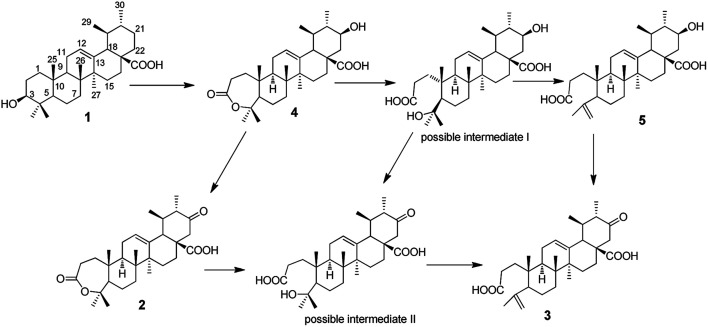
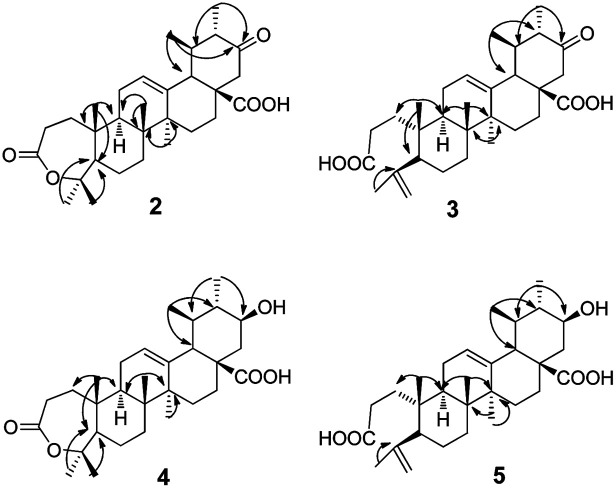
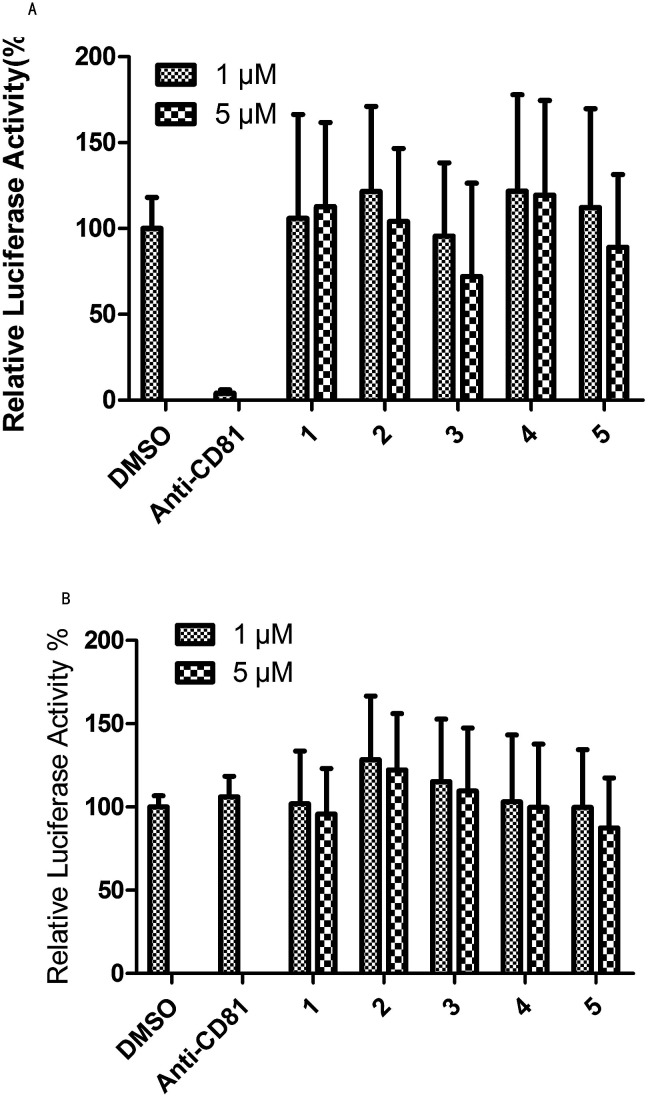
Biocatalysis of ursolic acid (UA 1) by CGMCC 3.3657 was investigated. Baeyer-Villiger oxidation was found to occur during the reaction. Four metabolites were isolated from the cultures and their structures were identified as 21-oxo,A-homo-3-oxa-urs-12-en-3-one-28-oic acid (2), 21-oxo-3,4-seco-ursan-4(23),12-dien-3,28-dioic acid (3), 21β-hydroxyl-A-homo-3-oxa-urs-12-en-3-one-28-oic acid (4) and 21β-hydroxyl-3,4-seco-ursan-4(23),12-dien-3,28-dioic acid (5), based on their NMR and MS spectral data. All of the four metabolites were new and their anti-HCV activity was tested. Their biotransformation pathway was also proposed.
研究了CGMCC 3.3657对熊果酸(UA 1)的生物催化作用。发现反应过程中发生了拜耳-维利格氧化反应。从培养物中分离出四种代谢产物,根据它们的核磁共振(NMR)和质谱(MS)光谱数据,其结构被鉴定为21-氧代-A-高-3-氧杂-乌苏-12-烯-3-酮-28-酸(2)、21-氧代-3,4-裂环乌苏烷-4(23),12-二烯-3,28-二酸(3)、21β-羟基-A-高-3-氧杂-乌苏-12-烯-3-酮-28-酸(4)和21β-羟基-3,4-裂环乌苏烷-4(23),12-二烯-3,28-二酸(5)。这四种代谢产物均为新化合物,并对其抗丙型肝炎病毒(HCV)活性进行了测试。还提出了它们的生物转化途径。