Zhao Guo, Wang Hui, Liu Gang
Key Lab of Modern Precision Agriculture System Integration Research, Ministry of Education of China, China Agricultural University Beijing 100083 P. R. China
Key Lab of Agricultural Information Acquisition Technology, Ministry of Agricultural of China, China Agricultural University Beijing 100083 P. R. China.
RSC Adv. 2018 Jan 30;8(10):5079-5089. doi: 10.1039/c7ra12767g. eCollection 2018 Jan 29.
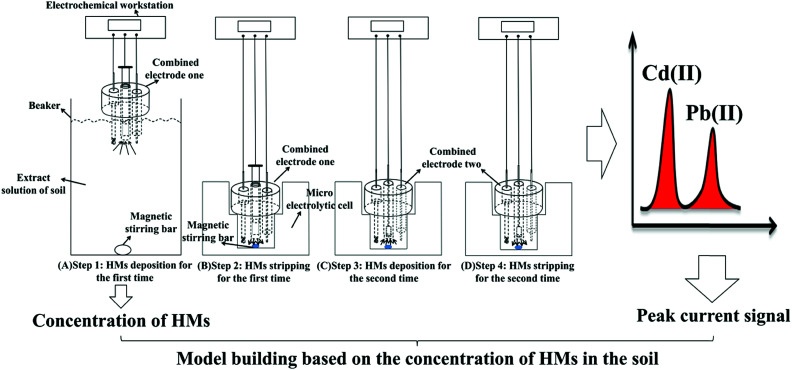
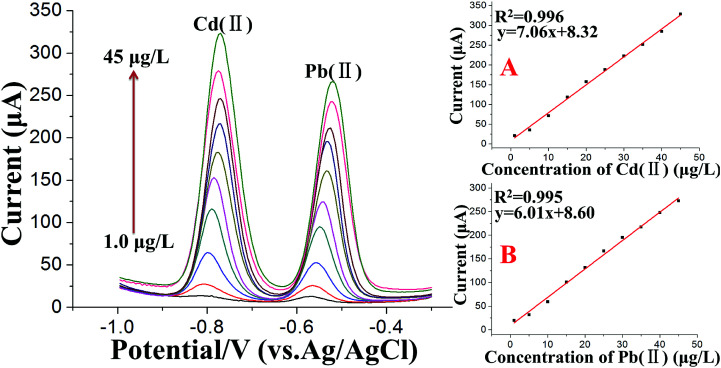
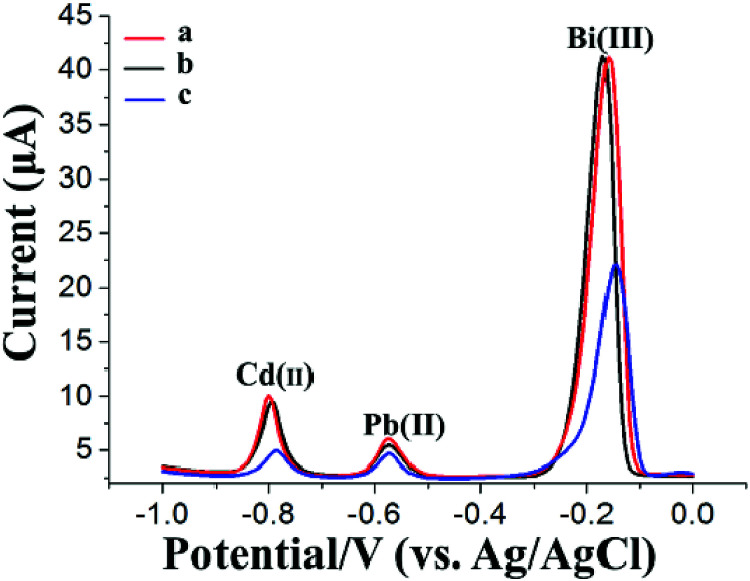
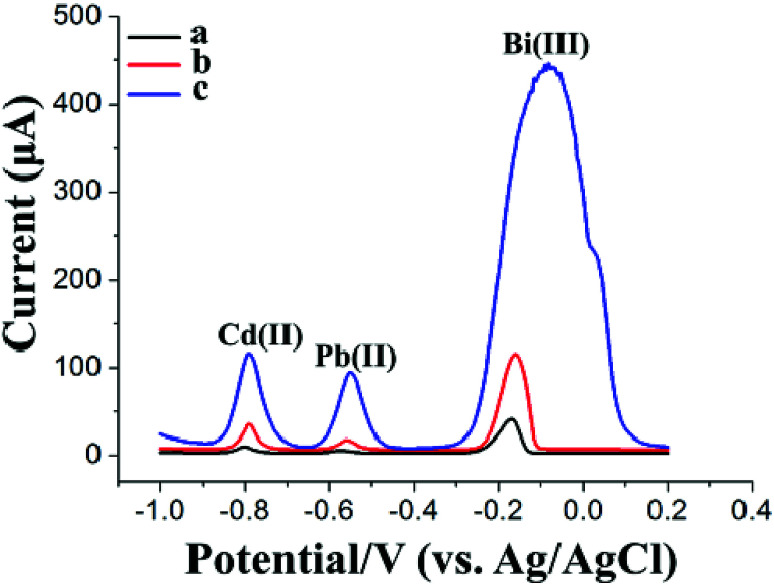
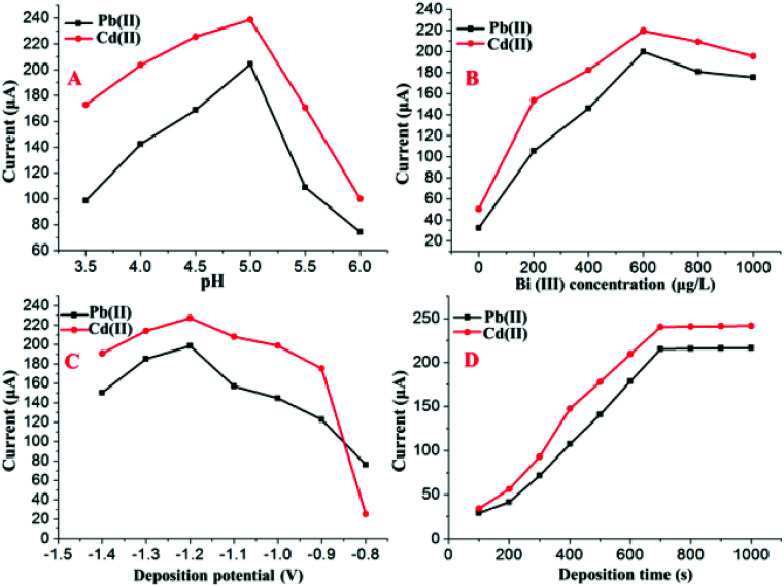
In this study, a simple but effective electrochemical method was developed to minimize the interference from real soil samples and increase the sensitivity of Pb(ii) and Cd(ii) detection by square-wave anodic stripping voltammetry (SWASV) using a novel electrochemical measurement system, which can be used for the on-site determination of trace Cd(ii) and Pb(ii) in real soil samples. The method involved performing SWASV following double deposition and stripping steps at two plated bismuth-film electrodes with drastically different surface properties. Pb(ii) and Cd(ii) were first deposited on an plated bismuth-film graphite carbon paste electrode (Bi/GCPE). When the first deposition was finished, the GCPE was moved to a micro-electrolytic cell to perform the first stripping step. The following measurements were performed with the other deposition and stripping steps using a highly sensitive plated bismuth-film multiwalled carbon nanotube-Nafion composite modified glassy carbon electrode (Bi/MWCNT-Nafion/GCE) as the working electrode. Pb(ii), Cd(ii) and Bi(iii) stripped from the GCPE in the micro-electrolytic cell were partially deposited on the MWCNT-Nafion/GCE, and the stripping current signals were obtained from their oxidation during the second stripping step. Considering the small volume of the micro-electrolytic cell, the concentrations of Cd(ii) and Pb(ii) were drastically higher than those in the bulk solution, and therefore, the detection limits were reduced. Under the optimized conditions, the concentrations in the linear range spanned from 1.0 to 45.0 μg L for both Pb(ii) and Cd(ii), with a detection limit of 0.03 μg L for Pb(ii) and 0.02 μg L for Cd(ii) (S/N = 3). Finally, analyses of real samples were performed to detect trace levels of Pb(ii) and Cd(ii) in soil with satisfactory results.
在本研究中,开发了一种简单但有效的电化学方法,以最小化来自实际土壤样品的干扰,并使用新型电化学测量系统通过方波阳极溶出伏安法(SWASV)提高Pb(II)和Cd(II)检测的灵敏度,该系统可用于现场测定实际土壤样品中的痕量Cd(II)和Pb(II)。该方法包括在两个具有截然不同表面性质的镀铋膜电极上进行双沉积和溶出步骤后进行SWASV。Pb(II)和Cd(II)首先沉积在镀铋膜石墨碳糊电极(Bi/GCPE)上。当第一次沉积完成后,将GCPE移至微电解池进行第一次溶出步骤。随后的测量使用高度灵敏的镀铋膜多壁碳纳米管-Nafion复合修饰玻碳电极(Bi/MWCNT-Nafion/GCE)作为工作电极进行其他沉积和溶出步骤。从微电解池中的GCPE上溶出的Pb(II)、Cd(II)和Bi(III)部分沉积在MWCNT-Nafion/GCE上,并在第二次溶出步骤中通过它们的氧化获得溶出电流信号。考虑到微电解池的体积小,Cd(II)和Pb(II)的浓度比本体溶液中的浓度高得多,因此检测限降低。在优化条件下,Pb(II)和Cd(II)的线性范围浓度均为1.0至45.0 μg/L,Pb(II)的检测限为0.03 μg/L,Cd(II)的检测限为0.02 μg/L(S/N = 3)。最后,对实际样品进行分析以检测土壤中痕量的Pb(II)和Cd(II),结果令人满意。