Pernak Juliusz, Łęgosz Bartosz, Klejdysz Tomasz, Marcinkowska Katarzyna, Rogowski Jacek, Kurasiak-Popowska Danuta, Stuper-Szablewska Kinga
Poznan Univeristy of Technology, Faculty of Chemical Technology Berdychowo 4 60-965 Poznań Poland
Institute of Plant Protection - National Research Institute Węgorka 20 60-101 Poznań Poland.
RSC Adv. 2018 Aug 13;8(50):28676-28683. doi: 10.1039/c8ra03519a. eCollection 2018 Aug 7.
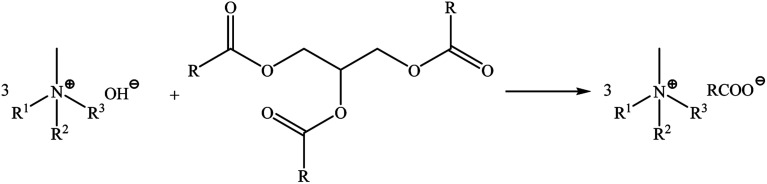
Third generation bio-ionic liquids (bio-ILs) were synthesized based on cheap and increasingly available camelina oil. The ionic liquids were obtained with high yield based on the reaction between camelina oil, which contained the following carboxylic acids: C18:3ω-3 linolenic >30%, C20:1 eicosenoic 28%, C18:2ω-6 linoleic 13%, C18:1 oleic 13%, C16:0 palmitic 4.5%, C22:1 erucic 4.5% and C18:0 stearic 2.5%, and quaternary ammonium hydroxides comprising cations such as: choline, di(hydrogenated tallow)dimethylammonium, oleylmethylbis(2-hydroxyethyl)ammonium, benzalkonium, tetradecyltrimethylammonium, tetramethylammonium and didecyldimethylammonium. The synthesized bio-ILs were characterized as high viscosity liquids which are thermally stable and their solubility in water and organic solvents depended on the type of cation. Two extreme examples of bio-ILs include the water soluble one comprising choline as the cation and the one comprising the di(hydrogenated tallow)dimethylammonium cation, which is soluble in hexane. The presented results show the importance of ammonium bio-ILs as antifeedants with a wide spectrum of activity. The tested beetles (Insecta: Coleoptera) of storage pests: grain weevil ( (L.)), confused flour beetle ( Duv.) and khapra beetle ( Ev.) presented notable differences in terms of susceptibility to the synthesized ILs. The synthesized bio-ILs are effective adjuvants for herbicides belonging to the sylfonylurea group. They exhibited high activity despite the fact they were applied at a dose almost half that used for commercial adjuvants, which opens the era of adjuvant ILs. Aside from its use in the production of biodiesel, renewable diesel and renewable jet fuel, camelina oil is starting to become a potential resource for the production of novel agrochemicals.
第三代生物离子液体(生物离子液体)是基于廉价且日益可得的亚麻荠油合成的。这些离子液体是通过亚麻荠油与季铵氢氧化物之间的反应高产获得的,亚麻荠油含有以下羧酸:C18:3ω-3亚麻酸>30%、C20:1二十碳烯酸28%、C18:2ω-6亚油酸13%、C18:1油酸13%、C16:0棕榈酸4.5%、C22:1芥酸4.5%和C18:0硬脂酸2.5%,季铵氢氧化物包含的阳离子如:胆碱、二(氢化牛脂)二甲基铵、油基甲基双(2-羟乙基)铵、苯扎氯铵、十四烷基三甲基铵、四甲基铵和二癸基二甲基铵。合成的生物离子液体被表征为具有热稳定性的高粘度液体,其在水和有机溶剂中的溶解度取决于阳离子类型。生物离子液体的两个极端例子包括以胆碱为阳离子的水溶性生物离子液体和以二(氢化牛脂)二甲基铵阳离子为成分且可溶于己烷的生物离子液体。所呈现的结果表明铵基生物离子液体作为具有广泛活性的拒食剂的重要性。所测试的储存害虫甲虫(昆虫纲:鞘翅目):谷象((L.))、赤拟谷盗(Duv.)和谷斑皮蠹(Ev.)在对合成离子液体的敏感性方面表现出显著差异。合成的生物离子液体是属于磺酰脲类除草剂的有效助剂。尽管它们的施用量几乎是商业助剂用量的一半,但仍表现出高活性,这开启了助剂离子液体的时代。除了用于生产生物柴油、可再生柴油和可再生喷气燃料外,亚麻荠油正开始成为生产新型农用化学品的潜在资源。