Bibi Rehana, Shen Quanhao, Wei Lingfei, Hao Dandan, Li Naixu, Zhou Jiancheng
School of Chemistry and Chemical Engineering, Southeast University Nanjing 211189 P. R. China
Department of Chemical and Pharmaceutical Engineering, Southeast University, Chengxian College Nanjing 210088 P. R. China.
RSC Adv. 2018 Jan 9;8(4):2048-2058. doi: 10.1039/c7ra11500h. eCollection 2018 Jan 5.
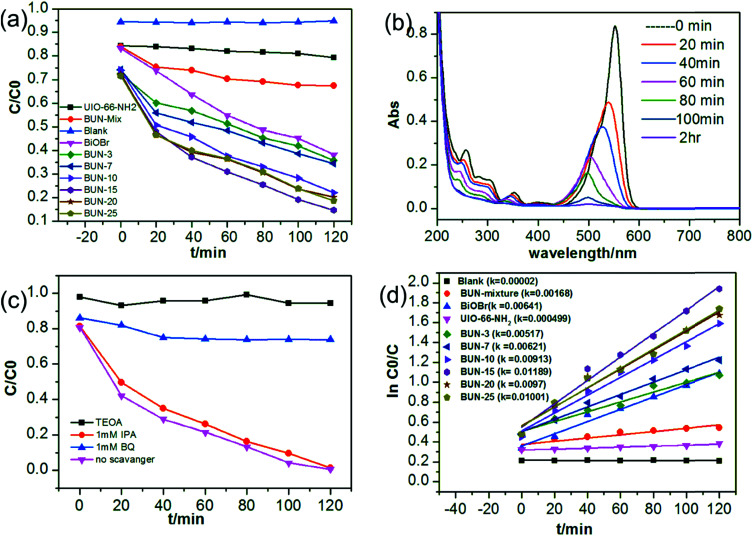
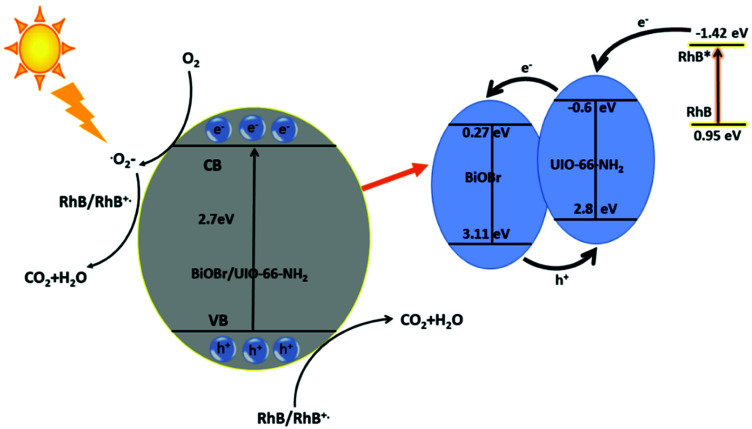
Metal-organic framework (MOFs) based composites have received more research interest for photocatalytic applications during recent years. In this work, a highly active, visible light photocatalyst BiOBr/UiO-66-NH hybrid composite was successfully prepared by introducing various amounts of UiO-66-NH with BiOBr through a co-precipitation method. The composites were applied for the photocatalytic degradation of RhB (rhodamine B) dye. The developed BiOBr/UiO-66-NH composites exhibited higher photocatalytic activity than the pristine material. In RhB degradation experiments the hybrid composite with 15 wt% of UiO-66-NH shows degradation efficiency conversion of 83% within two hours under visible light irradiation. The high photodegradation efficiency of BUN-15 could be ascribed to efficient interfacial charge transfer at the heterojunction and the synergistic effect between BiOBr/UiO-66-NH. In addition, an active species trapping experiment confirmed that photo-generated hole and O radicals are the major species involved in RhB degradation under visible light.
近年来,基于金属有机框架(MOFs)的复合材料在光催化应用方面受到了更多的研究关注。在本工作中,通过共沉淀法将不同量的UiO-66-NH与BiOBr引入,成功制备了一种高活性的可见光光催化剂BiOBr/UiO-66-NH杂化复合材料。该复合材料用于光催化降解罗丹明B(RhB)染料。所制备的BiOBr/UiO-66-NH复合材料表现出比原始材料更高的光催化活性。在RhB降解实验中,含15 wt% UiO-66-NH的杂化复合材料在可见光照射下两小时内的降解效率转化率达83%。BUN-15的高光降解效率可归因于异质结处有效的界面电荷转移以及BiOBr/UiO-66-NH之间的协同效应。此外,活性物种捕获实验证实,光生空穴和O自由基是可见光下参与RhB降解的主要物种。