Yue Liang, Rao Huashang, Du Jun, Pan Zhenxiao, Yu Juan, Zhong Xinhua
School of Chemistry and Molecular Engineering, East China University of Science and Technology Shanghai 200237 China
College of Materials and Energy, South China Agricultural University 483 Wushan Road Guangzhou 510642 China
RSC Adv. 2018 Jan 18;8(7):3637-3645. doi: 10.1039/c7ra12321c. eCollection 2018 Jan 16.
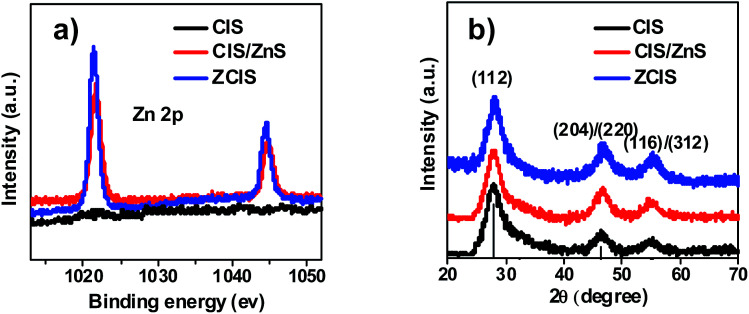
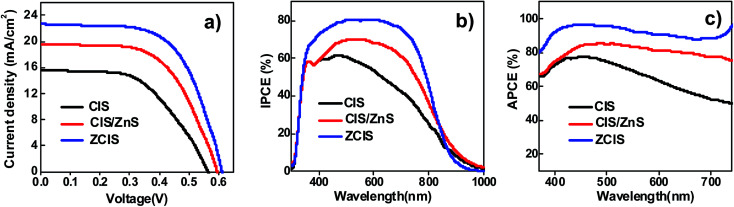
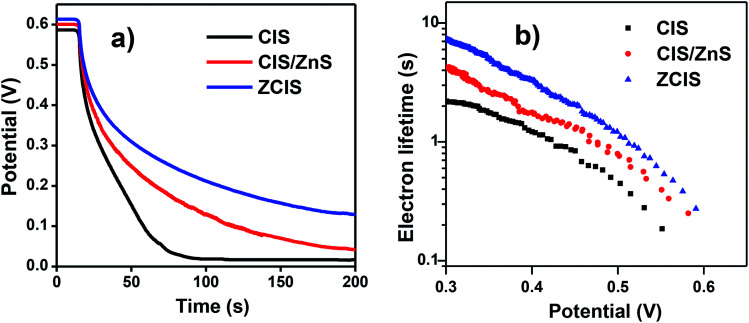
Alloyed structures of quantum dot light-harvesting materials favor the suppression of unwanted charge recombination as well as acceleration of the charge extraction and therefore the improvement of photovoltaic performance of the resulting solar cell devices. Herein, the advantages of Zn-Cu-In-S (ZCIS) alloy QD serving as light-harvesting sensitizer materials in the construction of quantum dot-sensitized solar cells (QDSCs) were compared with core/shell structured CIS/ZnS, as well as pristine CIS QDs. The built QDSCs with alloyed Zn-Cu-In-S QDs as photosensitizer achieved an average power conversion efficiency (PCE) of 8.47% ( = 0.613 V, = 22.62 mA cm, FF = 0.610) under AM 1.5G one sun irradiation, which was enhanced by 21%, and 82% in comparison to those of CIS/ZnS, and CIS based solar cells, respectively. In comparison to cell device assembled by the plain CIS and core/shell structured CIS/ZnS, the enhanced photovoltaic performance in ZCIS QDSCs is mainly ascribed to the faster photon generated electron injection rate from QD into TiO substrate, and the effective restraint of charge recombination, as confirmed by incident photon-to-current conversion efficiency (IPCE), open-circuit voltage decay (OCVD), as well as electrochemical impedance spectroscopy (EIS) measurements.
量子点光捕获材料的合金结构有利于抑制不必要的电荷复合以及加速电荷提取,从而提高所得太阳能电池器件的光伏性能。在此,将作为光捕获敏化剂材料的Zn-Cu-In-S(ZCIS)合金量子点在量子点敏化太阳能电池(QDSC)构建中的优势与核/壳结构的CIS/ZnS以及原始CIS量子点进行了比较。以合金化的Zn-Cu-In-S量子点作为光敏剂构建的QDSC在AM 1.5G一个太阳光照下实现了8.47%的平均功率转换效率(PCE)( = 0.613 V, = 22.62 mA cm,FF = 0.610),与基于CIS/ZnS和CIS的太阳能电池相比,分别提高了21%和82%。与由普通CIS和核/壳结构的CIS/ZnS组装的电池器件相比,ZCIS QDSC中光伏性能的提高主要归因于从量子点到TiO基底的更快的光子产生电子注入速率以及电荷复合的有效抑制,这通过入射光子到电流转换效率(IPCE)、开路电压衰减(OCVD)以及电化学阻抗谱(EIS)测量得到证实。