Department of Thoracic Surgery/Oncology, China State Key Laboratory of Respiratory Disease & National Clinical Research Center for Respiratory Disease, the First Affiliated Hospital of Guangzhou Medical University, Guangzhou, China.
Department of General Internal Medicine, Sun Yat-sen University Cancer Centre, State Key Laboratory of Oncology in South China, Collaborative Innovation Centre for Cancer Medicine, Guangzhou, China.
Cancer Med. 2022 Aug;11(16):3115-3125. doi: 10.1002/cam4.4676. Epub 2022 May 11.
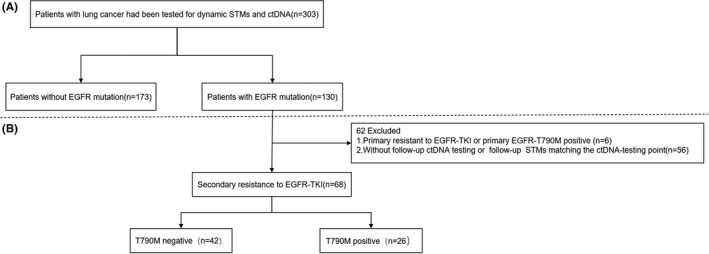
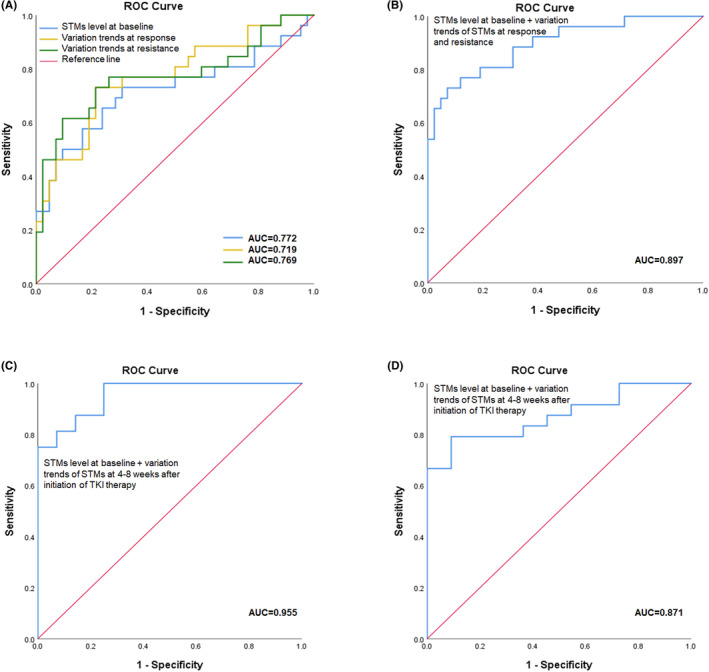
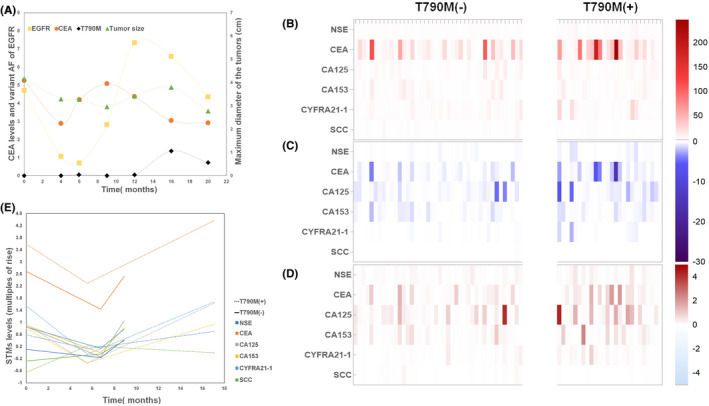
To reveal the correlation of dynamic serum tumor markers (STMs) and molecular features of epidermal growth factor receptor-mutated (EGFR-mutated) lung cancer during targeted therapy, we retrospectively reviewed 303 lung cancer patients who underwent dynamic STM tests [neuron-specific enolase (NSE), carcinoembryonic antigen (CEA), carbohydrate antigen 125 (CA125), carbohydrate antigen 153 (CA153), the soluble fragment of cytokeratin 19 (CYFRA21-1), and squamous cell carcinoma antigen (SCC)] and circulating tumor DNA (ctDNA) testing with a panel covering 168 genes. At baseline, patients with EGFR mutation trended to have abnormal CEA, abnormal CA153, and normal SCC levels. Additionally, patients with Thr790Met (T790M) mutation were more likely to have abnormal CEA levels than patients without T790M mutation. Among patients with secondary resistance to EGFR tyrosine kinase inhibitors (TKI), the dynamic STMs showed a descending trend in the responsive stage and a rising trend in the resistant stage. However, the changing slopes differed between T790M subgroup and the non-T790M subgroup in individual STMs. Our study demonstrated that the combination of baseline levels and variations of STMs (including the responsive stage and resistant stage) can be suggestive of secondary EGFR-T790M mutation [area under the curve (AUC) = 0.897] and that changing trends of STMs (within 8 weeks after initiating the TKI therapy) can be potential predictors for the clearance of EGFR ctDNA [AUC = 0.871]. In conclusion, dynamic monitoring STMs can help to predict the molecular features of EGFR-mutated lung cancer during targeted therapy.
为了揭示靶向治疗期间动态血清肿瘤标志物(STM)与表皮生长因子受体突变(EGFR 突变)肺癌分子特征的相关性,我们回顾性分析了 303 例接受动态 STM 测试[神经元特异性烯醇化酶(NSE)、癌胚抗原(CEA)、糖类抗原 125(CA125)、糖类抗原 153(CA153)、细胞角蛋白 19 的可溶性片段(CYFRA21-1)和鳞状细胞癌抗原(SCC)]和循环肿瘤 DNA(ctDNA)检测的肺癌患者,检测panel 涵盖了 168 个基因。在基线时,EGFR 突变患者的 CEA、CA153 异常,SCC 正常。此外,伴有 Thr790Met(T790M)突变的患者比无 T790M 突变的患者更有可能出现 CEA 水平异常。在 EGFR 酪氨酸激酶抑制剂(TKI)继发耐药的患者中,动态 STM 在应答期呈下降趋势,在耐药期呈上升趋势。然而,在个别 STM 中,T790M 亚组和非 T790M 亚组的变化斜率不同。本研究表明,基线水平和 STM 变化(包括应答期和耐药期)的组合可以提示继发 EGFR-T790M 突变[曲线下面积(AUC)=0.897],并且 STM 的变化趋势(在开始 TKI 治疗后 8 周内)可能是 EGFR ctDNA 清除的潜在预测因子[AUC=0.871]。总之,动态监测 STM 有助于预测靶向治疗期间 EGFR 突变型肺癌的分子特征。