School of Medicine, Stanford University, Stanford, USA.
Laboratory of Genetics and Molecular Cardiology, Heart Institute (InCor), University of São Paulo Medical School, São Paulo, Brazil.
J Clin Hypertens (Greenwich). 2022 Jun;24(6):731-737. doi: 10.1111/jch.14480. Epub 2022 May 11.
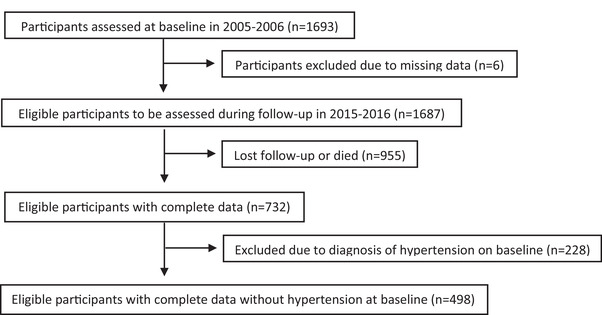
Hypertension is the leading cause of overall mortality in low- and middle-income countries. In Brazil, there is paucity of data on the determinants of incident hypertension and related risk factors. We aimed to determine the incidence of hypertension in a sample from the Brazilian population and investigate possible relationships with body adiposity indexes. We assessed risk factors associated with cardiovascular disease, including adiposity body indexes and biochemical analysis, in a sample from the Baependi Heart Study before and after a 10-year follow-up. Hypertension was defined by the presence of systolic blood pressure (SBP) ≥140 mmHg and/or diastolic blood pressure ≥90 mmHg or the use of antihypertensive drugs. From an initial sample of 1693 participants, 498 (56% women; mean age 38 ± 13 years) were eligible to be included. The overall hypertension incidence was 24.3% (22.3% in men and 25.6% in women). Persons who developed hypertension had higher prevalence of obesity, higher levels for blood pressure, higher frequency of dyslipidemia, and higher body adiposity indexes at baseline. The best prediction model for incident hypertension includes age, sex, HDL-c, SBP, and Body Mass Index (BMI) [AUC = 0.823, OR = 1.58 (95% CI 1.23-2.04)]. BMI was superior in its predictive capacity when compared to Body Adiposity Index (BAI), Body Roundness Index (BRI), and Visceral Adiposity Index (VAI). Incident hypertension in a sample from the Brazilian population was 24.3% after 10-year follow-up and BMI, albeit the simpler index to be calculated, is the best anthropometric index to predict incident hypertension.
高血压是中低收入国家全因死亡率的主要原因。在巴西,关于高血压发病的决定因素和相关危险因素的数据很少。我们旨在确定巴西人群样本中高血压的发病率,并研究其与身体肥胖指数的可能关系。我们评估了与心血管疾病相关的危险因素,包括肥胖身体指数和生化分析,在贝伦迪心脏研究的样本中进行,在 10 年随访前后进行。高血压的定义为收缩压(SBP)≥140mmHg 和/或舒张压≥90mmHg 或使用抗高血压药物。在最初的 1693 名参与者中,有 498 名(56%为女性;平均年龄 38±13 岁)符合入选条件。总体高血压发病率为 24.3%(男性为 22.3%,女性为 25.6%)。发生高血压的人肥胖率更高,血压水平更高,血脂异常频率更高,基线时身体肥胖指数更高。预测高血压发病的最佳模型包括年龄、性别、高密度脂蛋白胆固醇、SBP 和体重指数(BMI)[AUC=0.823,OR=1.58(95%CI 1.23-2.04)]。与身体脂肪指数(BAI)、身体圆形指数(BRI)和内脏脂肪指数(VAI)相比,BMI 在预测能力方面更具优势。10 年后,巴西人群样本中高血压的发病率为 24.3%,尽管 BMI 是更易于计算的指数,但它是预测高血压发病的最佳人体测量学指数。