Department of Psychiatry and Neurosciences, Graduate School of Biomedical Sciences, Hiroshima University, Hiroshima, Japan.
Department of Neurology, Faculty of Medicine, Shimane University, Izumo-shi, Japan.
Psychiatry Clin Neurosci. 2022 Aug;76(8):367-376. doi: 10.1111/pcn.13373. Epub 2022 Jun 1.
To establish treatment response biomarkers that reflect the pathophysiology of depression, it is important to use an integrated set of features. This study aimed to determine the relationship between regional brain activity at rest and blood metabolites related to treatment response to escitalopram to identify the characteristics of depression that respond to treatment.
Blood metabolite levels and resting-state brain activity were measured in patients with moderate to severe depression (n = 65) before and after 6-8 weeks of treatment with escitalopram, and these were compared between Responders and Nonresponders to treatment. We then examined the relationship between blood metabolites and brain activity related to treatment responsiveness in patients and healthy controls (n = 36).
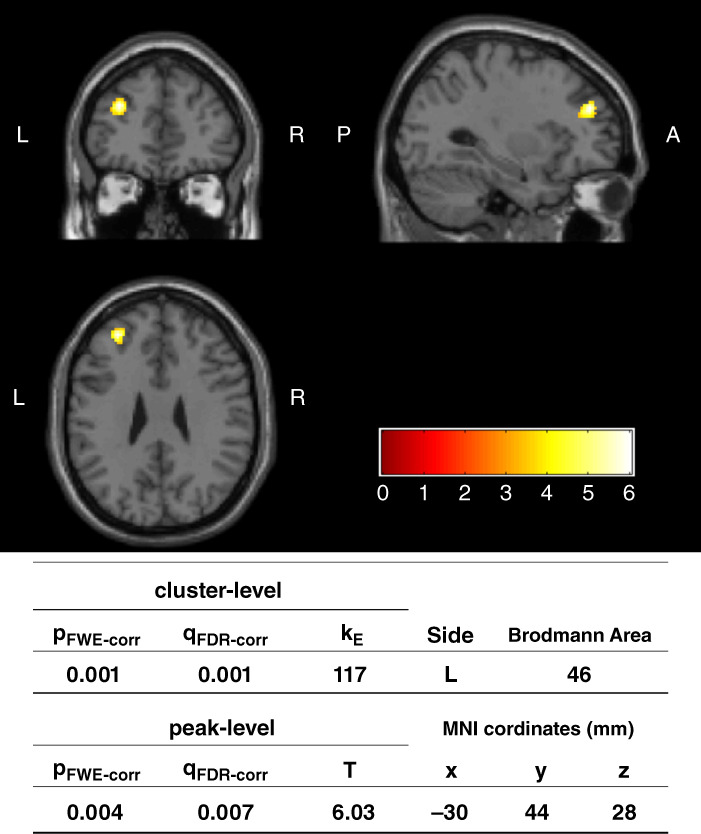
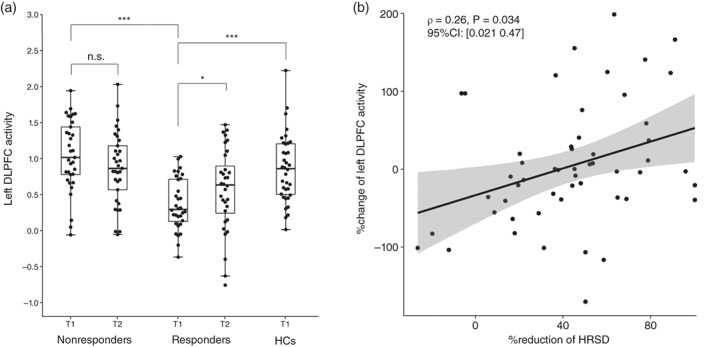
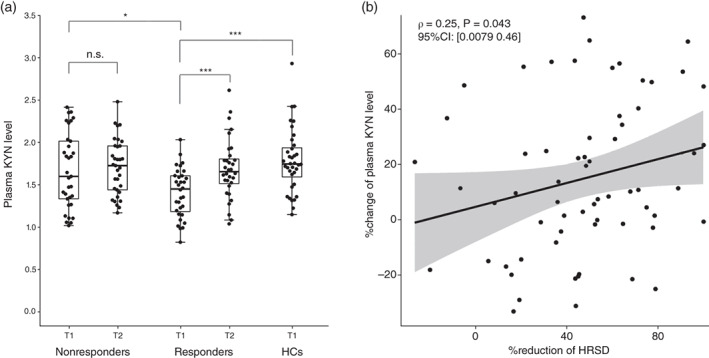
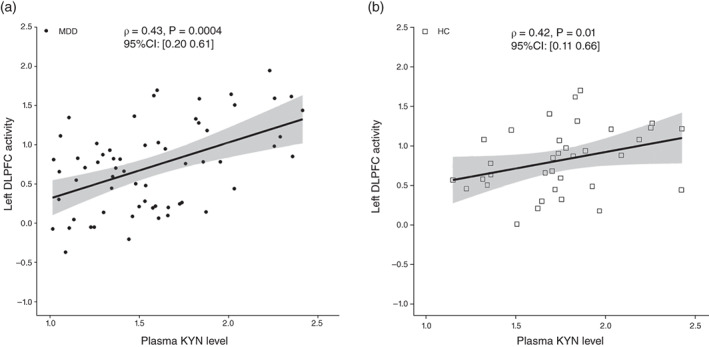
Thirty-two patients (49.2%) showed a clinical response (>50% reduction in the Hamilton Rating Scale for Depression score) and were classified as Responders, and the remaining 33 patients were classified as Nonresponders. The pretreatment fractional amplitude of low-frequency fluctuation (fALFF) value of the left dorsolateral prefrontal cortex (DLPFC) and plasma kynurenine levels were lower in Responders, and the rate of increase of both after treatment was correlated with an improvement in symptoms. Moreover, the fALFF value of the left DLPFC was significantly correlated with plasma kynurenine levels in pretreatment patients with depression and healthy controls.
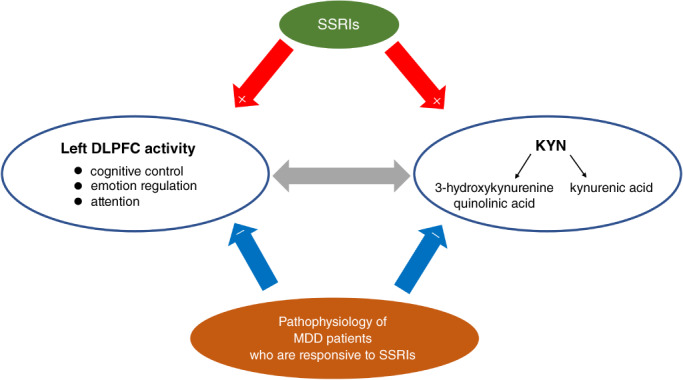
Decreased resting-state regional activity of the left DLPFC and decreased plasma kynurenine levels may predict treatment response to escitalopram, suggesting that it may be involved in the pathophysiology of major depressive disorder in response to escitalopram treatment.
为了建立反映抑郁症病理生理学的治疗反应生物标志物,使用一组综合特征非常重要。本研究旨在确定静息状态下大脑区域活动与与依西酞普兰治疗反应相关的血液代谢物之间的关系,以确定对治疗有反应的抑郁症特征。
在接受依西酞普兰治疗 6-8 周前后,测量了 65 例中重度抑郁症患者的血液代谢物水平和静息状态大脑活动,并比较了治疗反应的应答者和无应答者之间的差异。然后,我们在患者和健康对照组(n=36)中检查了与治疗反应性相关的血液代谢物和大脑活动之间的关系。
32 名患者(49.2%)表现出临床反应(汉密尔顿抑郁量表评分降低>50%),被归类为应答者,其余 33 名患者被归类为无应答者。左背外侧前额叶皮质(DLPFC)的预处理低频振幅(fALFF)值和血浆犬尿氨酸水平在应答者中较低,治疗后两者的增加率与症状改善相关。此外,左 DLPFC 的 fALFF 值与抑郁症和健康对照组患者的预处理血浆犬尿氨酸水平显著相关。
左 DLPFC 静息状态区域活动减少和血浆犬尿氨酸水平降低可能预示着依西酞普兰治疗反应,这表明它可能与依西酞普兰治疗的重度抑郁症的病理生理学有关。