Department of Infection Biology, London School of Hygiene & Tropical Medicine, London, UK.
Malaria Research and Training Centre, Faculty of Pharmacy and Faculty of Medicine and Dentistry, University of Sciences Techniques and Technologies of Bamako, Bamako, Mali.
Lancet Microbe. 2022 May;3(5):e336-e347. doi: 10.1016/S2666-5247(21)00356-6. Epub 2022 Mar 23.
Tafenoquine was recently approved as a prophylaxis and radical cure for Plasmodium vivax infection, but its Plasmodium falciparum transmission-blocking efficacy is unclear. We aimed to establish the efficacy and safety of three single low doses of tafenoquine in combination with dihydroartemisinin-piperaquine for reducing gametocyte density and transmission to mosquitoes.
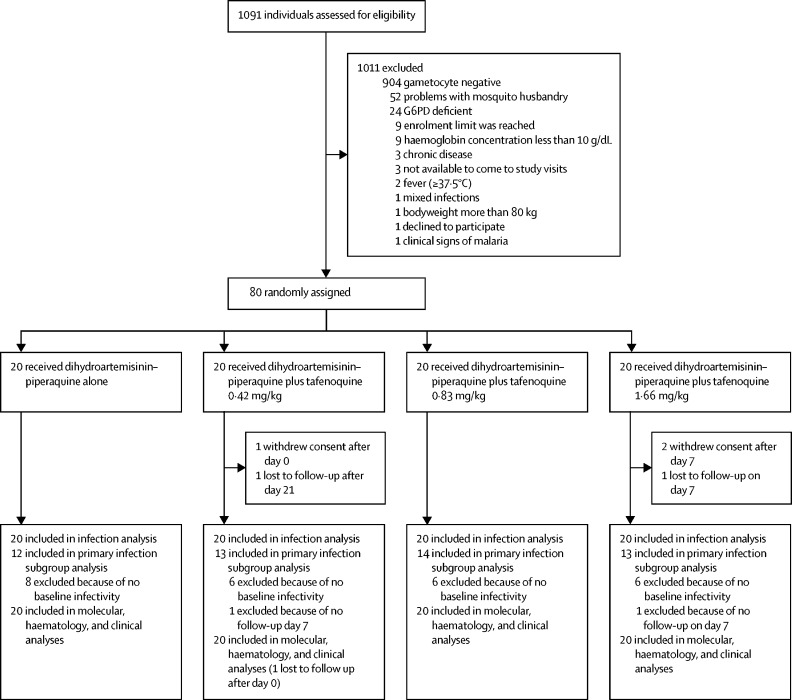
In this four-arm, single-blind, phase 2, randomised controlled trial, participants were recruited at the Clinical Research Unit of the Malaria Research and Training Centre of the University of Bamako in Mali. Eligible participants were aged 12-50 years, with asymptomatic P falciparum microscopy-detected gametocyte carriage, had a bodyweight of 80 kg or less, and had no clinical signs of malaria defined by fever. Participants were randomly assigned (1:1:1:1) to standard treatment with dihydroartemisinin-piperaquine, or dihydroartemisinin-piperaquine plus a single dose of tafenoquine (in solution) at a final dosage of 0·42 mg/kg, 0·83 mg/kg, or 1·66 mg/kg. Randomisation was done with a computer-generated randomisation list and concealed with sealed, opaque envelopes. Dihydroartemisinin-piperaquine was administered as oral tablets over 3 days (day 0, 1, and 2), as per manufacturer instructions. A single dose of tafenoquine was administered as oral solution on day 0 in parallel with the first dose of dihydroartemisinin-piperaquine. Tafenoquine dosing was based on bodyweight to standardise efficacy and risk variance. The primary endpoint, assessed in the per-protocol population, was median percentage change in mosquito infection rate 7 days after treatment compared with baseline. Safety endpoints included frequency and incidence of adverse events. The final follow-up visit was on Dec 23, 2021; the trial is registered with ClinicalTrials.gov, NCT04609098.
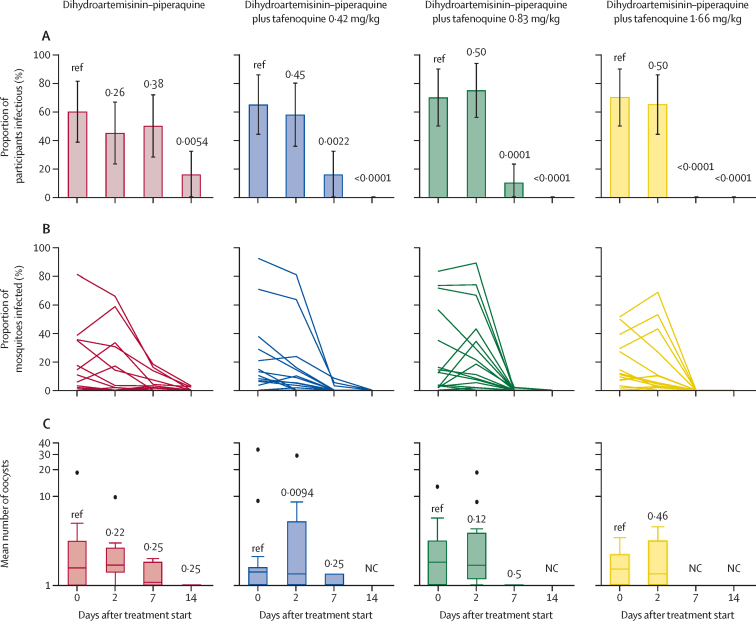
From Oct 29 to Nov 25, 2020, 1091 individuals were screened for eligibility, 80 of whom were enrolled and randomly assigned (20 per treatment group). Before treatment, 53 (66%) individuals were infectious to mosquitoes, infecting median 12·50% of mosquitoes (IQR 3·64-35·00). Within-group reduction in mosquito infection rate on day 7 was 79·95% (IQR 57·15-100; p=0·0005 for difference from baseline) following dihydroartemisinin-piperaquine only, 100% (98·36-100; p=0·0005) following dihydroartemisinin-piperaquine plus tafenoquine 0·42 mg/kg, 100% (100-100; p=0·0001) following dihydroartemisinin-piperaquine plus tafenoquine 0·83 mg/kg, and 100% (100-100; p=0·0001) following dihydroartemisinin-piperaquine plus tafenoquine 1·66 mg/kg. 55 (69%) of 80 participants had a total of 94 adverse events over the course of the trial; 86 (92%) adverse events were categorised as mild, seven (7%) as moderate, and one (1%) as severe. The most common treatment-related adverse event was mild or moderate headache, which occurred in 15 (19%) participants (dihydroartemisinin-piperaquine n=2; dihydroartemisinin-piperaquine plus tafenoquine 0·42 mg/kg n=6; dihydroartemisinin-piperaquine plus tafenoquine 0·83 mg/kg n=3; and dihydroartemisinin-piperaquine plus tafenoquine 1·66 mg/kg n=4). No serious adverse events occurred. No significant differences in the incidence of all adverse events (p=0·73) or treatment-related adverse events (p=0·62) were observed between treatment groups.
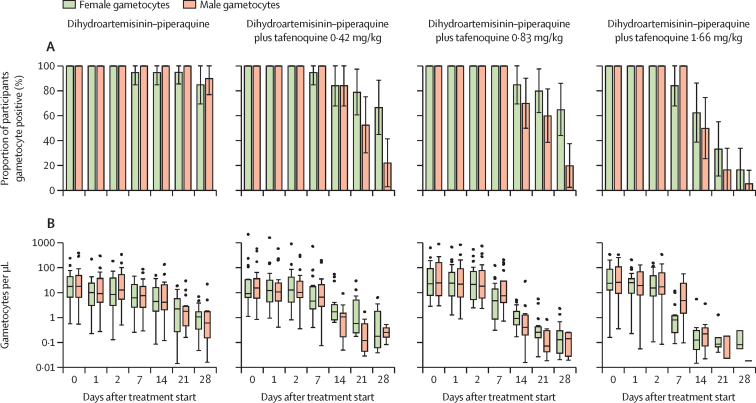
Tafenoquine was well tolerated at all doses and accelerated P falciparum gametocyte clearance. All tafenoquine doses showed improved transmission reduction at day 7 compared with dihydroartemisinin-piperaquine alone. These data support the case for further research on tafenoquine as a transmission-blocking supplement to standard antimalarials.
Bill & Melinda Gates Foundation.
For the French, Portuguese, Spanish and Swahili translations of the abstract see Supplementary Materials section.
泰法喹啉最近被批准作为预防和根治间日疟原虫感染的药物,但它对恶性疟原虫的传播阻断效果尚不清楚。我们旨在确定三种低剂量泰法喹啉联合双氢青蒿素-哌喹在降低配子体密度和向蚊子传播方面的疗效和安全性。
在这项四臂、单盲、2 期、随机对照试验中,参与者在马里巴马科大学疟疾研究和培训中心的临床研究单位招募。合格的参与者年龄在 12-50 岁之间,无疟疾症状,镜检有恶性疟原虫配子体携带,体重不超过 80 公斤,且无发热定义的临床疟疾体征。参与者按 1:1:1:1 的比例随机分配(1:1:1:1)接受标准的双氢青蒿素-哌喹治疗,或双氢青蒿素-哌喹加泰法喹啉(溶液)单剂量 0.42mg/kg、0.83mg/kg 或 1.66mg/kg。随机分配采用计算机生成的随机分配表,并使用密封、不透明的信封进行隐藏。双氢青蒿素-哌喹按制造商的说明口服 3 天(第 0、1 和 2 天)。泰法喹啉单剂量在第 0 天与双氢青蒿素-哌喹的第一剂同时口服溶液给药。泰法喹啉的剂量基于体重进行标准化,以均衡疗效和风险差异。主要终点是治疗后 7 天与基线相比,蚊媒感染率的中位数百分比变化,在符合方案人群中进行评估。安全性终点包括不良事件的频率和发生率。最后一次随访是在 2021 年 12 月 23 日;该试验在 ClinicalTrials.gov 注册,编号为 NCT04609098。
从 2020 年 10 月 29 日至 11 月 25 日,对 1091 人进行了筛查以确定其是否符合入选标准,其中 80 人入组并随机分配(每组 20 人)。治疗前,53(66%)人具有感染蚊子的能力,感染了中位数 12.50%的蚊子(IQR 3.64-35.00)。仅接受双氢青蒿素-哌喹治疗的蚊媒感染率在第 7 天下降了 79.95%(IQR 57.15-100;与基线相比差异有统计学意义,p=0.0005),而双氢青蒿素-哌喹联合泰法喹啉 0.42mg/kg 组为 100%(98.36-100;p=0.0005),双氢青蒿素-哌喹联合泰法喹啉 0.83mg/kg 组为 100%(100-100;p=0.0001),双氢青蒿素-哌喹联合泰法喹啉 1.66mg/kg 组为 100%(100-100;p=0.0001)。80 名参与者中有 55 人(69%)在整个试验过程中总共发生了 94 次不良事件;86 次(92%)不良事件被归类为轻度,7 次(7%)为中度,1 次(1%)为重度。最常见的与治疗相关的不良事件是轻度或中度头痛,15 名(19%)参与者发生(双氢青蒿素-哌喹组 n=2;双氢青蒿素-哌喹联合泰法喹啉 0.42mg/kg 组 n=6;双氢青蒿素-哌喹联合泰法喹啉 0.83mg/kg 组 n=3;双氢青蒿素-哌喹联合泰法喹啉 1.66mg/kg 组 n=4)。没有发生严重不良事件。各组间所有不良事件(p=0.73)或治疗相关不良事件(p=0.62)的发生率无显著差异。
泰法喹啉在所有剂量下均耐受良好,并加速了恶性疟原虫配子体的清除。与单独使用双氢青蒿素-哌喹相比,所有泰法喹啉剂量在第 7 天均显示出改善的传播减少。这些数据支持进一步研究泰法喹啉作为标准抗疟药物的传播阻断补充剂。
比尔及梅琳达·盖茨基金会。