Son Hyung Eun, Ryu Ji Young, Lee Kyunghoon, Choi Young Il, Kim Myeong Sung, Park Inwhee, Shin Gyu Tae, Kim Heungsoo, Ahn Curie, Kim Sejoong, Chin Ho Jun, Na Ki Young, Chae Dong-Wan, Ahn Soyeon, Hwang Seung Sik, Jeong Jong Cheol
Division of Nephrology, Department of Internal Medicine, Seoul National University Bundang Hospital, Seongnam, Republic of Korea.
Department of Laboratory Medicine, Seoul National University Bundang Hospital, Seongnam, Republic of Korea.
Kidney Res Clin Pract. 2022 Sep;41(5):611-622. doi: 10.23876/j.krcp.21.153. Epub 2022 May 11.
Patients undergoing hemodialysis are susceptible to sarcopenia. As intracellular reservoirs of water, skeletal muscles are important contributors to intradialytic hypotension. This study was designed to determine the role of skeletal muscle mass in intradialytic hypotension.
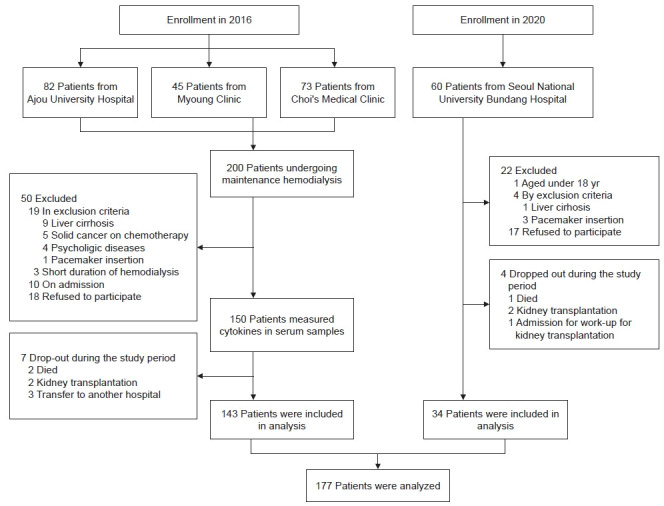
In a cross-sectional study, the body composition of 177 patients was measured immediately after hemodialysis using bioelectrical impedance analysis. The parameters measured were skeletal muscle mass, intracellular and extracellular water contents, total body water, and cell-membrane functionality (in phase angle at 50 kHz). Data from laboratory tests, chest radiography, measurements of handgrip strength and mid-arm circumference, and questionnaires were collected. The main outcome was intradialytic hypotension, defined as more than two episodes of hypotension (systolic blood pressure of <90 mmHg) with intervention over the 3 months following enrollment. Logistic regression models including each parameter related to sarcopenia were compared with a clinical model.
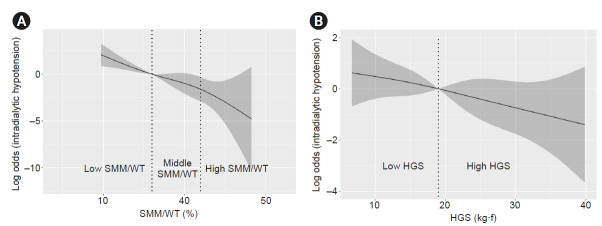
Patients with a low ratio of skeletal muscle mass to dry body weight (SMM/WT) had a higher rate of intradialytic hypotension (40.7%). Most low-SMM/WT patients were female, obese, diabetic, and had a lower handgrip strength compared with the other patients. In the high-SMM/WT group, the risk of intradialytic hypotension was lower, with an odds ratio of 0.08 (95% confidence interval [CI], 0.02-0.28) and adjusted odds ratio of 0.06 (95% CI, 0.01-0.29).
Measurement and maintenance of skeletal muscle can help prevent intradialytic hypotension in frail patients undergoing hemodialysis.
接受血液透析的患者易患肌肉减少症。作为细胞内的水分储存库,骨骼肌是透析中低血压的重要促成因素。本研究旨在确定骨骼肌质量在透析中低血压中的作用。
在一项横断面研究中,使用生物电阻抗分析在血液透析结束后立即测量了177例患者的身体成分。测量的参数包括骨骼肌质量、细胞内和细胞外水分含量、总体水以及细胞膜功能(50kHz时的相位角)。收集了实验室检查数据、胸部X线片、握力和上臂中部周长测量值以及问卷调查结果。主要结局是透析中低血压,定义为入组后3个月内有超过两次低血压发作(收缩压<90mmHg)且需要干预。将包括与肌肉减少症相关的每个参数的逻辑回归模型与临床模型进行比较。
骨骼肌质量与干体重之比(SMM/WT)低的患者透析中低血压发生率较高(40.7%)。与其他患者相比,大多数低SMM/WT患者为女性、肥胖、糖尿病患者,且握力较低。在高SMM/WT组中,透析中低血压的风险较低,优势比为0.08(95%置信区间[CI],0.02 - 0.28),调整后的优势比为0.06(95%CI,0.01 - 0.29)。
测量和维持骨骼肌质量有助于预防虚弱的血液透析患者发生透析中低血压。