Department of Internal Medicine, Chonnam National University Medical School.
Department of Internal Medicine, Chonnam National University Hospital, Gwangju.
Medicine (Baltimore). 2021 Apr 2;100(13):e25293. doi: 10.1097/MD.0000000000025293.
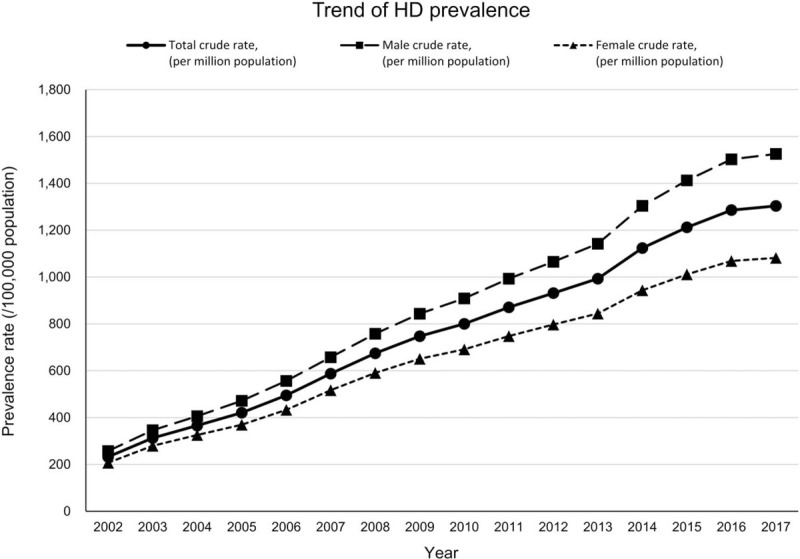
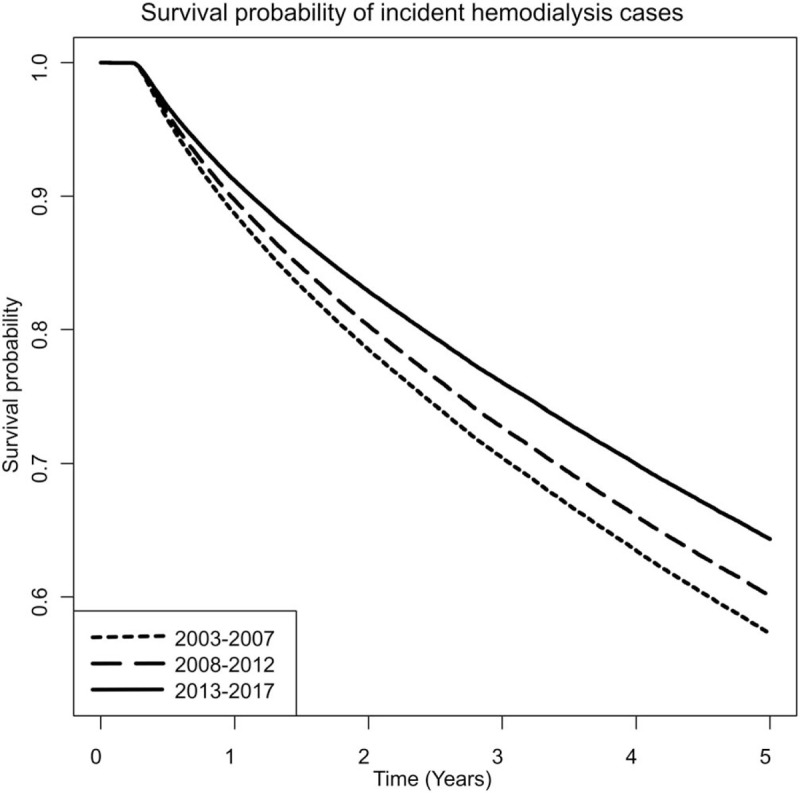
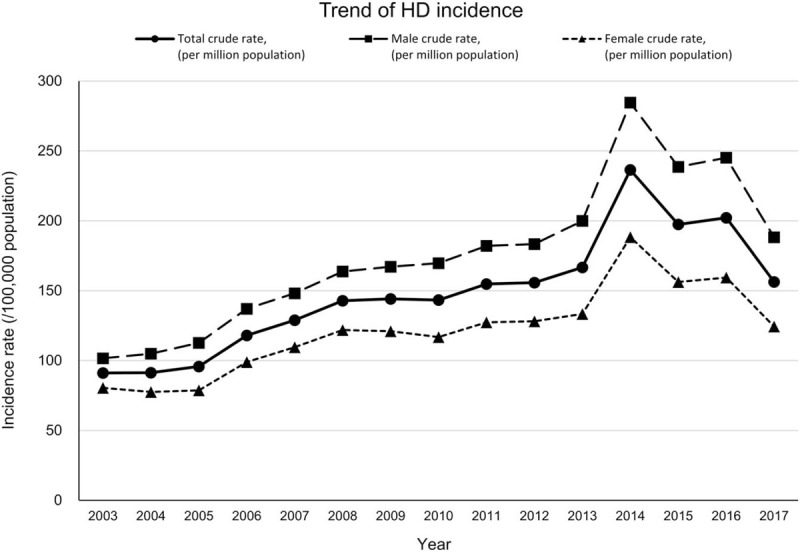
Data on the overall epidemiology and temporal trends of end-stage renal disease (ESRD) requiring hemodialysis in Korea are scarce. We aimed to estimate the prevalence and incidence of ESRD requiring hemodialysis in Korea between 2002 and 2017.Using the National Health Insurance Service database, we analyzed data from the entire Korean population between 2002 and 2017. Hemodialysis patients were identified using rare incurable disease codes (V001) or prescription of medical fee codes of hemodialysis (O7020 and O7021). We only included patients who had been maintained on hemodialysis for more than 90 days from the date of dialysis initiation, to exclude patients who required short-term dialysis for acute kidney injury, conversion to peritoneal dialysis, or kidney transplantation.During the 16-year follow-up, the number of hemodialysis patients in Korea has steadily increased from 11,215 in 2002 to 67,486 in 2017. The mean age of these patients has gradually increased from 55.57 ± 13.31 years in 2002 to 62.13 ± 13.23 years in 2017. In 2017, the crude prevalence rate of hemodialysis was 1303.4 per million population. Overall, the number of men tended to be somewhat higher than that of women, and the proportion of men increased slightly from 55.56% in 2002 to 58.45% in 2017. The proportion of diabetic patients increased rapidly from 23.84% to 47.84%, and the percentage of dyslipidemic patients rose from 18.9% to 86.7%. The number of incident hemodialysis patients increased significantly from 4406 in 2003 to 12,134 in 2014, and then decreased to 8090 in 2017. In the incident cases of hemodialysis, the observed increase in the proportion of male patients and in diabetes and dyslipidemia were similar to that of prevalent patients. The more recent era of hemodialysis initiation, the better 5-year survival rates were observed.The prevalence and incidence of hemodialysis in Korea gradually increased between 2002 and 2017. The proportion of men, and patients with diabetes and dyslipidemia requiring hemodialysis also increased continuously. The survival rate of hemodialysis patients was gradually improving. These findings may serve as a reference for future epidemiological studies on hemodialysis in Korea.
韩国终末期肾病(ESRD)患者接受血液透析的总体流行病学和时间趋势数据十分匮乏。本研究旨在评估 2002 年至 2017 年韩国 ESRD 患者接受血液透析的流行率和发病率。
我们使用国家健康保险服务数据库,对 2002 年至 2017 年期间的所有韩国人群进行数据分析。通过罕见不治之症代码(V001)或血液透析医疗费用代码(O7020 和 O7021)识别血液透析患者。我们仅纳入了自透析开始之日起接受血液透析超过 90 天的患者,以排除因急性肾损伤、转为腹膜透析或接受肾移植而需要短期透析的患者。
在 16 年的随访期间,韩国血液透析患者的数量从 2002 年的 11215 例稳步增加到 2017 年的 67486 例。这些患者的平均年龄逐渐从 2002 年的 55.57±13.31 岁增加到 2017 年的 62.13±13.23 岁。2017 年,血液透析的粗患病率为每百万人 1303.4 例。总体而言,男性人数略高于女性,男性比例从 2002 年的 55.56%略微增加到 2017 年的 58.45%。糖尿病患者的比例从 23.84%迅速增加到 47.84%,血脂异常患者的比例从 18.9%上升至 86.7%。血液透析新发病例数从 2003 年的 4406 例显著增加到 2014 年的 12134 例,然后在 2017 年减少到 8090 例。在血液透析新发病例中,观察到男性患者比例以及糖尿病和血脂异常的比例增加,与现患患者的情况相似。血液透析开始时间越晚,患者的 5 年生存率越高。
韩国血液透析的流行率和发病率从 2002 年至 2017 年逐渐增加。男性比例、糖尿病和血脂异常患者比例也持续增加。血液透析患者的生存率逐渐提高。这些发现可能为韩国未来血液透析的流行病学研究提供参考。