Department of Surgery, Friedrich-Alexander-Universität Erlangen-Nürnberg, Erlangen, Germany.
Comprehensive Cancer Center Erlangen-European Metropolitan Area of Nuremberg (CCC ER-EMN), Erlangen, Germany.
Int J Colorectal Dis. 2022 Jun;37(6):1355-1365. doi: 10.1007/s00384-022-04174-y. Epub 2022 May 11.
This single-centre cohort study was designed to identify factors that can predict primary tumour downstaging by neoadjuvant chemoradiotherapy (nCRT) in rectal carcinoma.
Prospectively collected data from 555 patients with clinical T category (cT) cT3-4 rectal carcinoma treated between 1995 and 2019 were retrospectively analysed. All patients received long-term neoadjuvant chemoradiotherapy followed by surgery with curative intent at the Department of Surgery, University Hospital Erlangen, Germany. Patient-, tumour- and treatment-related factors with a potential impact on the downstaging of rectal carcinoma to pathological T category (pT) ≤ ypT2 and ypT0 were analysed in univariate and multivariate logistic regression analyses. The prognosis of patients with and without downstaging of the primary tumour was compared.
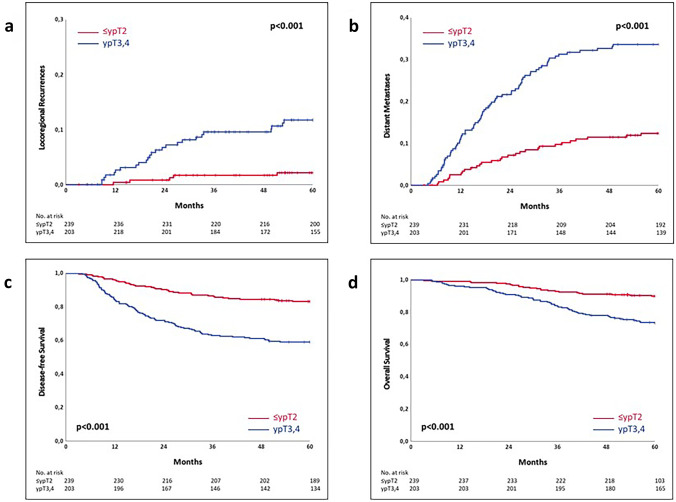
A total of 288 (51.9%) patients showed downstaging to ≤ ypT2. Eighty-six (15.5%) patients achieved clinical complete regression (ypT0). In the multivariate logistic regression analysis, the factors cT category, BMI, ECOG score, CEA, histological type, extension in the rectum and year of the start of treatment were found to be independent factors for predicting downstaging to ≤ ypT2 after neoadjuvant chemoradiotherapy. The year of treatment initiation also remained an independent significant predictor for pathological complete regression. The prognosis was superior in patients with downstaging to ≤ ypT2 in terms of locoregional and distant recurrence as well as disease-free and overall survival.
Factors predicting downstaging after long-term nCRT could be identified. This may be helpful for counselling patients and selecting the optimal treatment for patients with advanced rectal carcinoma.
本单中心队列研究旨在确定新辅助放化疗(nCRT)治疗直肠癌后原发肿瘤降期的预测因素。
回顾性分析了 1995 年至 2019 年在德国埃尔兰根大学医院外科接受治疗的 555 例临床 T 分期(cT)cT3-4 直肠癌患者的前瞻性收集数据。所有患者均接受长期新辅助放化疗,然后进行以治愈为目的的手术。在单因素和多因素逻辑回归分析中,分析了可能影响直肠癌降期至病理 T 分期(pT)≤ypT2 和 ypT0 的患者、肿瘤和治疗相关因素。比较了原发肿瘤降期和未降期患者的预后。
共有 288 例(51.9%)患者降期至≤ypT2。86 例(15.5%)患者达到临床完全缓解(ypT0)。多因素逻辑回归分析发现,cT 分期、BMI、ECOG 评分、CEA、组织学类型、直肠延伸和治疗开始年份是预测 nCRT 后降期至≤ypT2的独立因素。治疗起始年份也是病理完全缓解的独立显著预测因素。降期至≤ypT2 的患者在局部和远处复发、无病生存和总生存方面的预后较好。
可以确定预测 nCRT 后降期的因素。这可能有助于为患者提供咨询,并为晚期直肠癌患者选择最佳治疗方案。