Neuroscience and Cognitive Science Program, University of Maryland, College Park, Maryland, USA.
Department of Psychology, University of Maryland, College Park, Maryland, USA.
Hum Brain Mapp. 2022 Sep;43(13):4074-4090. doi: 10.1002/hbm.25903. Epub 2022 May 12.
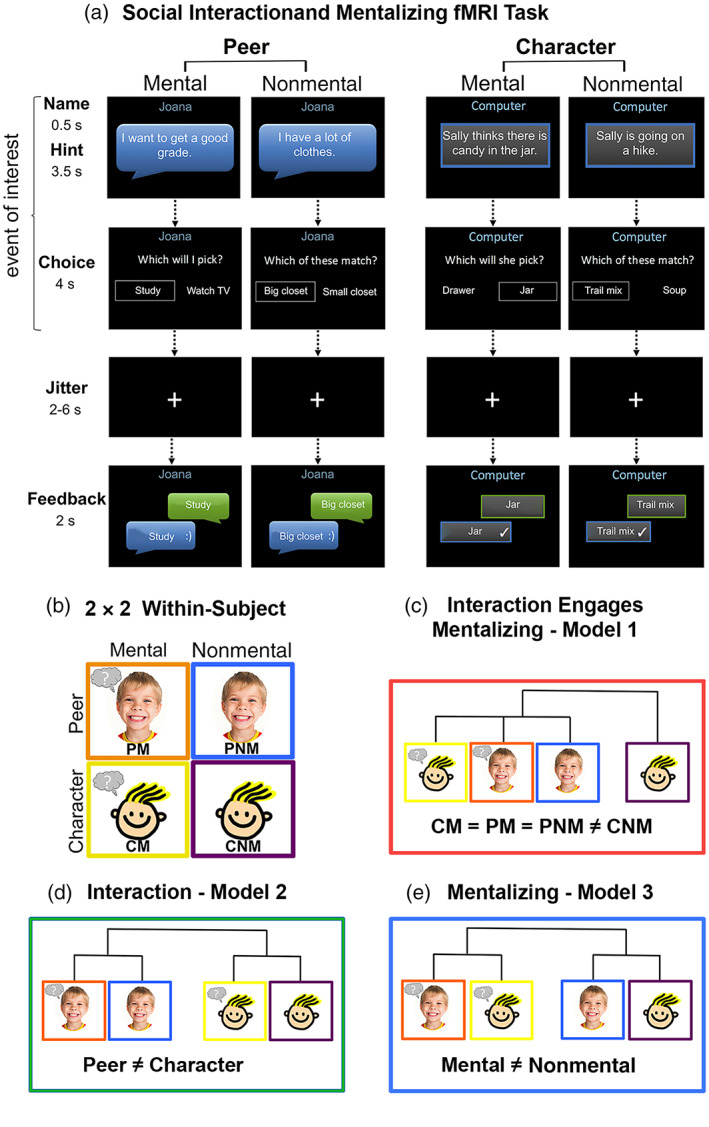
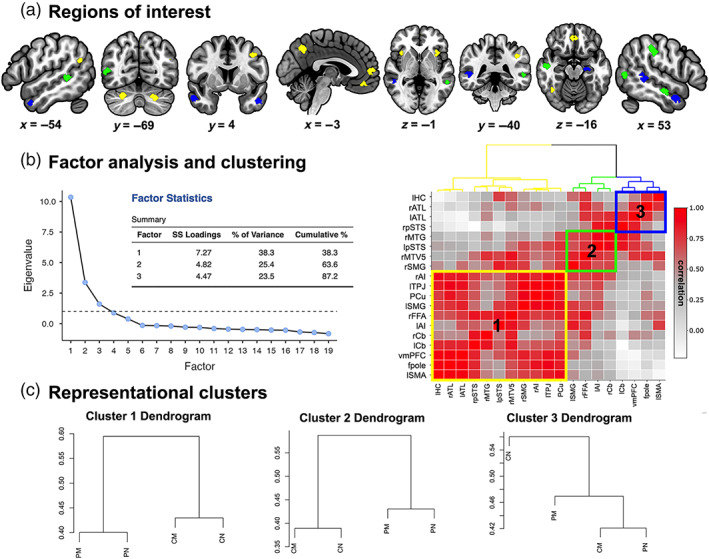
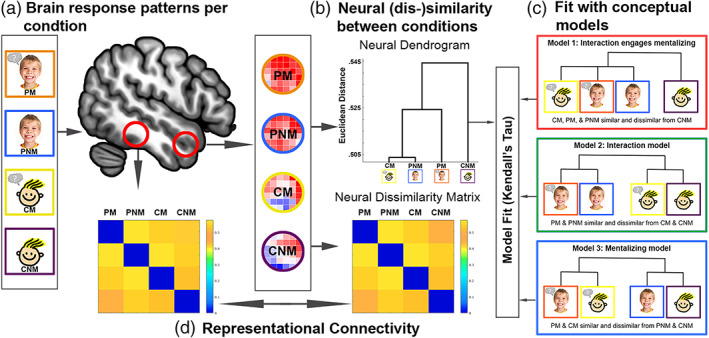
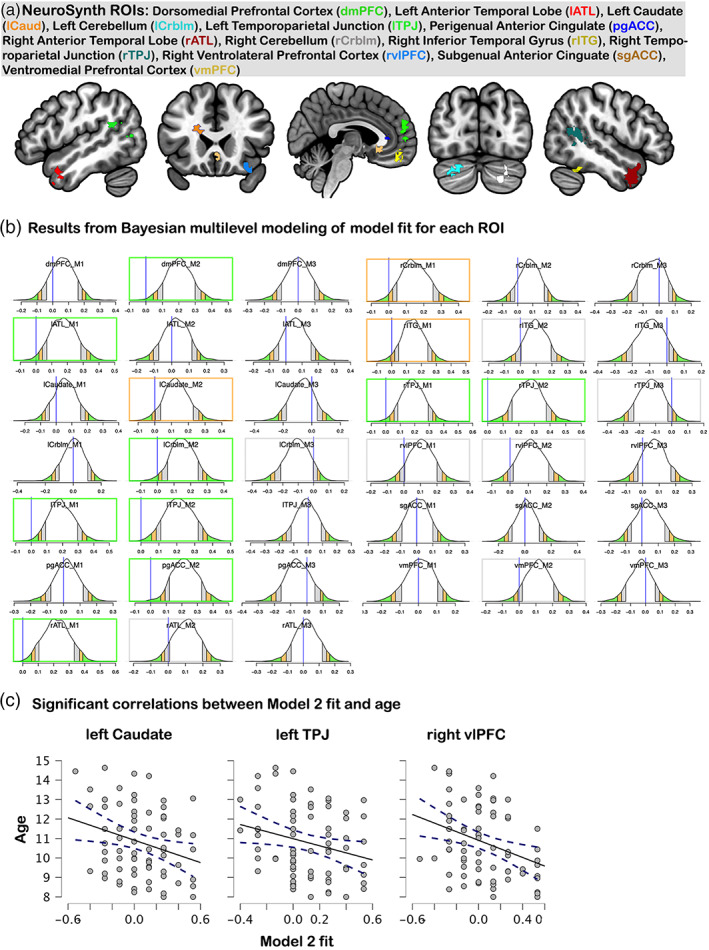
Social interactions are essential for human development, yet little neuroimaging research has examined their underlying neurocognitive mechanisms using socially interactive paradigms during childhood and adolescence. Recent neuroimaging research has revealed activity in the mentalizing network when children engage with a live social partner, even when mentalizing is not required. While this finding suggests that social-interactive contexts may spontaneously engage mentalizing, it is not a direct test of how similarly the brain responds to these two contexts. The current study used representational similarity analysis on data from 8- to 14-year-olds who made mental and nonmental judgments about an abstract character and a live interaction partner during fMRI. A within-subject, 2 (Mental/Nonmental) × 2 (Peer/Character) design enabled us to examine response pattern similarity between conditions, and estimate fit to three conceptual models of how the two contexts relate: (1) social interaction and mentalizing about an abstract character are represented similarly; (2) interactive peers and abstract characters are represented differently regardless of the evaluation type; and (3) mental and nonmental states are represented dissimilarly regardless of target. We found that the temporal poles represent mentalizing and peer interactions similarly (Model 1), suggesting a neurocognitive link between the two in these regions. Much of the rest of the social brain exhibits different representations of interactive peers and abstract characters (Model 2). Our findings highlight the importance of studying social-cognitive processes using interactive approaches, and the utility of pattern-based analyses for understanding how social-cognitive processes relate to each other.
社会互动对于人类发展至关重要,但很少有神经影像学研究使用儿童和青少年时期的社交互动范式来研究其潜在的神经认知机制。最近的神经影像学研究表明,当儿童与真实的社交伙伴互动时,即使不需要进行心理理论思考,心理理论网络也会活跃起来。虽然这一发现表明社交互动环境可能会自发地引发心理理论思考,但它并不能直接测试大脑对这两种环境的反应是否相似。本研究使用 8 至 14 岁儿童的 fMRI 数据,通过表示相似性分析,对他们进行了关于抽象角色和真实互动伙伴的心理和非心理判断。在一个被试内的 2(心理/非心理)×2(同伴/角色)设计中,我们能够检查条件之间的反应模式相似性,并估计三个概念模型如何关联这两种情况:(1)社交互动和对抽象角色的心理理论思考具有相似的表现;(2)无论评价类型如何,互动的同伴和抽象角色都具有不同的表现;(3)无论目标如何,心理和非心理状态都具有不同的表现。我们发现,颞极区域对心理理论思考和同伴互动的表现相似(模型 1),这表明这两个区域之间存在神经认知联系。社会大脑的大部分区域对互动的同伴和抽象角色表现出不同的表现(模型 2)。我们的研究结果强调了使用互动方法研究社会认知过程的重要性,以及基于模式的分析对于理解社会认知过程如何相互关联的作用。