Department of Pharmacology and Toxicology, College of Veterinary Science, Assam Agricultural University, Guwahati, Assam, India.
Department of Veterinary Biochemistry, College of Veterinary Science, Assam Agricultural University, Guwahati, Assam, India.
Indian J Pharmacol. 2022 Mar-Apr;54(2):102-109. doi: 10.4103/ijp.ijp_201_19.
Conyza bonariensis is an ornamental medicinal weed. This experiment was planned to explore the outcome of petroleum ether extract of C. bonariensis (PECB) leaves on scopolamine-induced amnesia in rats.
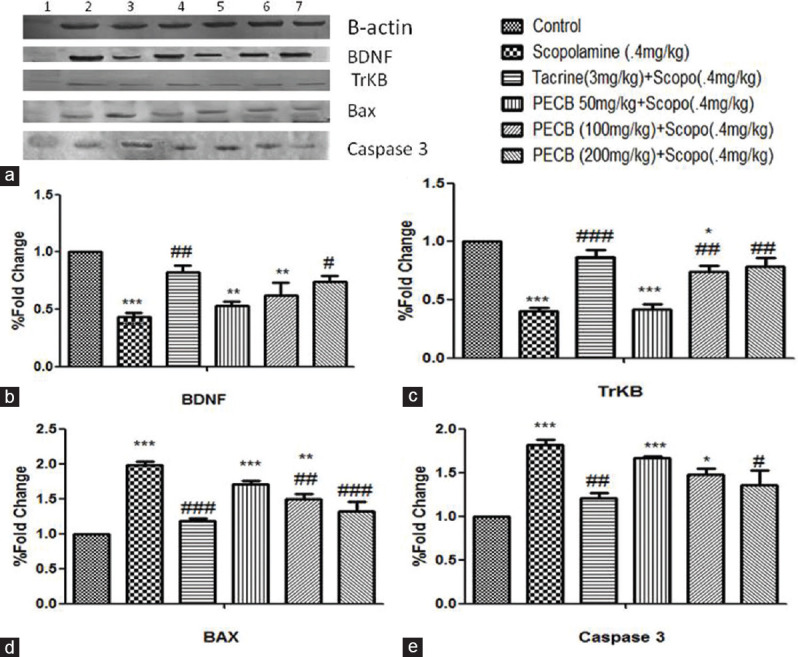
For impairing memory, 0.4 mg/kg (i. p.) of scopolamine was given. Fifty to 200 mg/kg of PECB was fed orally to rats and 3 mg/kg (i. p.) of tacrine was given as a standard drug. Anti-amnesic property was evaluated in Barnes maze using ANY-maze software. Following a behavioral study, acetylcholinesterase (AChE), β-amyloid, antioxidant enzymes, and cytokine levels were measured. Furthermore, reverse transcription-polymerase chain reaction was done for expression of the marker genes such as AChE, Nrf2, NF-κB, PP2A, and HO-1, whereas BDNF, TrkB, caspase-3, and Bax were measured by Western blotting.
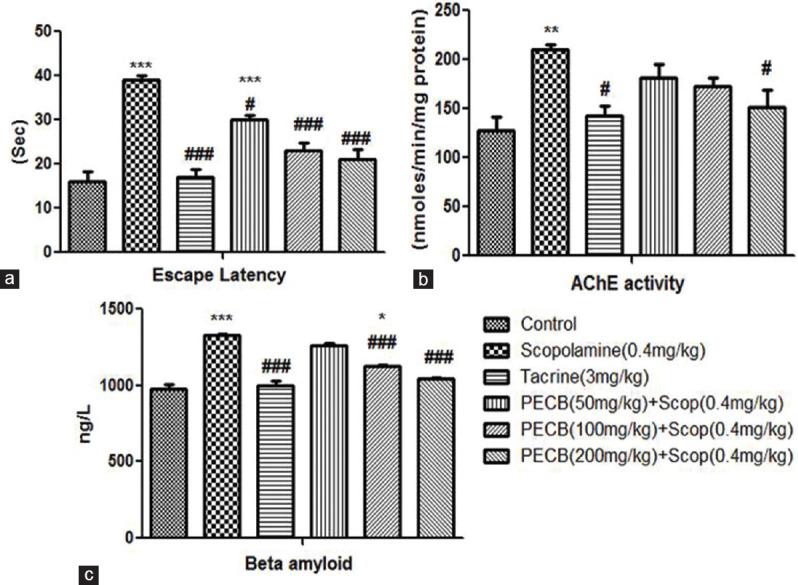
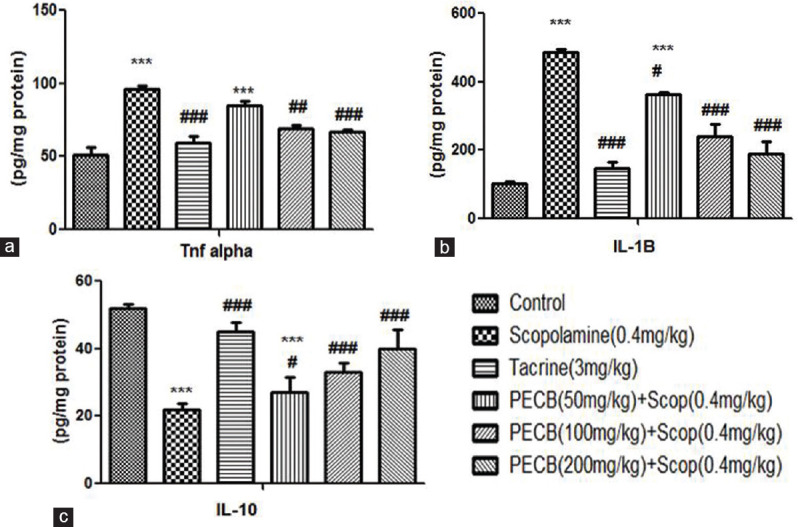
PECB and tacrine significantly improved memory dysfunction by decreasing escape latency in Barnes maze. At the highest dose, treatment with PECB altered the scopolamine-induced hyperactivation of AChE and β-amyloid activity. PECB elevated the levels of superoxide dismutase, glutathione, and catalase and decreased lipid peroxidation and nitric oxide dose dependently. PECB attenuated scopolamine-induced increase of tumor necrosis factor-α and interleukin (IL)-1β concentrations in the hippocampus with reversed diminished IL-10 level toward normal in the brain. Nrf2, HO-1, PP2A, BDNF, and TrkB were significantly upregulated with downregulation of AChE, NF-κB, Tau, Bax, and caspase-3. Different components such as beta-amyrin and alpha-amyrin were isolated from leaves of the plant.
The results indicated that PECB might be a potential curative drug for the treatment of cognitive impairment.
苦苣菜是一种观赏药用杂草。本实验旨在探讨苦苣菜叶石油醚提取物(PECB)对东莨菪碱诱导大鼠健忘症的影响。
为了损害记忆,给予 0.4mg/kg(ip)东莨菪碱。将 50 至 200mg/kg 的 PECB 口服给予大鼠,并给予 3mg/kg(ip)的他克林作为标准药物。使用 ANY-maze 软件在 Barnes 迷宫中评估抗健忘症特性。在行为研究后,测量乙酰胆碱酯酶(AChE)、β-淀粉样蛋白、抗氧化酶和细胞因子水平。此外,通过逆转录聚合酶链反应测量 AChE、Nrf2、NF-κB、PP2A 和 HO-1 等标记基因的表达,而通过 Western blot 测量 BDNF、TrkB、caspase-3 和 Bax 的表达。
PECB 和他克林通过降低 Barnes 迷宫中的逃避潜伏期显著改善了记忆功能障碍。在最高剂量下,PECB 治疗改变了东莨菪碱诱导的 AChE 和β-淀粉样蛋白活性的过度激活。PECB 剂量依赖性地提高超氧化物歧化酶、谷胱甘肽和过氧化氢酶的水平,并降低脂质过氧化和一氧化氮的水平。PECB 减弱了东莨菪碱诱导的海马肿瘤坏死因子-α和白细胞介素(IL)-1β浓度的增加,同时使大脑中降低的 IL-10 水平恢复正常。Nrf2、HO-1、PP2A、BDNF 和 TrkB 显著上调,而 AChE、NF-κB、Tau、Bax 和 caspase-3 下调。从植物叶子中分离出了β-香树脂醇和α-香树脂醇等不同成分。
结果表明,PECB 可能是治疗认知障碍的潜在治疗药物。