van Niekerk Zelna, Maguvhe Mbulaheni O, Magano Meahabo D
Department of Human Resource Management, College of Economic and Management Sciences, University of South Africa, Pretoria, South Africa.
Department of Inclusive Education, College of Education, University of South Africa, Pretoria, South Africa.
Afr J Disabil. 2022 Apr 29;11:882. doi: 10.4102/ajod.v11i0.882. eCollection 2022.
Existing wellness theories do not consider the unique needs of persons with disabilities. The lack of recognition of these needs in traditional wellness theories encouraged the researchers to develop a wellness framework for employees with disabilities (EWDs) to influence their wellness positively.
The aim of the study was to identify the wellness experiences of EWDs and explore how education, training and development can contribute towards the employees' wellness.
The qualitative study entailed semi-structured interviews with EWDs identified through snowball sampling. The study used the six-dimensional model of wellness that Bill Hettler developed in 1976 as a departure point to a holistic approach referring to social, intellectual, spiritual, physical, emotional and occupational wellness. The data collected was analysed through content analysis.
The study found that EWDs experience various workplace challenges as limited or no changes have been made to accommodate their specific needs. This then has a negative influence on their wellness. Their wellness diminishes as they attempt to cope with circumstances rather than request assistance. They recognised development needs in all the wellness dimensions explored. Employers and other stakeholders, including customers, colleagues and the communities they serve, need development and capacity building on disability matters to ensure equal opportunities for EWDs.
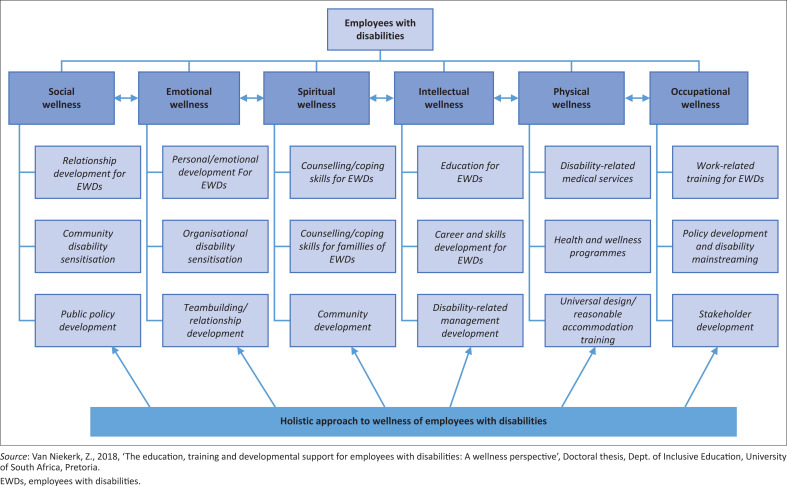
The study resulted in a Wellness framework for EWDs identifying the education, training and development needs that will contribute to their wellness.
现有的健康理论未考虑残疾人的独特需求。传统健康理论中对这些需求的忽视促使研究人员为残疾员工(EWD)制定一个健康框架,以积极影响他们的健康状况。
该研究的目的是确定残疾员工的健康体验,并探索教育、培训和发展如何有助于员工的健康。
这项定性研究涉及通过滚雪球抽样法确定的对残疾员工进行的半结构化访谈。该研究以比尔·赫特勒1976年开发的六维健康模型为出发点,采用一种整体方法,涉及社会、智力、精神、身体、情感和职业健康。通过内容分析法对收集到的数据进行分析。
研究发现,由于未做出有限或无变化以满足他们的特定需求,残疾员工面临各种工作场所挑战。这进而对他们的健康产生负面影响。当他们试图应对各种情况而不是寻求帮助时,他们的健康状况会下降。他们认识到在所探讨的所有健康维度中的发展需求。雇主和其他利益相关者,包括客户、同事以及他们所服务的社区,需要在残疾问题上进行发展和能力建设,以确保残疾员工有平等机会。
该研究得出了一个针对残疾员工的健康框架,确定了有助于他们健康的教育、培训和发展需求。