Almici Enrico, Chiappini Vanessa, López-Márquez Arístides, Badosa Carmen, Blázquez Blanca, Caballero David, Montero Joan, Natera-de Benito Daniel, Nascimento Andrés, Roldán Mònica, Lagunas Anna, Jiménez-Mallebrera Cecilia, Samitier Josep
Nanobioengineering Group, Institute for Bioengineering of Catalonia (IBEC), The Barcelona Institute of Science and Technology (BIST), Barcelona, Spain.
Department of Electronic and Biomedical Engineering, University of Barcelona, Barcelona, Spain.
Front Bioeng Biotechnol. 2022 Apr 25;10:851825. doi: 10.3389/fbioe.2022.851825. eCollection 2022.
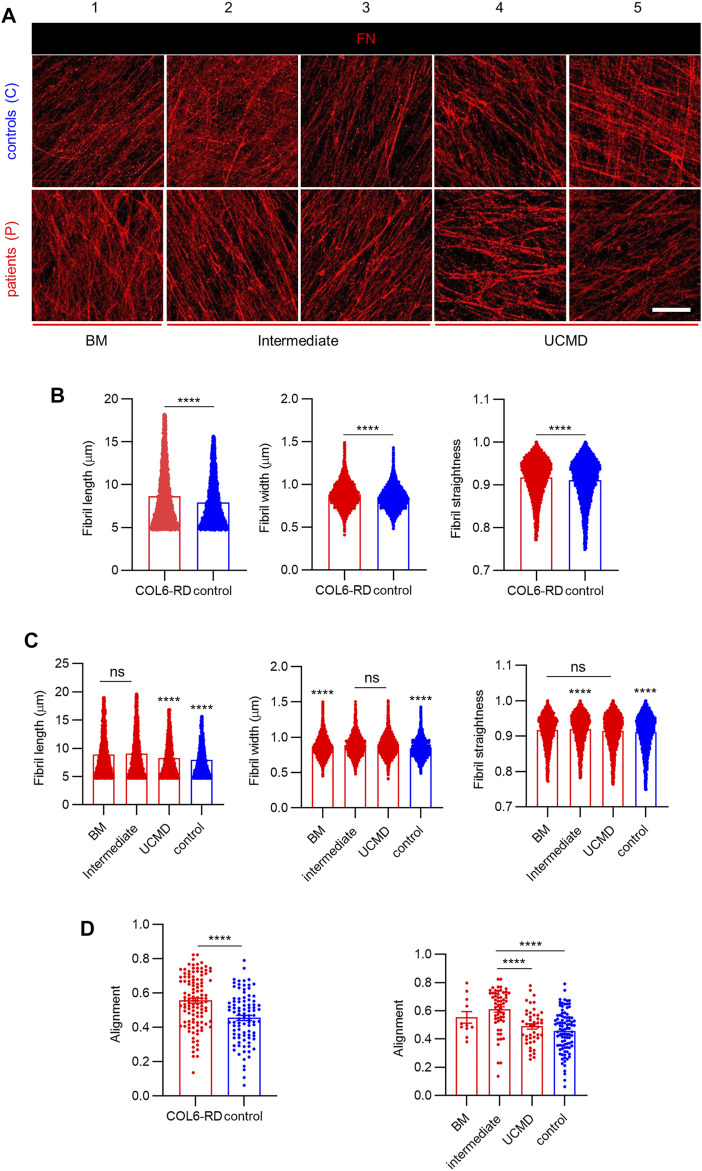
Collagen VI-related dystrophies (COL6-RDs) are a group of rare congenital neuromuscular dystrophies that represent a continuum of overlapping clinical phenotypes that go from the milder Bethlem myopathy (BM) to the severe Ullrich congenital muscular dystrophy, for which there is no effective treatment. Mutations in one of the three Collagen VI genes alter the incorporation of this protein into the extracellular matrix (ECM), affecting the assembly and the structural integrity of the whole fibrillar network. Clinical hallmarks of COL6-RDs are secondary to the ECM disruption and include muscle weakness, proximal joint contractures, and distal hyperlaxity. Although some traits have been identified in patients' ECMs, a correlation between the ECM features and the clinical phenotype has not been established, mainly due to the lack of predictive and reliable models of the pathology. Herein, we engineered a new personalized pre-clinical model of COL6-RDs using cell-derived matrices (CDMs) technology to better recapitulate the complexity of the native scenario. We found that CDMs from COL6-RD patients presented alterations in ECM structure and composition, showing a significantly decreased Collagen VI secretion, especially in the more severe phenotypes, and a decrease in Fibrillin-1 inclusion. Next, we examined the Collagen VI-mediated deposition of Fibronectin in the ECM, finding a higher alignment, length, width, and straightness than in patients with COL6-RDs. Overall, these results indicate that CDMs models are promising tools to explore the alterations that arise in the composition and fibrillar architecture due to mutations in Collagen VI genes, especially in early stages of matrix organization. Ultimately, CDMs derived from COL6-RD patients may become relevant pre-clinical models, which may help identifying novel biomarkers to be employed in the clinics and to investigate novel therapeutic targets and treatments.
与胶原蛋白VI相关的肌营养不良症(COL6-RDs)是一组罕见的先天性神经肌肉疾病,代表了一系列重叠的临床表型,从较轻的Bethlem肌病(BM)到严重的Ullrich先天性肌营养不良症,目前尚无有效治疗方法。三个胶原蛋白VI基因之一发生突变会改变该蛋白整合到细胞外基质(ECM)中的过程,影响整个纤维网络的组装和结构完整性。COL6-RDs的临床特征继发于ECM破坏,包括肌肉无力、近端关节挛缩和远端关节过度松弛。尽管在患者的ECM中已发现一些特征,但ECM特征与临床表型之间的相关性尚未确立,主要原因是缺乏该病理学的预测性和可靠模型。在此,我们利用细胞衍生基质(CDMs)技术构建了一种新的个性化COL6-RDs临床前模型,以更好地重现天然情况的复杂性。我们发现,COL6-RD患者的CDMs在ECM结构和组成上存在改变,胶原蛋白VI分泌显著减少,尤其是在更严重的表型中,并且纤连蛋白-1的包含量也减少。接下来,我们研究了胶原蛋白VI介导的纤连蛋白在ECM中的沉积,发现其排列、长度、宽度和直线度均高于COL6-RD患者。总体而言,这些结果表明,CDMs模型是探索由于胶原蛋白VI基因突变导致的组成和纤维结构改变的有前景的工具,尤其是在基质组织的早期阶段。最终,来自COL6-RD患者的CDMs可能成为相关的临床前模型,这可能有助于识别临床上可使用的新型生物标志物,并研究新型治疗靶点和治疗方法。