Mutua Benard M, Sowayi George, Okoth Patrick
Department of Medical Laboratory Sciences, School of Public Health Biomedical Sciences and Technology, Masinde Muliro University of Science and Technology, Kakamega, Kenya.
Department of Biological Sciences, School of Natural and Applied Sciences, Masinde Muliro University of Science and Technology, Kakamega, Kenya.
Afr J Lab Med. 2022 Apr 29;11(1):1644. doi: 10.4102/ajlm.v11i1.1644. eCollection 2022.
Haemoglobinopathies are inherited haemoglobin disorders that result in anaemia characterised by erythrocyte anisopoikilocytosis. Red cell distribution width (RDW) measures anisopoikiloytosis and is readily reported by haematology analysers as a complete blood count parameter. The utility of RDW as a diagnostic marker of haemoglobinopathies in Kenya remains undetermined and undocumented.
This study aimed to determine the diagnostic efficacy of RDW in discriminating haemoglobinopathy and haemoglobinopathy-free cases in Kenya.
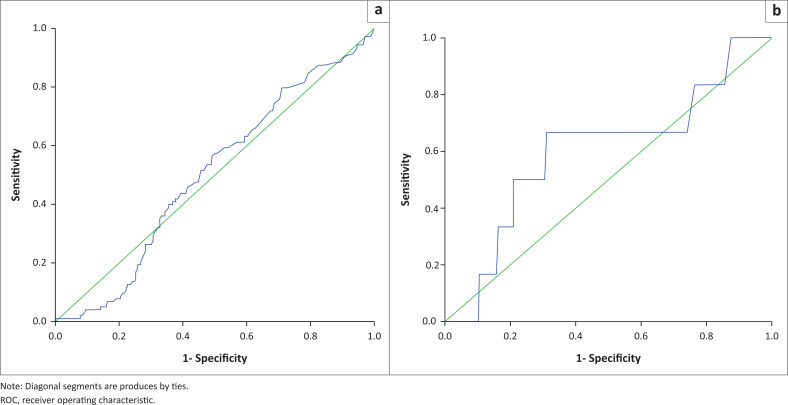
The case-control study used randomly selected haematology analyser outputs for haemoglobinopathy-free (241, 49.4%) and haemoglobinopathy cases (247, 50.1%) aged 1 month to 66 years old tested in the Aga Khan Hospital, Kisumu, and its satellite centres in western Kenya from 01 January 2015 to 31 December 2020. Results were verified using high performance liquid chromatography. The receiver operating characteristic (ROC) curve was used to evaluate the diagnostic power of RDW as a biomarker for sickle cell disease (SCD) and sickle cell trait phenotypes and β-thalassaemia.
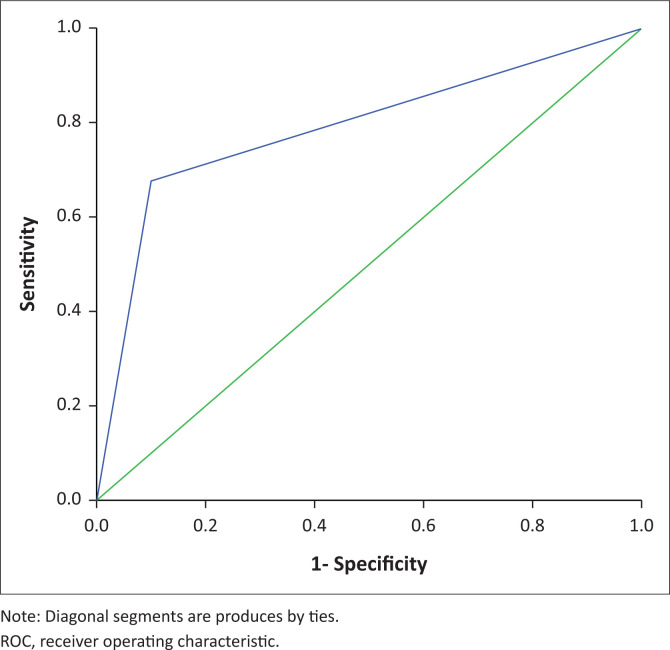
The RDW showed diagnostic significance in SCD phenotypes at 21.1 ROC curve coordinate with 67.7% sensitivity, 90.0% specificity, 0.789 accuracy, 70.5% positive predictive validity, 88.8% negative predictive validity, 6.77 positive likelihood ratio, 0.36 negative likelihood ratio and 18.94 (11.4-31.4) odds ratio.
An RDW of 21.1% is potentially a predictor of SCD haemoglobin phenotypes and should be included in the haematology screening algorithm as a critical value, above which suspected cases qualify to be investigated for SCD.
血红蛋白病是遗传性血红蛋白疾病,可导致以红细胞大小不均一性为特征的贫血。红细胞分布宽度(RDW)可衡量红细胞大小不均一性,血液学分析仪在全血细胞计数参数中可轻松报告该指标。在肯尼亚,RDW作为血红蛋白病诊断标志物的效用仍未确定且无文献记载。
本研究旨在确定RDW在肯尼亚鉴别血红蛋白病和无血红蛋白病病例中的诊断效能。
该病例对照研究使用了2015年1月1日至2020年12月31日在基苏木的阿迦汗医院及其在肯尼亚西部的卫星中心对年龄在1个月至66岁之间的无血红蛋白病(241例,49.4%)和血红蛋白病病例(247例,50.1%)随机选择的血液学分析仪检测结果。结果通过高效液相色谱法进行验证。采用受试者工作特征(ROC)曲线评估RDW作为镰状细胞病(SCD)、镰状细胞性状表型和β地中海贫血生物标志物的诊断能力。
RDW在SCD表型中具有诊断意义,ROC曲线坐标为21.1,灵敏度为67.7%,特异性为90.0%,准确度为0.789,阳性预测效度为70.5%,阴性预测效度为88.8%,阳性似然比为6.77,阴性似然比为0.36,比值比为值为18.94(11.4 - 31.4)。
RDW为21.1%可能是SCD血红蛋白表型的一个预测指标,应作为临界值纳入血液学筛查算法,高于该值的疑似病例有资格接受SCD调查。