KEMRI-Wellcome Trust Research Programme, Kilifi, Kenya.
KEMRI-Wellcome Trust Research Programme, Kilifi, Kenya; Faculty of Medicine, Imperial College, St Mary's Hospital, London, UK.
Lancet Glob Health. 2019 Oct;7(10):e1458-e1466. doi: 10.1016/S2214-109X(19)30328-6. Epub 2019 Aug 23.
Sickle cell disease is the most common severe monogenic disorder in humans. In Africa, 50-90% of children born with sickle cell disease die before they reach their fifth birthday. In this study, we aimed to describe the comparative incidence of specific clinical outcomes among children aged between birth and 5 years with and without sickle cell disease, who were resident within the Kilifi area of Kenya.
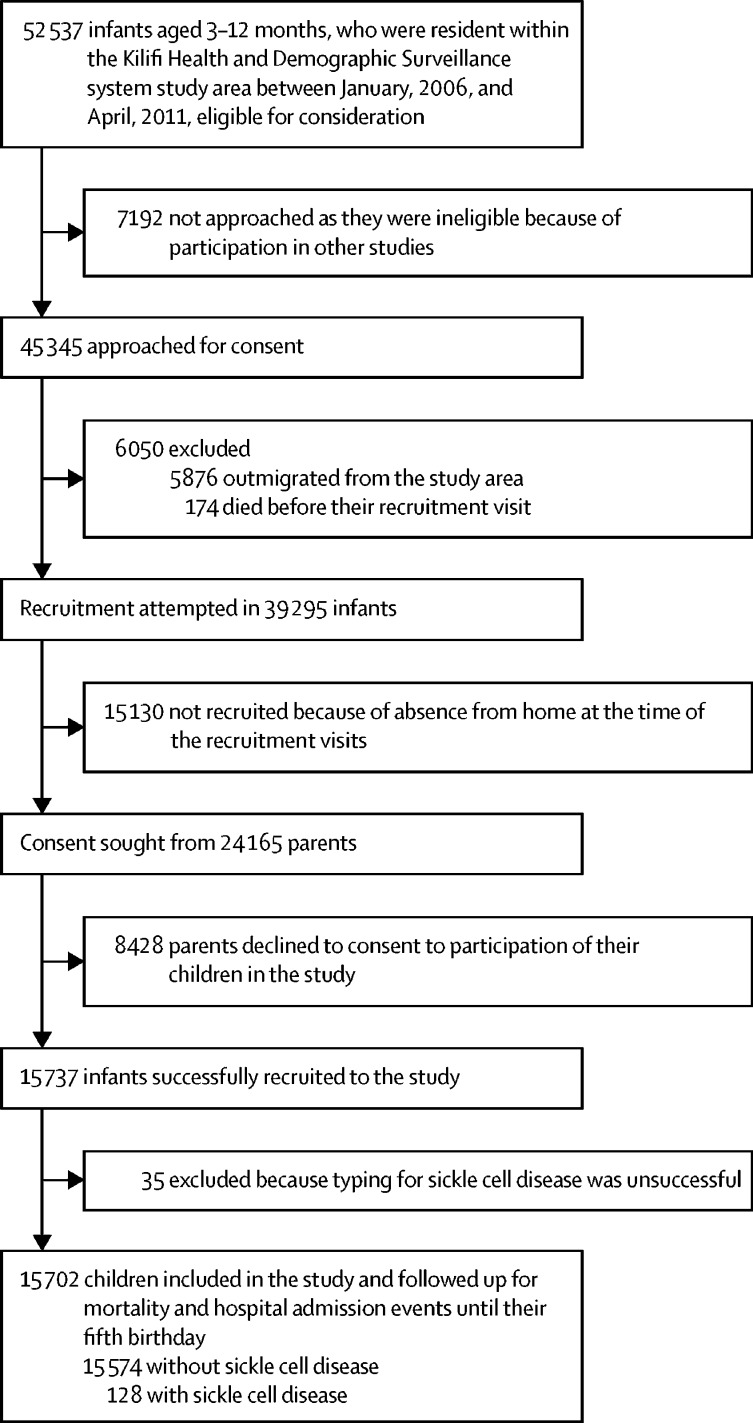
This prospective cohort study was done on members of the Kilifi Genetic Birth Cohort Study (KGBCS) on the Indian Ocean coast of Kenya. Recruitment to the study was facilitated through the Kilifi Health and Demographic Surveillance System (KHDSS), which covers a resident population of 260 000 people, and was undertaken between Jan 1, 2006, and April 30, 2011. All children who were born within the KHDSS area and who were aged 3-12 months during the recruitment period were eligible for inclusion. Participants were tested for sickle cell disease and followed up for survival status and disease-specific admission to Kilifi County Hospital by passive surveillance until their fifth birthday. Children with sickle cell disease were offered confirmatory testing and care at a dedicated outpatient clinic.
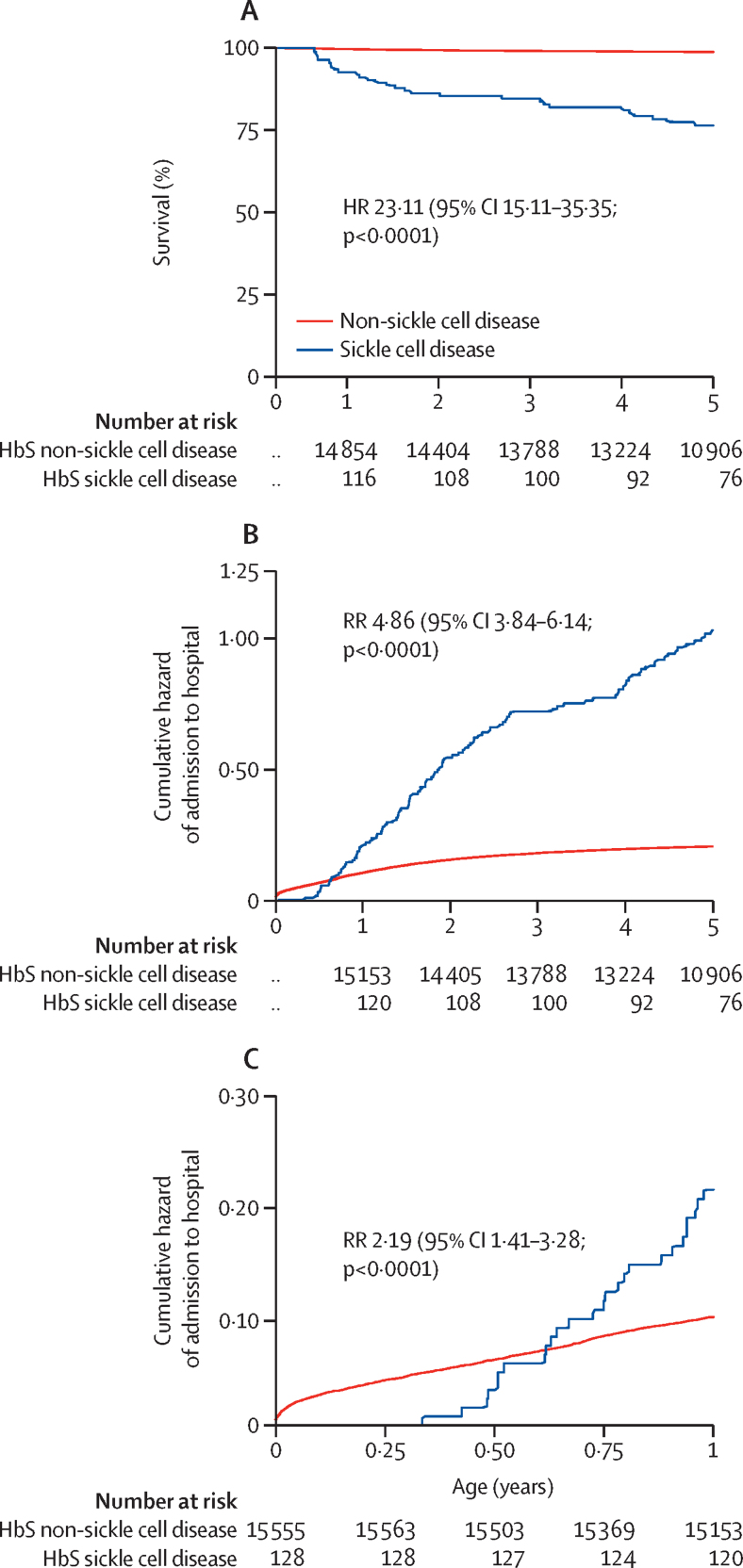
15 737 infants were recruited successfully to the KGBCS, and 128 (0·8%) of these infants had sickle cell disease, of whom 70 (54·7%) enrolled at the outpatient clinic within 12 months of recruitment. Mortality was higher in children with sickle cell disease (58 per 1000 person-years of observation, 95% CI 40-86) than in those without sickle cell disease (2·4 per 1000 person-years of observation, 2·0-2·8; adjusted incidence rate ratio [IRR] 23·1, 95% CI 15·1-35·3). Among children with sickle cell disease, mortality was lower in those who enrolled at the clinic (adjusted IRR 0·26, 95% CI 0·11-0·62) and in those with higher levels of haemoglobin F (HbF; adjusted IRR 0·40, 0·17-0·94). The incidence of admission to hospital was also higher in children with sickle cell disease than in children without sickle cell disease (210 per 1000 person-years of observation, 95% CI 174-253, vs 43 per 1000 person-years of observation, 42-45; adjusted IRR 4·80, 95% CI 3·84-6·15). The most common reason for admission to hospital among those with sickle cell disease was severe anaemia (incidence 48 per 1000 person-years of observation, 95% CI 32-71). Admission to hospital was lower in those with a recruitment HbF level above the median (IRR 0·43, 95% CI 0·24-0·78; p=0·005) and those who were homozygous for α-thalassaemia (0·07, 0·01-0·83; p=0·035).
Although morbidity and mortality were high in young children with sickle cell disease in this Kenyan cohort, both were reduced by early diagnosis and supportive care. The emphasis must now move towards early detection and prevention of long-term complications of sickle cell disease.
Wellcome Trust.
镰状细胞病是人类最常见的严重单基因疾病。在非洲,50-90%的镰状细胞病患儿在 5 岁生日前死亡。本研究旨在描述肯尼亚基利菲地区出生至 5 岁的镰状细胞病患儿与非镰状细胞病患儿的特定临床结局的发生率。
本前瞻性队列研究在肯尼亚印度洋沿岸的基利菲遗传出生队列研究(KGBCS)中进行。通过基利菲人口与健康动态监测系统(KHDSS)促进了对该研究的招募,该系统覆盖了 26 万常驻人口,并于 2006 年 1 月 1 日至 2011 年 4 月 30 日进行。所有在 KHDSS 地区出生且在招募期间年龄为 3-12 个月的儿童均有资格入组。对参与者进行镰状细胞病检测,并通过被动监测跟踪其生存状况和镰状细胞病特定入院情况至 5 岁生日。镰状细胞病患儿在专门的门诊接受确认检测和护理。
成功招募了 15737 名婴儿进入 KGBCS,其中 128 名(0.8%)婴儿患有镰状细胞病,其中 70 名(54.7%)在招募后 12 个月内入组门诊。镰状细胞病患儿的死亡率(58/1000人年的观察,95%CI 40-86)高于无镰状细胞病患儿(2.4/1000人年的观察,2.0-2.8;调整后的发病率比[IRR]23.1,95%CI 15.1-35.3)。在镰状细胞病患儿中,在门诊就诊的患儿死亡率较低(调整后的 IRR 0.26,95%CI 0.11-0.62),且血红蛋白 F(HbF)水平较高的患儿死亡率也较低(调整后的 IRR 0.40,0.17-0.94)。镰状细胞病患儿的住院率也高于无镰状细胞病患儿(210/1000人年的观察,95%CI 174-253,vs 43/1000人年的观察,42-45;调整后的 IRR 4.80,95%CI 3.84-6.15)。镰状细胞病患儿最常见的住院原因是严重贫血(发生率 48/1000人年的观察,95%CI 32-71)。镰状细胞病患儿中,HbF 水平高于中位数的患儿(IRR 0.43,95%CI 0.24-0.78;p=0.005)和α-地中海贫血纯合子患儿(IRR 0.07,0.01-0.83;p=0.035)住院率较低。
尽管本肯尼亚队列中镰状细胞病患儿的发病率和死亡率都很高,但早期诊断和支持性护理都降低了发病率和死亡率。现在的重点必须转移到早期发现和预防镰状细胞病的长期并发症。
惠康信托基金会。