Liang Qiongyue, Dong Mengmeng, Gu Minghua, Zhang Peng, Ma Qiuxiang, He Bing
State Key Laboratory for Conservation and Utilization of Subtropical Agro-Bioresources, College of Agriculture, Guangxi University, Nanning, China.
National Demonstration Center for Experimental Plant Science Education, College of Agriculture, Guangxi University, Nanning, China.
Front Plant Sci. 2022 Apr 25;13:866855. doi: 10.3389/fpls.2022.866855. eCollection 2022.
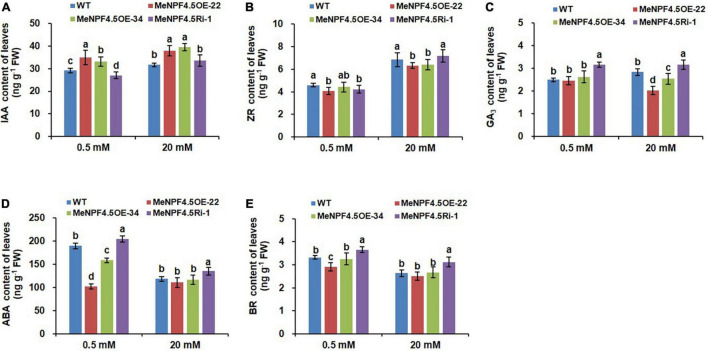
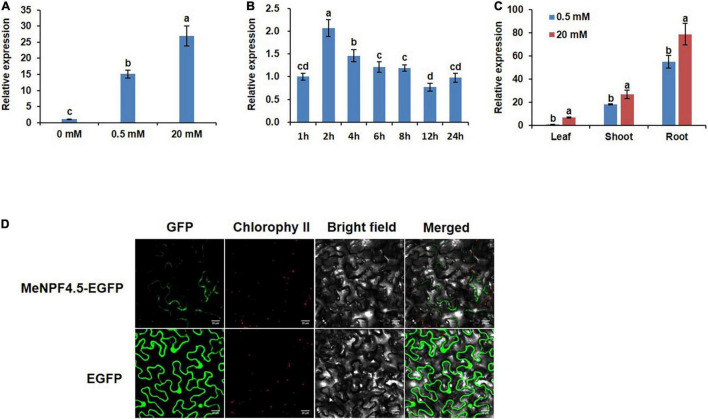
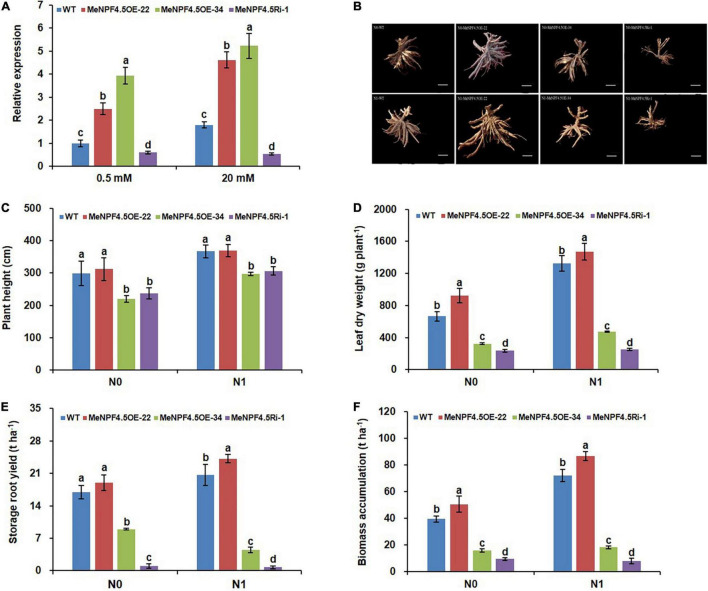
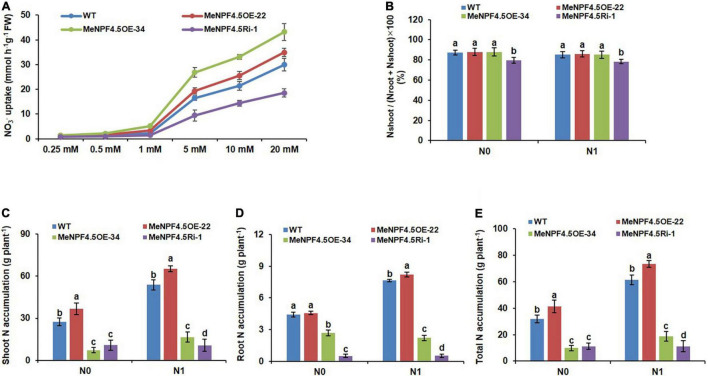
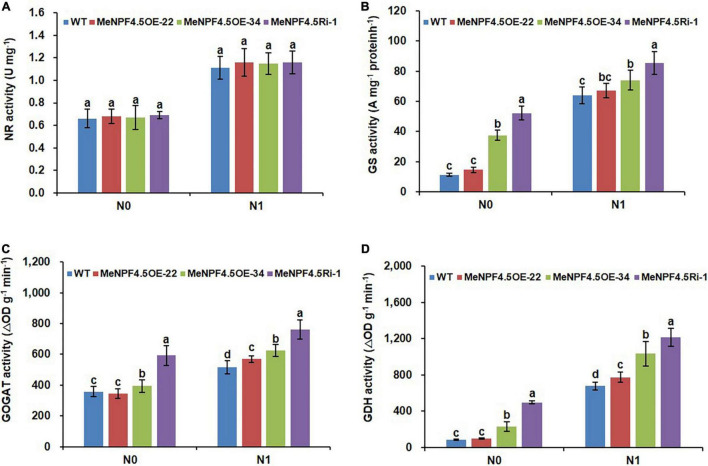
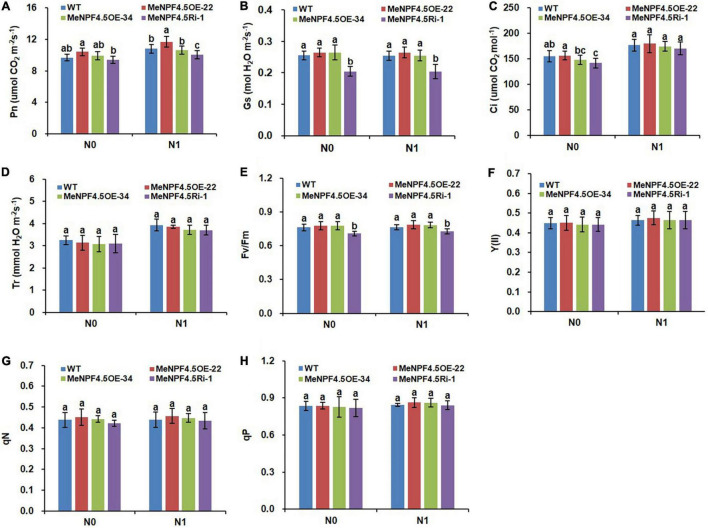
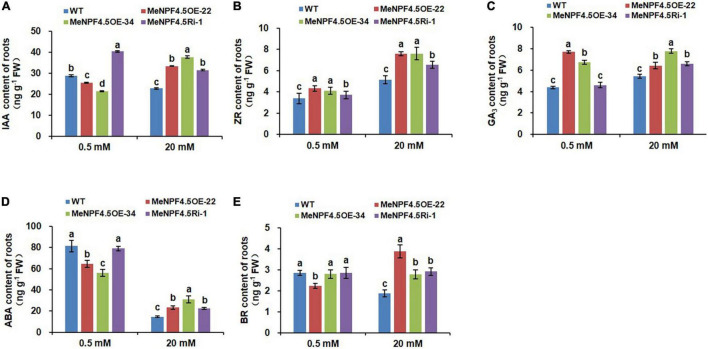
Improving nitrogen use efficiency (NUE) is a very important goal of crop breeding throughout the world. Cassava is an important food and energy crop in tropical and subtropical regions, and it mainly use nitrate as an N source. To evaluate the effect of the nitrate transporter gene on the uptake and utilization of N in cassava, two overexpression lines ( OE-22 and OE-34) and one RNA interference (RNAi) line ( Ri-1) were used for a tissue culture experiment, combining with a field trial. The results indicated that MeNPF4.5 is a plasma membrane transporter mainly expressed in roots. The gene is induced by NO . Compared with the wild type, OE-22 exhibited improved growth, yield, and NUE under both low N and normal N levels, especially in the normal N treatment. However, the growth and N uptake of RNAi plants were significantly reduced, indicating poor N uptake and utilization capacity. In addition, photosynthesis and the activities of N metabolism-related enzymes (glutamine synthetase, glutamine oxoglutarate aminotransferase, and glutamate dehydrogenase) of leaves in overexpression lines were significantly higher than those in wild type. Interestingly, the RNAi line increased enzymatic activity but decreased photosynthesis. IAA content of roots in overexpressed lines were lower than that in wild type under low N level, but higher than that of wild type under normal N level. The RNAi line increased IAA content of roots under both N levels. The IAA content of leaves in the overexpression lines was significantly higher than that of the wild type, but showed negative effects on that of the RNAi lines. Thus, our results demonstrated that the MeNPF4.5 nitrate transporter is involved in regulating the uptake and utilization of N in cassava, which leads to the increase of N metabolizing enzyme activity and photosynthesis, along with the change of endogenous hormones, thereby improving the NUE and yield of cassava. These findings shed light that MeNPF4.5 is involved in N use efficiency use in cassava.
提高氮素利用效率(NUE)是全球作物育种的一个非常重要的目标。木薯是热带和亚热带地区重要的粮食和能源作物,它主要利用硝酸盐作为氮源。为了评估硝酸盐转运蛋白基因对木薯氮素吸收和利用的影响,使用了两个过表达系(OE - 22和OE - 34)和一个RNA干扰(RNAi)系(Ri - 1)进行组织培养实验,并结合田间试验。结果表明,MeNPF4.5是一种主要在根中表达的质膜转运蛋白。该基因受NO诱导。与野生型相比,OE - 22在低氮和正常氮水平下均表现出更好的生长、产量和氮素利用效率,尤其是在正常氮处理下。然而,RNAi植株的生长和氮吸收显著降低,表明其氮吸收和利用能力较差。此外,过表达系叶片的光合作用和氮代谢相关酶(谷氨酰胺合成酶、谷氨酰胺 - 酮戊二酸氨基转移酶和谷氨酸脱氢酶)的活性显著高于野生型。有趣的是,RNAi系酶活性增加但光合作用降低。在低氮水平下,过表达系根中的IAA含量低于野生型,但在正常氮水平下高于野生型。RNAi系在两种氮水平下均增加了根中的IAA含量。过表达系叶片中的IAA含量显著高于野生型,但对RNAi系叶片中的IAA含量有负面影响。因此,我们的结果表明,MeNPF4.5硝酸盐转运蛋白参与调节木薯中氮的吸收和利用,这导致氮代谢酶活性和光合作用增加,同时伴随着内源激素的变化,从而提高了木薯的氮素利用效率和产量。这些发现揭示了MeNPF4.5参与木薯氮素利用效率的调控。