Wong Albert Chern Sun, Massel Karen, Lam Yasmine, Hintzsche Jessica, Chauhan Bhagirath Singh
Centre for Crop Science, Queensland Alliance for Agriculture and Food Innovation, The University of Queensland, Brisbane, QLD, Australia.
Centre for Crop Science, Queensland Alliance for Agriculture and Food Innovation, The University of Queensland, Gatton, QLD, Australia.
Front Plant Sci. 2022 Apr 25;13:887723. doi: 10.3389/fpls.2022.887723. eCollection 2022.
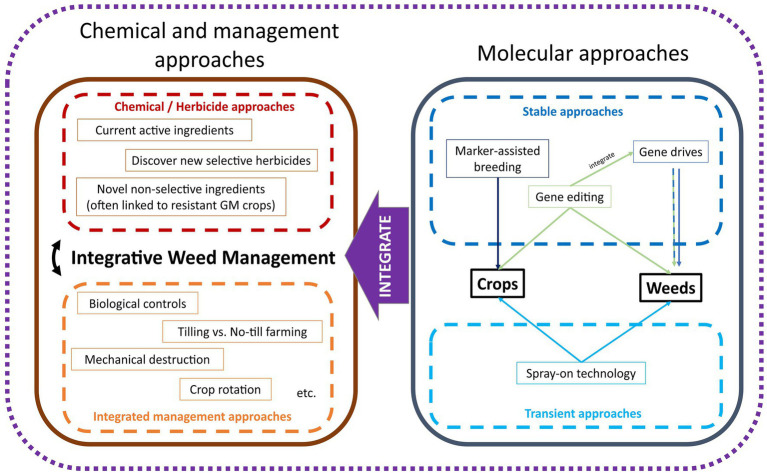
In most agriculture farmlands, weed management is predominantly reliant on integrated weed management (IWM) strategies, such as herbicide application. However, the overuse and misuse of herbicides, coupled with the lack of novel active ingredients, has resulted in the uptrend of herbicide-resistant weeds globally. Moreover, weedy traits that contribute to weed seed bank persistence further exacerbate the challenges in weed management. Despite ongoing efforts in identifying and improving current weed management processes, the pressing need for novel control techniques in agricultural weed management should not be overlooked. The advent of CRISPR/Cas9 gene-editing systems, coupled with the recent advances in "omics" and cheaper sequencing technologies, has brought into focus the potential of managing weeds in farmlands through direct genetic control approaches, but could be achieved stably or transiently. These approaches encompass a range of technologies that could potentially manipulate expression of key genes in weeds to reduce its fitness and competitiveness, or, by altering the crop to improve its competitiveness or herbicide tolerance. The push for reducing or circumventing the use of chemicals in farmlands has provided an added incentive to develop practical and feasible molecular approaches for weed management, although there are significant technical, practical, and regulatory challenges for utilizing these prospective molecular technologies in weed management.
在大多数农业耕地上,杂草管理主要依赖于综合杂草管理(IWM)策略,如施用除草剂。然而,除草剂的过度使用和滥用,再加上缺乏新型活性成分,导致全球抗除草剂杂草呈上升趋势。此外,有助于杂草种子库持久性的杂草特性进一步加剧了杂草管理的挑战。尽管目前一直在努力识别和改进现有的杂草管理流程,但农业杂草管理中对新型控制技术的迫切需求不容忽视。CRISPR/Cas9基因编辑系统的出现,再加上“组学”和更廉价测序技术的最新进展,使得通过直接遗传控制方法管理农田杂草的潜力受到关注,且这种控制可以稳定或短暂实现。这些方法包括一系列技术,这些技术有可能操纵杂草中关键基因的表达,以降低其适应性和竞争力,或者通过改变作物来提高其竞争力或除草剂耐受性。减少或避免在农田中使用化学品的推动,为开发实用可行的杂草管理分子方法提供了额外的动力,尽管在杂草管理中利用这些前瞻性分子技术存在重大的技术、实践和监管挑战。