Winter Matthew J, Ono Yosuke, Ball Jonathan S, Walentinsson Anna, Michaelsson Erik, Tochwin Anna, Scholpp Steffen, Tyler Charles R, Rees Steve, Hetheridge Malcolm J, Bohlooly-Y Mohammad
Biosciences, College of Life and Environmental Sciences, University of Exeter, Exeter, United Kingdom.
Living Systems Institute, College of Life and Environmental Sciences, University of Exeter, Exeter, United Kingdom.
Front Pharmacol. 2022 Apr 25;13:827686. doi: 10.3389/fphar.2022.827686. eCollection 2022.
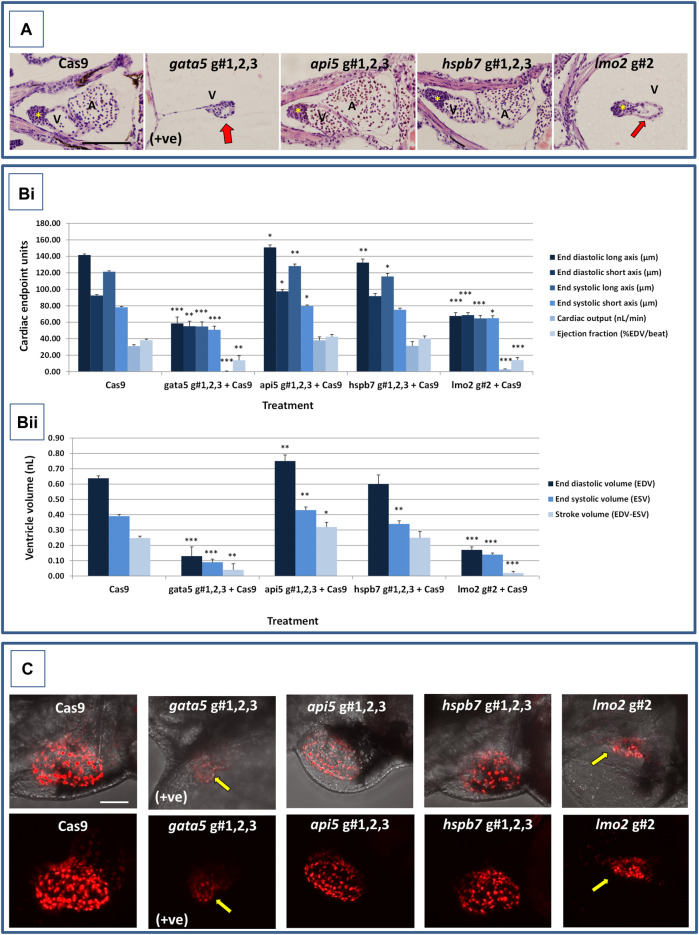
The clinical heterogeneity of heart failure has challenged our understanding of the underlying genetic mechanisms of this disease. In this respect, large-scale patient DNA sequencing studies have become an invaluable strategy for identifying potential genetic contributing factors. The complex aetiology of heart failure, however, also means that models are vital to understand the links between genetic perturbations and functional impacts as part of the process for validating potential new drug targets. Traditional approaches (e.g., genetically-modified mice) are optimal for assessing small numbers of genes, but less practical when multiple genes are identified. The zebrafish, in contrast, offers great potential for higher throughput gene functional assessment to aid target prioritisation, by providing more confidence in target relevance and facilitating gene selection for definitive loss of function studies undertaken in mice. Here we used whole-exome sequencing and bioinformatics on human patient data to identify 3 genes (, , and ) suggestively associated with heart failure that were also predicted to play a broader role in disease aetiology. The role of these genes in cardiovascular system development and function was then further investigated using CRISPR/Cas9-mediated gene mutation analysis in zebrafish. We observed multiple impacts in F0 knockout zebrafish embryos (crispants) following effective somatic mutation, including changes in ventricle size, pericardial oedema, and chamber malformation. In the case of , there was also a significant impact on cardiovascular function as well as an expected reduction in erythropoiesis. The data generated from both the human and zebrafish assessments undertaken supports further investigation of the potential roles of , , and in human cardiovascular disease. The data presented also supports the use of human genetic variant analysis, in combination with zebrafish crispant phenotyping, as a powerful approach for assessing gene function as part of an integrated multi-level drug target validation strategy.
心力衰竭的临床异质性对我们理解该疾病潜在的遗传机制提出了挑战。在这方面,大规模患者DNA测序研究已成为识别潜在遗传影响因素的一项宝贵策略。然而,心力衰竭复杂的病因也意味着,作为验证潜在新药靶点过程的一部分,模型对于理解基因扰动与功能影响之间的联系至关重要。传统方法(如基因编辑小鼠)对于评估少量基因是最佳选择,但当识别出多个基因时就不太实用了。相比之下,斑马鱼为高通量基因功能评估提供了巨大潜力,有助于确定靶点优先级,因为它能增强对靶点相关性的信心,并便于为在小鼠中进行的明确功能丧失研究选择基因。在此,我们对人类患者数据进行了全外显子组测序和生物信息学分析,以识别3个与心力衰竭可能相关的基因(、和),这些基因预计在疾病病因中也发挥更广泛作用。然后,我们利用斑马鱼中CRISPR/Cas9介导的基因突变分析,进一步研究了这些基因在心血管系统发育和功能中的作用。我们观察到在有效的体细胞突变后,F0基因敲除斑马鱼胚胎(基因敲降胚胎)出现了多种影响,包括心室大小改变、心包水肿和腔室畸形。就而言,对心血管功能也有显著影响,同时红细胞生成预期减少。来自人类和斑马鱼评估的数据支持进一步研究、和在人类心血管疾病中的潜在作用。所呈现的数据还支持将人类遗传变异分析与斑马鱼基因敲降胚胎表型分析相结合,作为评估基因功能的有力方法,作为综合多层次药物靶点验证策略的一部分。