The Graduate School, Dalian Medical University, Dalian, Liaoning, People's Republic of China.
Department of Orthopedics, Northern Jiangsu People's Hospital Affiliated to Yangzhou University, Yangzhou, Jiangsu, People's Republic of China.
Clin Interv Aging. 2022 May 4;17:707-715. doi: 10.2147/CIA.S363682. eCollection 2022.
To investigate the risk factors of increased hidden blood loss (HBL) after total hip arthroplasty (THA) for femoral neck fracture in elderly women and establish the nomogram prediction model for the guidance to reduce HBL in clinic.
A total of 206 elderly female patients with femoral neck fracture who underwent THA in Northern Jiangsu People's Hospital from January 2019 to November 2021 were included. The demographic and relevant clinical information of the patients were collected. Pearson, independent sample -test, multiple linear regression and other statistical methods were used for correlation analysis by SPSS 22.0 statistical software. Moreover, the risk factors of postoperative HBL increase in THA patients were obtained and the nomogram prediction model for the guidance to reduce HBL in clinic was established.
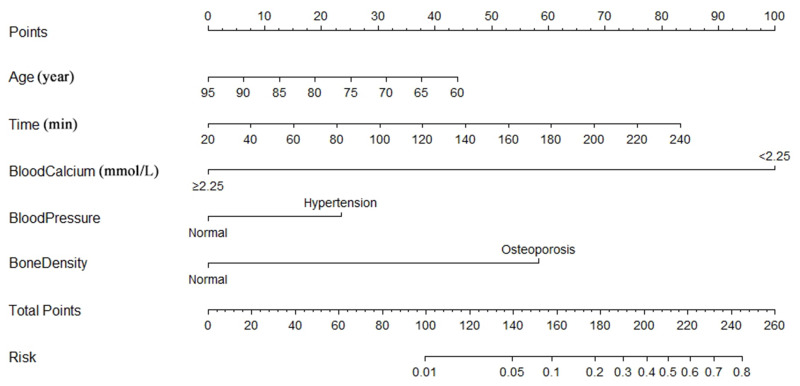
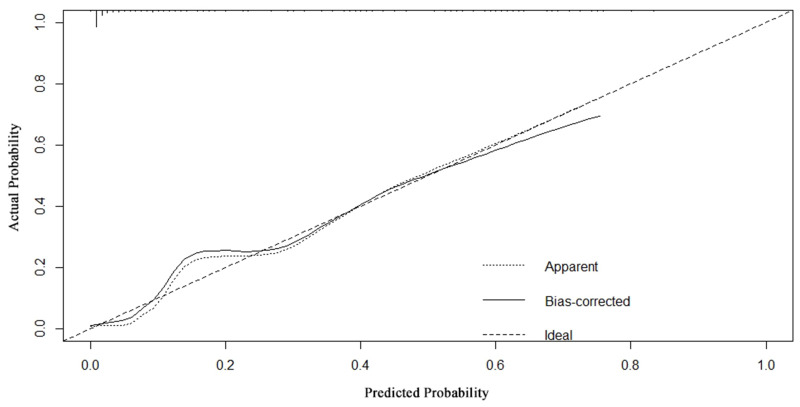
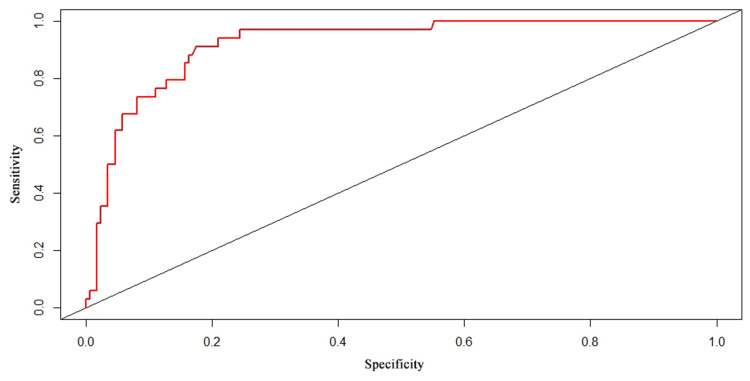
HBL was 626 ± 400 mL, accounting for 72.8% ± 18.4% of the perioperative total blood loss (TBL) (799 ± 411 mL), while blood loss of HGB was 15.1±10.4 g/L. Multiple linear regression analysis showed that HBL was associated with lower age (regression coefficient = -9.271, P = 0.010), operative time (regression coefficient = 2.653, P = 0.004), preoperative blood calcium (<2.25 mmol/L) (regression coefficient = 232.492, P < 0.001), hypertension (regression coefficient = 150.352, P = 0.002) and osteoporosis (regression coefficient = 276.072, P < 0.001). R software was used to construct the nomogram prediction model and draw the ROC curve and calibration curve. The area under the curve (AUC) is 0.92 and the slope of calibration curve is close to 1.
Based on the five independent risk factors including age, operative time, preoperative blood calcium, hypertension and osteoporosis, the nomogram can predict the risk of HBL after THA for femoral neck fracture in elderly women with favorable differentiation and accuracy.
探讨老年女性股骨颈骨折患者全髋关节置换术(THA)后隐性失血(HBL)增加的危险因素,并建立指导临床减少 HBL 的列线图预测模型。
纳入 2019 年 1 月至 2021 年 11 月在苏北人民医院行 THA 的 206 例老年女性股骨颈骨折患者,收集患者的人口统计学和相关临床资料。采用 SPSS 22.0 统计软件进行 Pearson、独立样本 t 检验、多元线性回归等统计方法进行相关性分析。获得 THA 患者术后 HBL 增加的危险因素,并建立指导临床减少 HBL 的列线图预测模型。
HBL 为 626±400ml,占围手术期总失血量(TBL)(799±411ml)的 72.8%±18.4%,而 HGB 失血为 15.1±10.4g/L。多元线性回归分析显示,HBL 与年龄较低(回归系数=-9.271,P=0.010)、手术时间较长(回归系数=2.653,P=0.004)、术前血钙水平较低(<2.25mmol/L)(回归系数=232.492,P<0.001)、高血压(回归系数=150.352,P=0.002)和骨质疏松症(回归系数=276.072,P<0.001)有关。R 软件用于构建列线图预测模型,并绘制 ROC 曲线和校准曲线。曲线下面积(AUC)为 0.92,校准曲线的斜率接近 1。
基于年龄、手术时间、术前血钙、高血压和骨质疏松症 5 个独立危险因素,该列线图可预测老年女性股骨颈骨折 THA 后 HBL 的风险,具有良好的区分度和准确性。