Sabatino Jolanda, Leo Isabella, Strangio Antonio, Bella Sabrina La, Borrelli Nunzia, Avesani Martina, Josen Manjit, Paredes Josefa, Piccinelli Enrico, Sirico Domenico, Pergola Valeria, Fraisse Alain, De Rosa Salvatore, Indolfi Ciro, Di Salvo Giovanni
Division of Paediatric Cardiology, Department of Women's and Children's Health, University Hospital Padua, Padua, Italy.
Pediatric Research Institute (IRP) "Città della Speranza", Padua, Italy.
Front Cardiovasc Med. 2022 Apr 25;9:792622. doi: 10.3389/fcvm.2022.792622. eCollection 2022.
This international multi-center study aimed to demonstrate the feasibility and reliability of non-invasive myocardial work (MW) parameters in the pediatric population, and to provide normal reference ranges for this useful echocardiographic tool in this specific subset of patients.
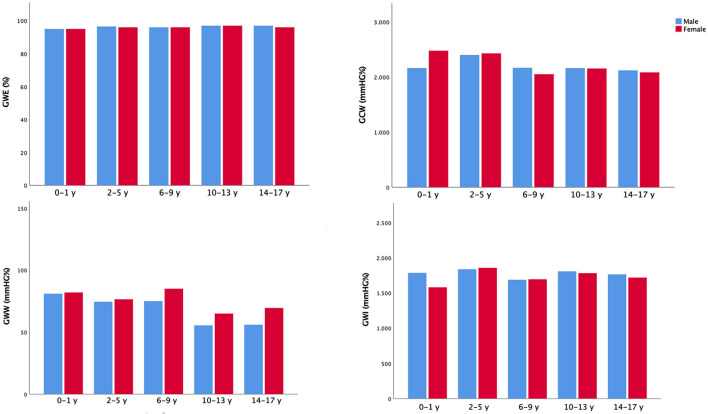
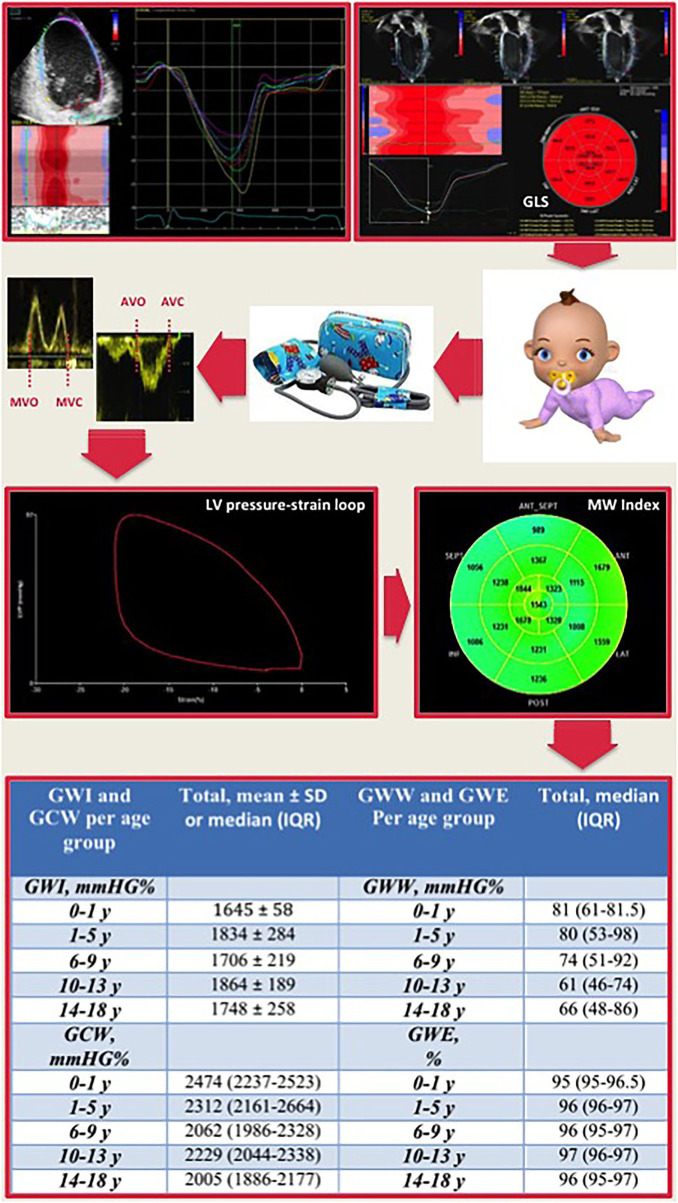
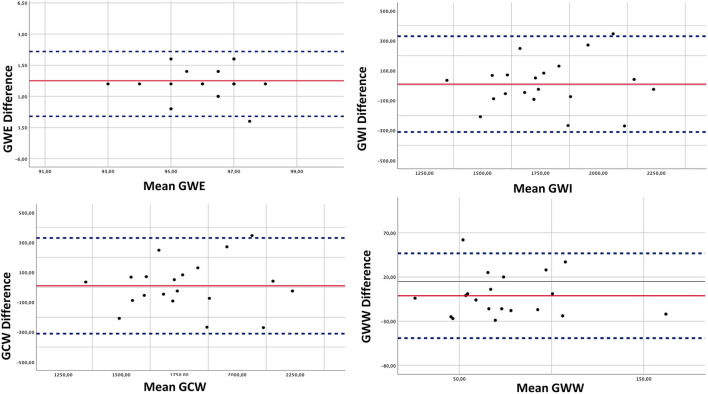
In this retrospective multi-center study involving three pediatric laboratories, 150 healthy children and adolescents (mean age of 10.6 ± 4.5, 91 males) were enrolled. A complete echocardiographic examination has been performed, including global longitudinal strain (GLS) assessment. The following parameters of non-invasive MW have been obtained through a dedicated software: global work index (GWI), global constructive work (GCW), global work waste (GWW), and global work efficiency (GWE), using left ventricular (LV) strain loops and non-invasive brachial artery cuff pressure values. The lowest expected values were for GWI 1,723 mmHg% in males and 1,682 mmHg% in females, for GCW 2,089 and 2,106 mmHg%, for GWE 95.9 and 95.5% whereas the highest expected value for GWW was 78 mmHg% in men and 90 mmHg% in women. The univariable and multivariable analysis showed significant associations between either GWI or GCW with SBP (β coefficient = 0.446, < 0.001; β coefficient = 0.456, < 0.001, respectively) and LV GLS (β coefficient = -0.268, = 0.001; β coefficient = -0.233, = 0.003, respectively). Inter- and intra-observer variability showed good reproducibility of non-invasive MW parameters.
Non-invasive MW parameters were feasible and reliable in the pediatric population. This study provided normal reference ranges of these useful echocardiographic indices.
这项国际多中心研究旨在证明无创心肌做功(MW)参数在儿科人群中的可行性和可靠性,并为这一特定患者亚组中这种有用的超声心动图工具提供正常参考范围。
在这项涉及三个儿科实验室的回顾性多中心研究中,纳入了150名健康儿童和青少年(平均年龄10.6±4.5岁,男性91名)。进行了完整的超声心动图检查,包括整体纵向应变(GLS)评估。通过专用软件获得以下无创MW参数:整体做功指数(GWI)、整体建设性做功(GCW)、整体做功损耗(GWW)和整体做功效率(GWE),使用左心室(LV)应变环和无创肱动脉袖带压力值。男性GWI的最低预期值为1723mmHg%,女性为1682mmHg%;GCW分别为2089和2106mmHg%;GWE分别为95.9%和95.5%;而GWW的最高预期值男性为78mmHg%,女性为90mmHg%。单变量和多变量分析显示,GWI或GCW与收缩压(β系数分别为0.446,P<0.001;β系数为0.456,P<0.001)以及LV GLS(β系数分别为-0.268,P=0.001;β系数为-0.233,P=0.003)之间存在显著关联。观察者间和观察者内的变异性显示无创MW参数具有良好的可重复性。
无创MW参数在儿科人群中是可行且可靠的。本研究提供了这些有用的超声心动图指标的正常参考范围。