Hasselbach Lisa, Weidner Johannes, Elsässer Albrecht, Theilmeier Gregor
Division of Cardiology and Division of Perioperative Inflammation and Infection, Department Human Medicine, University of Oldenburg, Oldenburg, Germany.
Division of Perioperative Inflammation and Infection, Department Human Medicine, University of Oldenburg, Oldenburg, Germany.
Front Cardiovasc Med. 2022 Apr 25;9:809935. doi: 10.3389/fcvm.2022.809935. eCollection 2022.
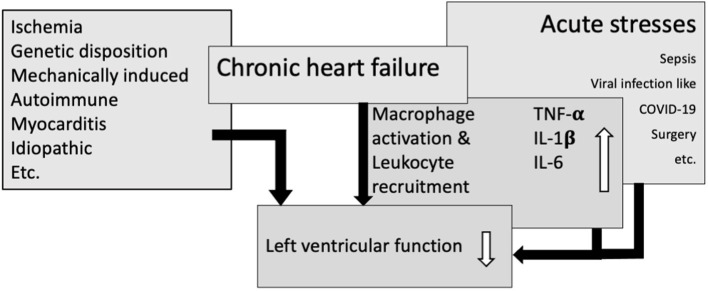
Cardiovascular diseases continue to be the most imminent health care problems in the western world, accounting for numerous deaths per year. Heart failure (HF), namely the reduction of left ventricular function, is one of the major cardiovascular disease entities. It is chronically progressing with relapsing acute decompensations and an overall grave prognosis that is little different if not worse than most malignant diseases. Interestingly acute metabolically and/or immunologically challenging events like infections or major surgical procedures will cause relapses in the course of preexisting chronic heart failure, decrease the patients wellbeing and worsen myocardial function. HF itself and or its progression has been demonstrated to be driven at least in part by inflammatory pathways that are similarly turned on by infectious or non-infectious stress responses. These thus add to HF progression or relapse. TNF-α plasma levels are associated with disease severity and progression in HF. In addition, several cytokines (e.g., IL-1β, IL-6) are involved in deteriorating left ventricular function. Those observations are based on clinical studies using inhibitors of cytokines or their receptors or they stem from animal studies examining the effect of cytokine mediated inflammation on myocardial remodeling in models of heart failure. This short review summarizes the known underlying immunological processes that are shared by and drive all: chronic heart failure, select infectious diseases, and inflammatory stress responses. In conclusion the text provides a brief summary of the current development in immunomodulatory therapies for HF and their overlap with treatments of other disease entities.
心血管疾病仍然是西方世界最紧迫的医疗保健问题,每年导致众多人死亡。心力衰竭(HF),即左心室功能减退,是主要的心血管疾病实体之一。它呈慢性进展,伴有急性失代偿的复发,总体预后严重,与大多数恶性疾病相比,即便不差,也相差无几。有趣的是,急性代谢和/或免疫挑战性事件,如感染或大手术,会导致已有的慢性心力衰竭复发,降低患者的健康状况,并使心肌功能恶化。HF本身及其进展已被证明至少部分是由炎症途径驱动的,这些炎症途径在感染性或非感染性应激反应中同样会被激活。因此,这些因素会加剧HF的进展或复发。肿瘤坏死因子-α(TNF-α)血浆水平与HF的疾病严重程度和进展相关。此外,几种细胞因子(如白细胞介素-1β、白细胞介素-6)参与了左心室功能的恶化。这些观察结果基于使用细胞因子或其受体抑制剂的临床研究,或者源于在心力衰竭模型中研究细胞因子介导的炎症对心肌重塑影响的动物研究。这篇简短的综述总结了慢性心力衰竭、特定传染病和炎症应激反应所共有的、并驱动所有这些情况的已知潜在免疫过程。总之,本文简要概述了HF免疫调节治疗的当前进展及其与其他疾病实体治疗的重叠情况。