Lee In Hae, Duvall Laura B
Department of Biological Sciences, Columbia University in the City of New York, New York, NY, United States.
Front Behav Neurosci. 2022 Apr 25;16:778264. doi: 10.3389/fnbeh.2022.778264. eCollection 2022.
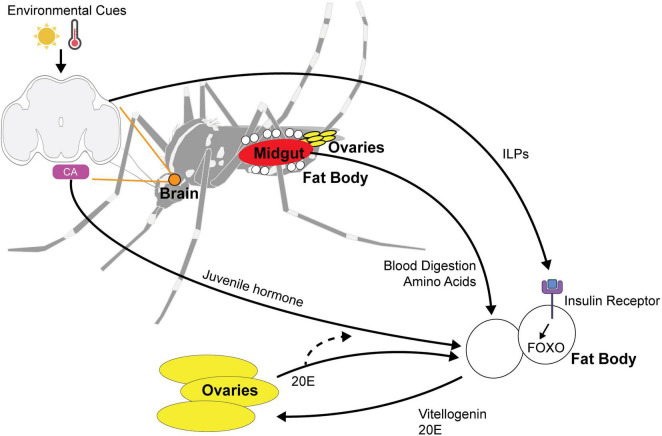
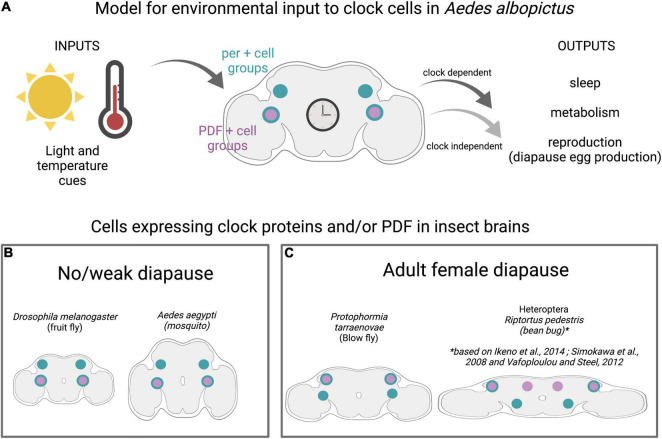
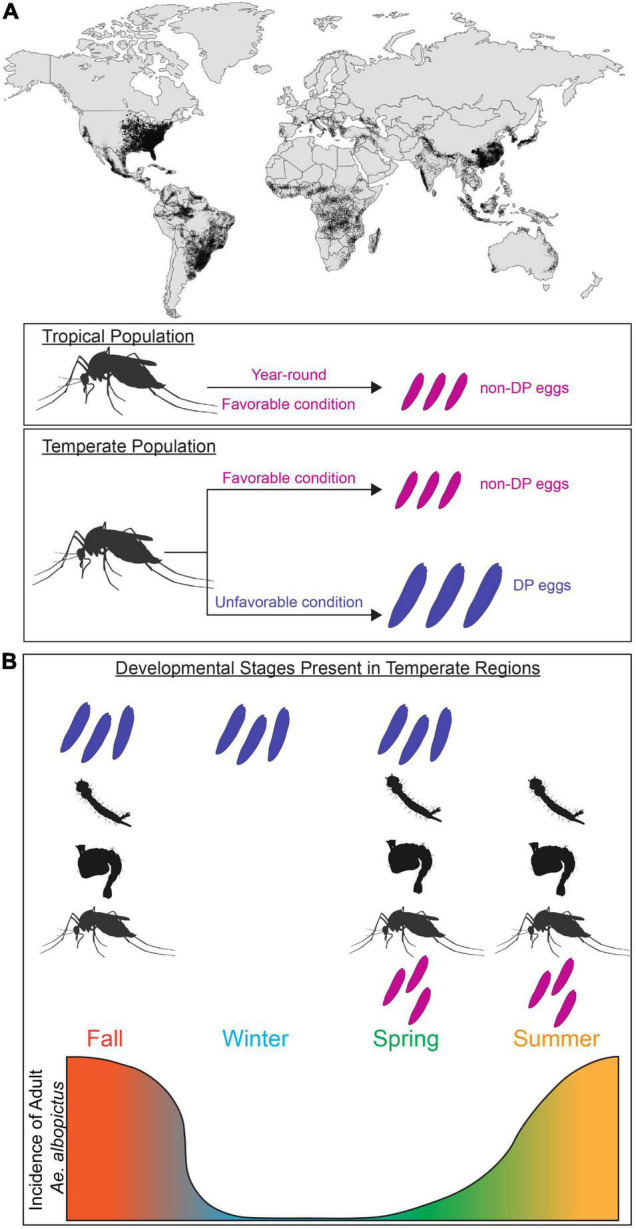
The Asian tiger mosquito, , is one of the most dangerous invasive species in the world. Females bite mammalian hosts, including humans, to obtain blood for egg development. The ancestral range of likely spanned from India to Japan and this species has since invaded a substantial portion of the globe. can be broadly categorized into temperate and tropical populations. One key to their ability to invade diverse ecological spaces is the capacity of females to detect seasonal changes and produce stress-resistant eggs that survive harsh winters. Females living in temperate regions respond to cues that predict the onset of unfavorable environmental conditions by producing eggs that enter maternally instigated embryonic diapause, a developmentally arrested state, which allows species survival by protecting the embryos until favorable conditions return. To appropriately produce diapause eggs, the female must integrate environmental cues and internal physiological state (blood feeding and reproductive status) to allocate nutrients and regulate reproduction. There is variation in reproductive responses to environmental cues between interfertile tropical and temperate populations depending on whether females are actively producing diapause vs. non-diapause eggs and whether they originate from populations that are capable of diapause. Although diapause-inducing environmental cues and diapause eggs have been extensively characterized, little is known about how the female detects gradual environmental changes and coordinates her reproductive status with seasonal dynamics to lay diapause eggs in order to maximize offspring survival. Previous studies suggest that the circadian system is involved in detecting daylength as a critical cue. However, it is unknown which clock network components are important, how these connect to reproductive physiology, and how they may differ between behavioral states or across populations with variable diapause competence. In this review, we showcase as an emerging species for neurogenetics to study how the nervous system combines environmental conditions and internal state to optimize reproductive behavior. We review environmental cues for diapause induction, downstream pathways that control female metabolic changes and reproductive capacity, as well as diapause heterogeneity between populations with different evolutionary histories. We highlight genetic tools that can be implemented in to identify signaling molecules and cellular circuits that control diapause. The tools and discoveries made in this species could translate to a broader understanding of how environmental cues are interpreted to alter reproductive physiology in other species and how populations with similar genetic and circuit organizations diversify behavioral patterns. These approaches may yield new targets to interfere with mosquito reproductive capacity, which could be exploited to reduce mosquito populations and the burden of the pathogens they transmit.
白纹伊蚊是世界上最危险的入侵物种之一。雌蚊叮咬包括人类在内的哺乳动物宿主以获取血液用于卵子发育。白纹伊蚊的原始分布范围可能从印度延伸至日本,此后该物种已入侵全球大部分地区。白纹伊蚊可大致分为温带和热带种群。它们能够入侵多种生态空间的一个关键因素是雌蚊有能力检测季节变化并产生抗逆性强的卵,这些卵能在严酷的冬季存活下来。生活在温带地区的雌蚊会对预示不利环境条件即将到来的线索做出反应,通过产出进入母源性引发的胚胎滞育状态的卵来应对,胚胎滞育是一种发育停滞状态,它通过保护胚胎直至有利条件恢复,从而确保物种得以生存。为了恰当地产出滞育卵,雌蚊必须整合环境线索和自身生理状态(吸血和生殖状态)来分配营养物质并调节生殖。在可育的热带和温带种群之间,对环境线索的生殖反应存在差异,这取决于雌蚊是在积极产出滞育卵还是非滞育卵,以及它们是否来自能够产生滞育的种群。尽管诱导滞育的环境线索和滞育卵已得到广泛研究,但对于雌蚊如何检测逐渐变化的环境并将其生殖状态与季节动态相协调以产出滞育卵从而使后代存活最大化,我们了解甚少。先前的研究表明,昼夜节律系统参与将日照长度作为关键线索进行检测。然而,尚不清楚哪些生物钟网络组件是重要的,它们如何与生殖生理相联系,以及在行为状态之间或具有不同滞育能力的种群之间这些组件可能存在怎样的差异。在这篇综述中,我们展示白纹伊蚊作为神经遗传学研究的一个新兴物种,来探究神经系统如何结合环境条件和内部状态以优化生殖行为。我们综述诱导滞育的环境线索、控制雌蚊代谢变化和生殖能力的下游途径,以及具有不同进化历史的种群之间的滞育异质性。我们强调可在白纹伊蚊中应用的遗传工具,以识别控制滞育的信号分子和细胞回路。在这个物种中所使用的工具和取得的发现可能有助于更广泛地理解环境线索是如何被解读以改变其他物种的生殖生理,以及具有相似遗传和回路组织的种群如何使行为模式多样化。这些方法可能会产生干扰蚊子生殖能力的新靶点,可用于减少蚊子种群数量以及它们所传播病原体的负担。