Zhang Xing, Yao Jilun, Peng Wei, Xu Wensi, Li Zhongguo, Zhou Chong, Fang Zhendong
Department of Military Facilities, Army Logistics University of PLA Chongqing 401331 China.
Engineering and Technological Research Center of National Disaster Relief Equipment, Army Logistics University of PLA Chongqing 401331 China
RSC Adv. 2018 Oct 1;8(59):33681-33687. doi: 10.1039/c8ra07009a. eCollection 2018 Sep 28.
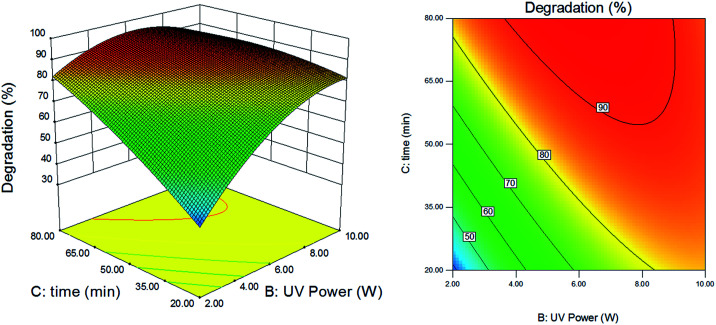
Response surface methodology (RSM) was utilized to model and optimize the dichloroacetonitrile (DCAN) degradation process by UV/PMS. A quadratic function between DCAN degradation efficiency and three factors including dosage of PMS, UV power and retention time was obtained. The model fitted very well according to high the value of (0.9919) and Adj- (0.9814). Additionally, the analysis of variance showed the influence of factors on degradation efficiency followed: retention time > UV power > dosage of PMS. Finally, the optimum conditions were suggested under this model. The degradation efficiency reached the maximum value of 96.2% with the optimum conditions: dosage of PMS = 0.2 mM, UV power = 7.95 W, retention time = 80 min.
采用响应面法(RSM)对紫外光/过一硫酸氢钾复合盐(PMS)降解二氯乙腈(DCAN)的过程进行建模和优化。得到了DCAN降解效率与PMS投加量、紫外光功率和停留时间这三个因素之间的二次函数关系。根据较高的决定系数(R² = 0.9919)和调整后的决定系数(Adj-R² = 0.9814),该模型拟合效果良好。此外,方差分析表明各因素对降解效率的影响顺序为:停留时间>紫外光功率>PMS投加量。最后,在此模型下给出了最佳条件。在最佳条件下:PMS投加量 = 0.2 mM,紫外光功率 = 7.95 W,停留时间 = 80 min时,降解效率达到最大值96.2%。