Hu Xianglin, Fujiwara Tomohiro, Houdek Matthew T, Chen Lingxiao, Huang Wending, Sun Zhengwang, Sun Yangbai, Yan Wangjun
Department of Musculoskeletal Surgery, Fudan University Shanghai Cancer Center, Shanghai, China.
Department of Oncology, Shanghai Medical College, Fudan University, Shanghai, China.
Bone Joint Res. 2022 May;11(5):278-291. doi: 10.1302/2046-3758.115.BJR-2021-0258.R2.
Socioeconomic and racial disparities have been recognized as impacting the care of patients with cancer, however there are a lack of data examining the impact of these disparities on patients with bone sarcoma. The purpose of this study was to examine socioeconomic and racial disparities that impact the oncological outcomes of patients with bone sarcoma.
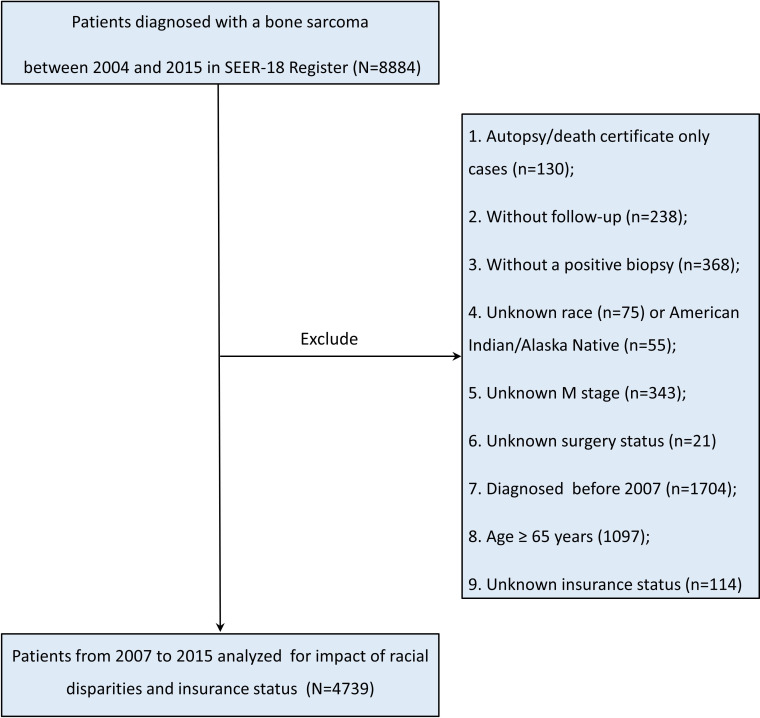
We reviewed 4,739 patients diagnosed with primary bone sarcomas from the Surveillance, Epidemiology and End Results (SEER) registry between 2007 and 2015. We examined the impact of race and insurance status associated with the presence of metastatic disease at diagnosis, treatment outcome, and overall survival (OS).
Patients with Medicaid (odds ratio (OR) 1.41; 95% confidence interval (CI) 1.15 to 1.72) and uninsured patients (OR 1.90; 95% CI 1.26 to 2.86) had higher risks of metastatic disease at diagnosis compared to patients with health insurance. Compared to White patients, Black (OR 0.63, 95% CI 0.47 to 0.85) and Asian/Pacific Islander (OR 0.65, 95% CI 0.46 to 0.91) were less likely to undergo surgery. In addition, Black patients were less likely to receive chemotherapy (OR 0.67, 95% CI 0.49 to 0.91) compared to White patients. In patients with chondrosarcoma, those with Medicaid had worse OS compared to patients with insurance (hazard ratio (HR) 1.65, 95% CI 1.06 to 2.56).
In patients with a bone sarcoma, the cancer stage at diagnosis varied based on insurance status, and racial disparities were identified in treatment. Further studies are needed to identify modifiable factors which can mitigate socioeconomic and racial disparities found in patients with bone sarcomas. Cite this article: 2022;11(5):278-291.
社会经济和种族差异已被认为会影响癌症患者的治疗,然而,缺乏数据来研究这些差异对骨肉瘤患者的影响。本研究的目的是探讨影响骨肉瘤患者肿瘤学结局的社会经济和种族差异。
我们回顾了2007年至2015年间监测、流行病学和最终结果(SEER)登记处诊断为原发性骨肉瘤的4739例患者。我们研究了种族和保险状况对诊断时转移性疾病的存在、治疗结果和总生存期(OS)的影响。
与有健康保险的患者相比,医疗补助患者(优势比(OR)1.41;95%置信区间(CI)1.15至1.72)和未参保患者(OR 1.90;95%CI 1.26至2.86)在诊断时发生转移性疾病的风险更高。与白人患者相比,黑人(OR 0.63,95%CI 0.47至0.85)和亚太岛民(OR 0.65,95%CI 0.46至0.91)接受手术的可能性较小。此外,与白人患者相比,黑人患者接受化疗的可能性较小(OR 0.67,95%CI 0.49至0.91)。在软骨肉瘤患者中,与有保险的患者相比,医疗补助患者的总生存期较差(风险比(HR)1.65,95%CI 1.06至2.56)。
在骨肉瘤患者中,诊断时的癌症分期因保险状况而异,并且在治疗中发现了种族差异。需要进一步研究以确定可改变的因素,这些因素可以减轻骨肉瘤患者中发现的社会经济和种族差异。引用本文:2022;11(5):278-291。