Health Promotion Research Center, University of Washington, Seattle, Washington.
Department of Family Medicine Office of Community Health, University of Wisconsin-Madison,1100 Delaplaine Court, Madison, WI 53715. Email:
Prev Chronic Dis. 2022 May 12;19:E25. doi: 10.5888/pcd19.210395.
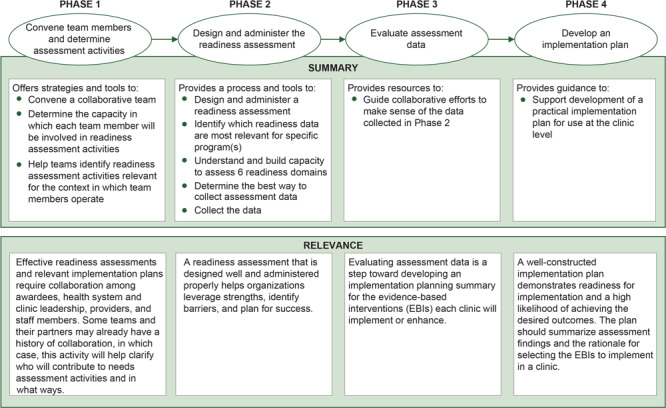
Evidence-based interventions, including provider assessment and feedback, provider reminders, patient reminders, and reduction of structural barriers, improve colorectal cancer screening rates. Assessing primary care clinics' readiness to implement these interventions can help clinics use strengths, identify barriers, and plan for success. However, clinics may lack tools to assess readiness and use findings to plan for successful implementation. To address this need, we developed the Field Guide for Assessing Readiness to Implement Evidence-Based Cancer Screening Interventions (Field Guide) for the Centers for Disease Control and Prevention's (CDC's) Colorectal Cancer Control Program (CRCCP). We conducted a literature review of evidence and existing tools to measure implementation readiness, reviewed readiness tools from selected CRCCP award recipients (n = 35), and conducted semi-structured interviews with key informants (n = 8). We sought feedback from CDC staff and recipients to inform the final document. The Field Guide, which is publicly available online, outlines 4 assessment phases: 1) convene team members and determine assessment activities, 2) design and administer the readiness assessment, 3) evaluate assessment data, and 4) develop an implementation plan. Assessment activities and tools are included to facilitate completion of each phase. The Field Guide integrates implementation science and practical experience into a relevant tool to bolster clinic capacity for implementation, increase potential for intervention sustainability, and improve colorectal cancer screening rates, with a focus on patients served in safety net clinic settings. Although this tool was developed for use in primary care clinics for cancer screening, the Field Guide may have broader application for clinics and their partners for other chronic diseases.
循证干预措施,包括提供者评估和反馈、提供者提醒、患者提醒以及减少结构性障碍,可提高结直肠癌筛查率。评估初级保健诊所实施这些干预措施的准备情况可以帮助诊所利用优势,发现障碍,并为成功实施做好计划。然而,诊所可能缺乏评估准备情况并利用评估结果来规划成功实施的工具。为了解决这一需求,我们为疾病预防控制中心(CDC)的结直肠癌控制计划(CRCCP)开发了用于评估实施循证癌症筛查干预措施准备情况的现场指南(Field Guide)。我们对证据和现有工具进行了文献回顾,以衡量实施准备情况,审查了来自选定 CRCCP 受赠者的准备情况工具(n = 35),并对主要知情人(n = 8)进行了半结构化访谈。我们征求了 CDC 工作人员和受赠者的反馈意见,以完善最终文件。该现场指南在线上公开提供,概述了 4 个评估阶段:1)召集团队成员并确定评估活动,2)设计并实施准备情况评估,3)评估评估数据,以及 4)制定实施计划。评估活动和工具包括在内,以促进每个阶段的完成。现场指南将实施科学和实践经验融入到一个相关工具中,以增强诊所的实施能力,提高干预措施可持续性的潜力,并提高结直肠癌筛查率,重点是服务于安全网诊所环境中的患者。虽然该工具是为癌症筛查的初级保健诊所开发的,但现场指南可能更广泛地适用于其他慢性病的诊所及其合作伙伴。