Teichmann Pascâl, Both Anna, Wolz Christiane, Hornef Mathias W, Rohde Holger, Yazdi Amir S, Burian Marc
Department of Dermatology and Allergology, RWTH University Hospital Aachen, Aachen, Germany.
Institute of Medical Microbiology, Virology and Hygiene, University Hospital Hamburg-Eppendorf, Hamburg, Germany.
Front Microbiol. 2022 Apr 26;13:896311. doi: 10.3389/fmicb.2022.896311. eCollection 2022.
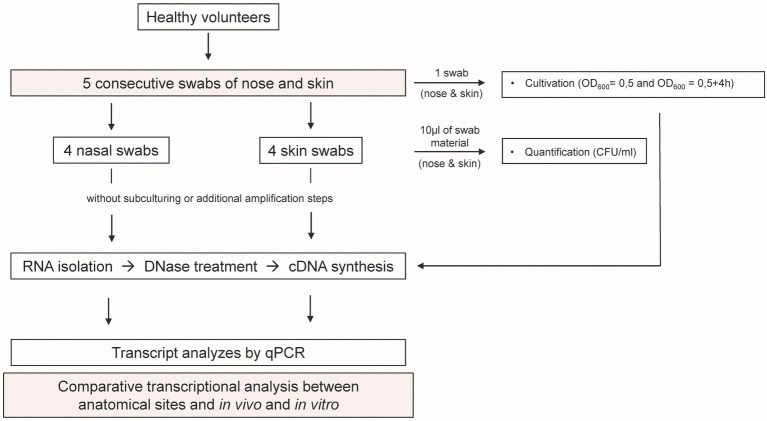
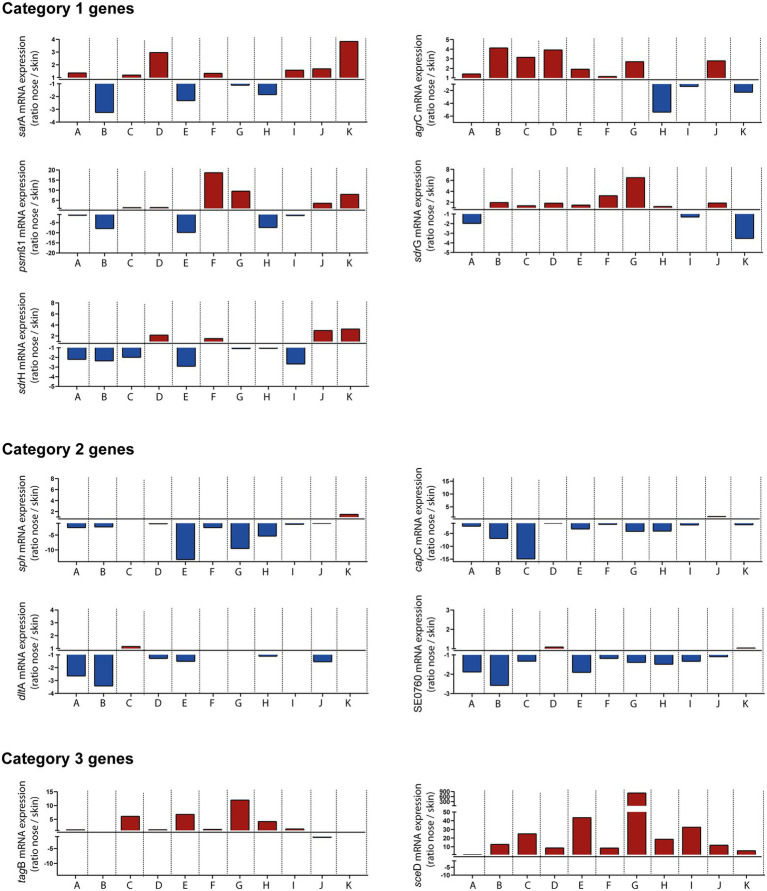
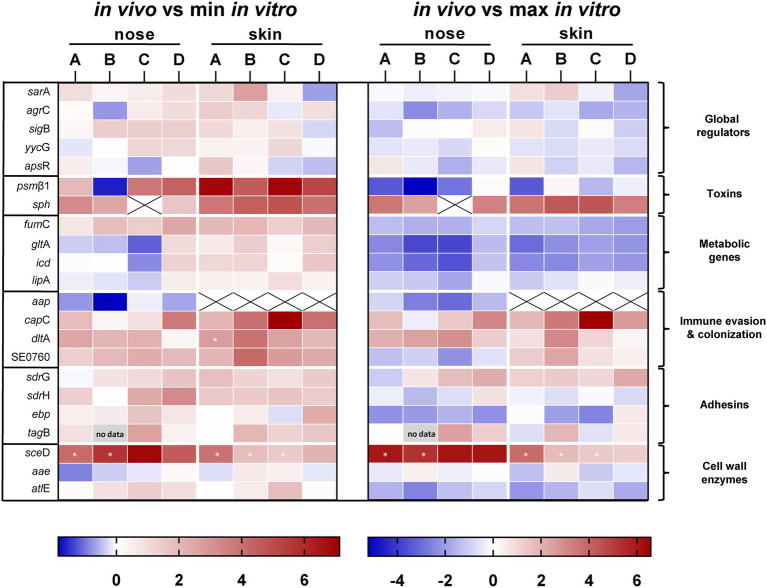
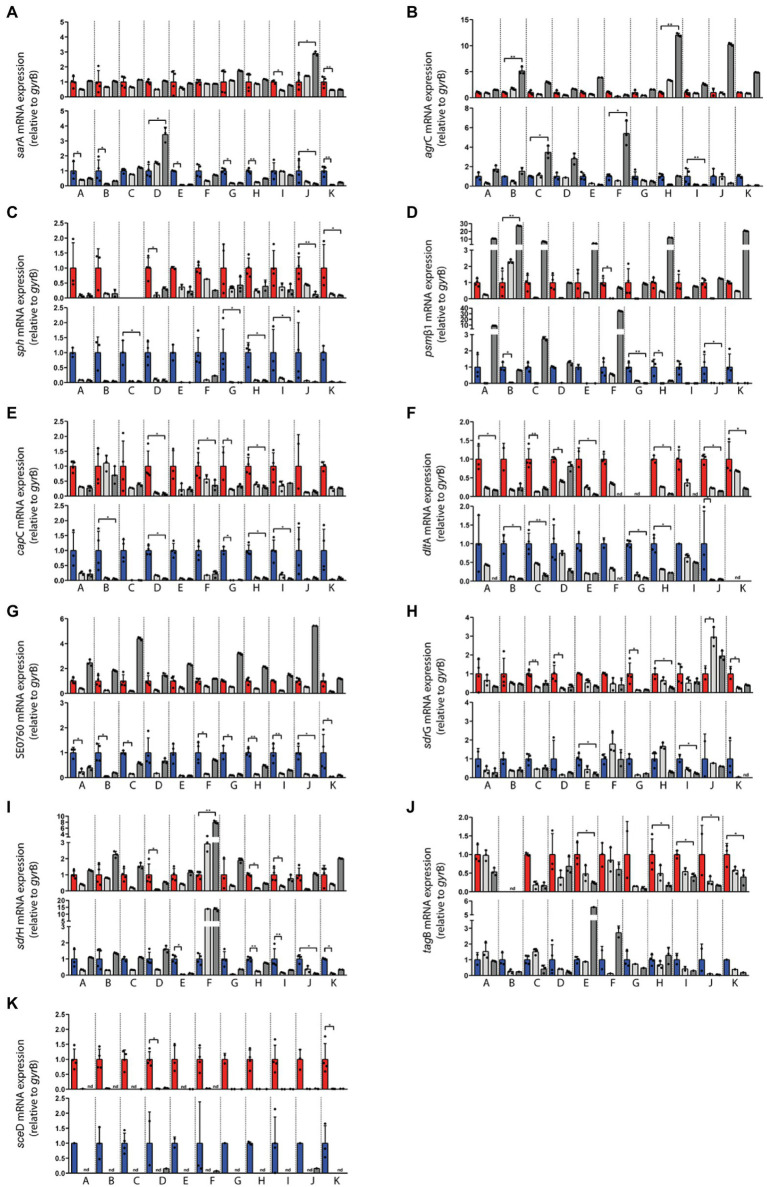
The virulence factors of the opportunistic human pathogen have been a main subject of research. In contrast, limited information is available on the mechanisms that allow the bacterium to accommodate to the conditions during carriage, a prerequisite for pathogenicity. Here, we tested the hypothesis that the adaptation of at different anatomical sites is reflected by differential gene regulation. We used qPCR to profile gene expression in nose and skin swabs of 11 healthy individuals. Despite some heterogeneity between individuals, significant site-specific differences were detected. For example, expression of the regulator A was found similarly in the nose and on the skin of all individuals. Also, genes encoding colonization and immune evasion factors (G, C, and A), as well as the sphingomyelinase encoding gene , were expressed at both anatomical sites. In contrast, expression of the global regulator was almost inactive in the nose but readily present on the skin. A similar site-specific expression profile was also identified for the putative chitinase-encoding SE0760. In contrast, expression of the autolysine-encoding gene D and the wall teichoic acid (WTA) biosynthesis gene B were more pronounced in the nose as compared to the skin. In summary, our analysis identifies site-specific gene expression patterns of during colonization. In addition, the observed expression signature was significantly different from growth . Interestingly, the strong transcription of sphingomyelinase together with the low expression of genes encoding the tricarboxylic acid cycle (TCA) suggests very good nutrient supply in both anatomical niches, even on the skin where one might have suspected a rather lower nutrient supply compared to the nose.
机会性人类病原体的毒力因子一直是研究的主要课题。相比之下,关于该细菌在携带过程中适应环境条件(致病性的一个先决条件)的机制的信息有限。在此,我们检验了一个假设,即该细菌在不同解剖部位的适应性通过差异基因调控得以体现。我们使用定量聚合酶链反应(qPCR)来分析11名健康个体鼻腔和皮肤拭子中的基因表达情况。尽管个体之间存在一些异质性,但仍检测到了显著的部位特异性差异。例如,在所有个体的鼻腔和皮肤中均发现调节因子A的表达相似。此外,编码定植和免疫逃避因子(G、C和A)的基因以及编码鞘磷脂酶的基因,在两个解剖部位均有表达。相比之下,全局调节因子在鼻腔中几乎不表达,但在皮肤上则易于检测到。对于假定的几丁质酶编码基因SE0760,也鉴定出了类似的部位特异性表达谱。相反,与皮肤相比,编码自溶素的基因D和壁磷壁酸(WTA)生物合成基因B在鼻腔中的表达更为明显。总之,我们的分析确定了该细菌在定植过程中的部位特异性基因表达模式。此外,观察到的表达特征与生长时的显著不同。有趣的是,鞘磷脂酶的强烈转录以及编码三羧酸循环(TCA)的基因的低表达表明,在这两个解剖微环境中,即使在皮肤(相比鼻腔可能被认为营养供应较低)中,营养供应也非常充足。