Department of Psychology and Cognitive Sciences, University of Trento, Trento, Italy.
Department of Psychology, Science Division, New York University of Abu Dhabi, Abu Dhabi, UAE.
Brain Behav. 2022 Jun;12(6):e2597. doi: 10.1002/brb3.2597. Epub 2022 May 13.
Over the past years, electroencephalography (EEG) studies focused on task-related activity to characterize cortical responses associated with emotion regulation (ER), without exploring the possibility that regulating emotions can leave a trace in the brain by affecting its oscillatory activity. Demonstrating whether the effect of regulation alters the brain activity after the session and whether this reflects an increased cognitive regulatory ability has great relevance.
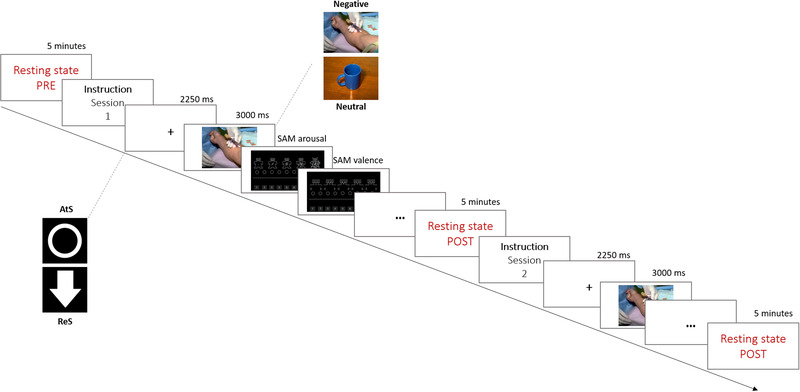
To address this issue, 5 min of electrical brain activity at rest were recorded before and after (1) one session in which participants perceived and regulated (through distancing) their emotions (regulation session, ReS), and (2) another session in which they only perceived emotions (attend session, AtS). One hundred and sixty visual stimuli were presented, and subjective ratings of valence and arousal of stimuli were recorded.
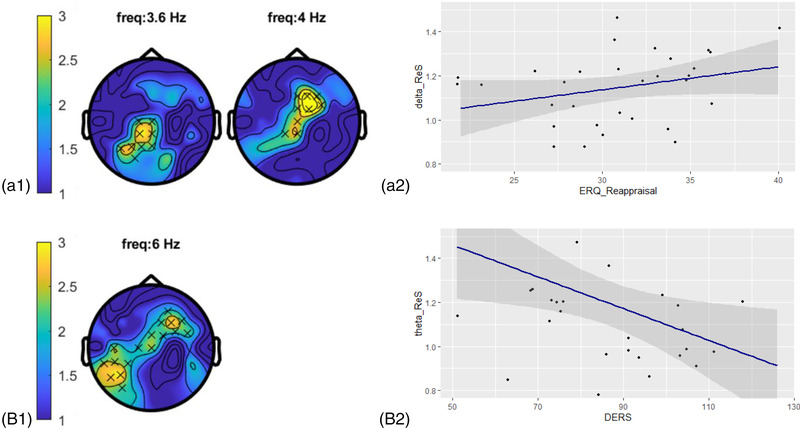
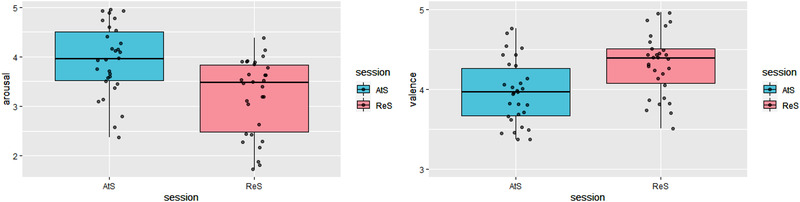
Behavioral results showed the efficacy of the regulation strategy in modulating both arousal and valence. A cluster-based permutation test on EEG data at rest revealed a significant increase in theta and delta activity after the ReS compared to the AtS, suggesting that regulating emotions can alter brain activity after the session.
These results allowed us to outline a comprehensive view of the neurophysiological mechanisms associated with ER, as well as some possible implications in psychotherapy.
在过去的几年中,脑电图(EEG)研究侧重于与任务相关的活动,以描述与情绪调节(ER)相关的皮质反应,而没有探索调节情绪是否可以通过影响其振荡活动在大脑中留下痕迹的可能性。证明调节的效果是否会在会话后改变大脑活动,以及这是否反映出认知调节能力的提高,具有重要意义。
为了解决这个问题,在(1)参与者感知和调节(通过疏远)自己的情绪(调节会话,ReS)的 1 次会话之前和之后记录了 5 分钟的静息脑电活动,以及(2)参与者仅感知情绪(关注会话,AtS)的另一次会话。呈现了 160 个视觉刺激,并记录了刺激的主观效价和唤醒度评分。
行为结果表明,调节策略在调节唤醒度和效价方面都非常有效。基于 EEG 数据的聚类置换检验在 ReS 后显示出与 AtS 相比,θ和δ活动明显增加,表明调节情绪可以改变会话后的大脑活动。
这些结果使我们能够概述与 ER 相关的神经生理机制的综合观点,以及在心理治疗中的一些可能的影响。