Division of Public Health and Medical Service, Seoul National University Hospital, Seoul, Korea.
The Mining Company, VAIV, Seoul, Korea.
BMC Psychiatry. 2022 May 13;22(1):332. doi: 10.1186/s12888-022-03969-1.
The psychiatric treatment gap is substantial in Korea, implying barriers in seeking help.
This study aims to explore barriers of seeing psychiatrists, expressed on the internet by age groups.
A corpus of data was garnered extensively from internet communities, blogs and social network services from 1 January 2016 to 31 July 2019. Among the texts collected, texts containing words linked to psychiatry were selected. Then the corpus was dismantled into words by using natural language processing. Words linked to barriers to seeking help were identified and classified. Then the words from web communities that we were able to identify the age groups were additionally organized by age groups.
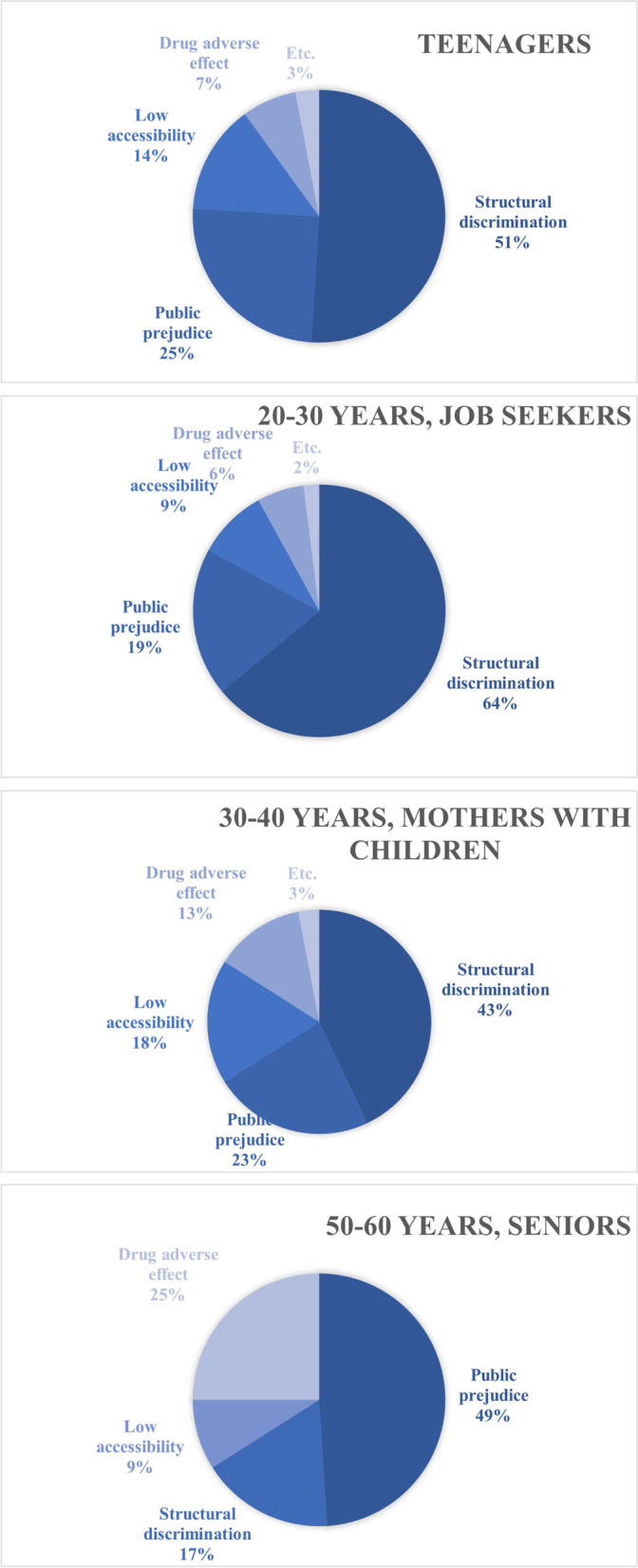
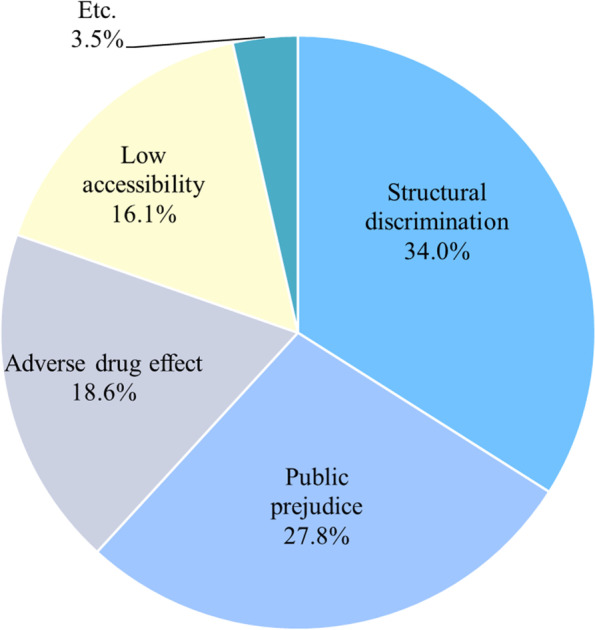
97,730,360 articles were identified and 6,097,369 were included in the analysis. Words implying the barriers were selected and classified into four groups of structural discrimination, public prejudice, low accessibility, and adverse drug effects. Structural discrimination was the greatest barrier occupying 34%, followed by public prejudice (27.8%), adverse drug effects (18.6%), and cost/low accessibility (16.1%). In the analysis by age groups, structural discrimination caused teenagers (51%), job seekers (64%) and mothers with children (43%) the most concern. In contrast, the public prejudice (49%) was the greatest barriers in the senior group.
Although structural discrimination may most contribute to barriers to visiting psychiatrists in Korea, variation by generations may exist. Along with the general attempt to tackle the discrimination, customized approach might be needed.
韩国的精神科治疗差距很大,这意味着寻求帮助存在障碍。
本研究旨在通过年龄组探索在互联网上表达的看精神科医生的障碍。
从 2016 年 1 月 1 日至 2019 年 7 月 31 日,广泛从互联网社区、博客和社交网络服务中收集了一个语料库。在所收集的文本中,选择了包含与精神病学相关的词的文本。然后,使用自然语言处理将语料库拆分为单词。确定与寻求帮助障碍相关的单词并进行分类。然后,将能够识别年龄组的网络社区中的单词按年龄组进行分类。
确定了 97730360 篇文章,其中 6097369 篇文章被纳入分析。选择并分类了暗示障碍的词,分为结构性歧视、公众偏见、低可及性和药物不良反应四大类。结构性歧视是最大的障碍,占 34%,其次是公众偏见(27.8%)、药物不良反应(18.6%)和费用/低可及性(16.1%)。在按年龄组的分析中,结构性歧视对青少年(51%)、求职者(64%)和有子女的母亲(43%)的影响最大。相比之下,公众偏见(49%)是老年人面临的最大障碍。
尽管结构性歧视可能是导致韩国人看精神科医生的最大障碍,但代际之间可能存在差异。除了一般性地解决歧视问题外,可能还需要采取定制的方法。